Re-reading of the Intelligence Report on Idanre District. Re-reading of the Intelligence Report on Idanre District.
A critical re-appraisal.
By Charles Akinde Ph.D.
The Osore of Idanre Kingdom
Preface.
Every writer has a peculiar way to approach an issue. The issue of Idanre history is no exemption.
The few books that have appeared on the town in the past few years have largely been narrative; The paucity of literature on the town has costed Idanre its rejection firsthand as a world heritage site by UNESCO even though it was acknowledged that there are unique elements that would have made the landscape one of the world heritage sites in Nigeria.
The present situation therefore calls for critical reappraisal of the history of the district handed down to us by the past generation.
It follows that the first written document on Idanre was the one by the colonial office collated by Mr. Bovell-Jones the then an assistant District officer titled, An Intelligence Report on the Idanre District in the Ondo Division of the Ondo Province. It is therefore pertinent to begin the critique from the point of view of what we gather from that report.
There was a small pamphlet written by two progressive and forward looking men, Messrs Akindoju and Olagundoye in 1952 which contained some fragments of what is known about the district today. These people may have got a glimpse of the intelligence report by Bovell Jones since they were the first set of civil servants in Idanre under the Colonial Administratioin. Mr. (Later Chief) Akindoju was for instance, a native court clerk at that time and Mr. Olagundoye was a………. There was also a book compiled and published in 1991 by a journalist, Mr. Samuel ‘Femi Odamo titled Idanre-Beauty and Culture on the Hills.. The book was more or less a restatement of the materials largely collected from the Intelligent Report by Bovell-Jones.
Perhaps the most important document published on the District in recent times, is the one published by High Chief Agboola Akintan titled, The History of Idanre (Ufe’ke) Earliest times to the present. These documents will form the bases of any reappraisal of the History of Idanre District. .
Introduction (Preamble)
The Intelligence Report and comments.
No. S. P. 10996/21 29/3/1936
Secretary’s Office Southern Provinces Nigeria. Enugun 29th March, 1935.
The Honourable,
The Chief Secretary to the Government,
Lagos.
From the AG. Resident, Ondo Province.
Akure, 25th January 1935.
Intelligence Report on Idanre District: Ondo Province.
I am directed by the acting Lieutenant-Governor to forward an Intelligence Report on the Idanre District of the Ondo Division of the Ondo Province, compiled by Mr. T. B. Bovell-Jones, Assitant District Officer, together with the Resident’s covering report.
2. In spite of the arguments in paragraphs 21-33 of the report and paragrapgh 19 of the covering report His Honour doubts very much whether there is any real difference between the Idanre and Ondo systems of land tenure but it is at present impossible to obtain an unbiased account of the latter. With regard to the last sentence in paragraph 30 of the report, the Resident is being asked to inquire of the Owa what happens in the reverse case if an Idanre native wants to cultivate land in the Atosin village area.
3. His Honour is gratified to note from paragraph 36 of the report the practical demonstration of public spirit given by the Owa and Chiefs, and wishes that a little more of it could be inculcated at Ondo, where it would go a long way towards solving the Odigbo problem. (Your M. P. 23610/S.250/63 of 18. 11. 34 refers).
4. It is not clear whether the District Heads mentioned in paragraph 39 of the report are a Government creation or a native appointment. No explanation of their position is given in the report only the Lisa, apart from the Owa, appears under this head. His Honour dislikes the complication of the tax passing through the hands of the District Head, a system which led to the loss of some §600 in Benin, and would prefer to see the tax paid direct to the Treasury by the Village Heads. The views of the Resident are being ascertained on this point.
5. The Resident is being asked whether it is proposed that the scale of tax shown in paragraph 40 of the report should take the place of the trade schedule in Appendix 11. His Honour would welcome such a change as he is not in favour of trade schedules which do not take into consideration the difference in prosperity of persons engaged in the same trade. His Honour is also glad to see that specific cocoa assessment has been dropped since he considers that a man should be assessed on his income from whatever source it is derived.
6. His Honour agrees with the Resident in paragraph 23(d) of his covering report that specific representation of the various religious denominations as proposed in paragraph 42(111) (b) of the report is unnecessary and undesirable.
7. His Honour will be interested to hear how exactly the sessional system proposed in paragraph 56 1(b) of the report is carried out in practice and the Resident is being asked to report in due course.
8. The Resident is being informed that a cautious policy should be adopted with regard to the question of the rules regarding dowry and adultery dealt with on pages 58-61 of the report. His Honour would prefer to see no rules but gradual modification of custom by case law.
9. His Honour, who knew Idanre well 20 years ago, has read this report with special interest and and considers that Mr. Bovell-Jones is to be congratulated on the thorough way in which he has done his work. Subject to His Excellency’s covering sanction His Honour has approved provisionally the proposals set out in paragraph 41 of the Resident’s covering report.
Signed. Acting Secretary,
Southern Province.
A COVERING REPORT TO AN INTELLIGENCE REPORT ON IDANRE DISTRICT OF THE ONDO DIVISION
INTRODUCTORY
This report is a covering report to an Intelligence Report compiled by Mr. T. B. Bovell-Jones, Assistant District Officer, on the Idanre District of the Ondo ivision of the Ondo Province. The Idanre District at present forms a part of the Ondo Divisional Native Administration but proposals will be made herein for its separation and constitution as a separate Native Administration.
Area and Population
The area of the district is approximately 619 square miles and the population is as follows.
Males Females Children Total
2895 3247 5169 11,311.
The density of population is 18 to the square mile.
History
It is related that the people of Idanre migrated from Ile Ife at the same time and together with the people who subsequently founded Benin. It is said that the whoile migration was led by one Olofin and……..departure of the people destined for Benin remained with the Idanres as their leader. Various sites were occupied but the Idanres, after the division occupied a site known as Utaja not far from the site of existing Idanre town. Here they lived in caves until the death of Olofin when they moved to their present site. From this time the Idanres seem to have led a peaceful existence, which can probably be accounted for by the inaccessibility of their town which is situated high up amidst enormous and precipitous granite formations. A few minor wars were indulged in but there is no record of any invaders having reached the town or of the Idanres having been scattered.
In 1894 a treaty was signed between His Excellency Sir Gilbert Thomas Carter K.C.M.G., Governor and Commander-in-Chief of the Colony of Lagos and Arubiefin the Owa of Idanre who is described therein as “the absolute Monarch of the Idanre Country”. The Owa still holds this treaty, which he regards as one of his most treasured possessions. A copy of the treaty appears as Appendix No. 4 to Mr. Bovell-Jones’ report. After the signing of the treaty there are no outstanding events to record during the period of British Administration.
ADMINISTRATION.
The old organization
The old organization has persisted to the present day and although the people of Idanre seem unable to account for certain details of the organization or to account for its development yet they are quite certain of what it actually is. It may be recorded that Idanre consists almost entirely of one big town and it is the organization of the town itself which will now be discussed. The organization of such settlements from the mother town as there are will be discussed separately.
The family does not and never has played an important part in the indigenous organization and although family heads are recognized yet, as such, they have no administrative standing. The basic unit of organization may be said to be the quarter and the internal organization of the quarter is dependent on a system of age-grades. Cognate with this organization but at times superimposed thereon is a somewhat complicated system of chieftainship or title-holders and it is the growth of this and the reason for certain of its aspects which the people are unable to explain.
Every adult male automatically becomes a member of an age class in his own quarter and every nine years the classes progress upwards. A titled person who is selected from any family within the quarter controls each class. This person generally progresses with his age class assuming the title of the leader of the most senior class as he moves upward except in the most senior age class of all at the head of which is the quarter head. A list of the heads of the classes is given in appendix No.5 of Mr. Bovell-Jones’ report.
The quarter heads are selected from any family in the quarter and are in charge of the affairs of their respective quarters. They are titled men and collectively known as the Olori Idimi. A body of elders known as Agba, the most important of which bear titles, assists them in their duties. It is in fact the titleholders only who are actually considered of importance and the remainder appears largely to be included as inactive members as a matter of courtesy and respect for age. A list of the quarter heads and the titled men in each quarter is given in Appendix No. 6 to Mr. Bovell-Jones’ report.
So far as further grades of title-holders are concerned there are four:-
The Iwarefa
The Edibo 1st grade
The Edibo 2nd grade
The Edibo 3rd grade
The seniority of these grades between themselves is indefinite but the Iwarefa and the 1st Grade of Edibo are certainly the most important. They are moreover supernumerary to the quarter titles. The titles of the 2nd and 3rd Grade Edibos appear in the quarter council, or Agba, titles but it seems that seniority varied on the quarter councils and the Owa’s Council. It is possible that some or all of these titles were originally and perhaps still are Afin (Owa’s house) titles but the people do not admit this. The point is not, however, considered to be of great importance at the present time.
The Owa or the head of the Idanre people is the senior Iwarefa title holder andf the remainder are:-
The Lisa
The Ojomu
The Sama
The Lobu
The Osolo.
The 1st Grade Edibo titles are:-
The Sashere
The Logboshere
The Lisagha
The Oshore.
Three more titles of importance exist and are also supernumerary to the quarter council titles. These are war titles and are:-
The Odongho
The Sagho
TheOjumu
The Neren
The Maran.
the affairs of Idanre town itself and as will be shown later of the settlements also are administered by the Owa who is assisted by a council composed as follows:-
Iwarefa Chiefs
The Lisa
The Ojomu
The Sama
The Lobu
The Osolo
1st Grade Edibo.
The Sashere
The Logboshere
The Lisagha
The Oshore .
War Chiefs
The Odongho
The Sagho
The Ojumu
TheNeren
The Maran
2nd Grade Edibo Chiefs
The Adaja
The Lejuwa
The Manare
The Ayadi
The Bepie
The Egbedi.
3rd Grade Edibo Chiefs
The Osshile
The Igbatoyo
The Orunfunsin
The Gbogi
The Losare
The Baniken
Heads and Elders of Quarters
The Egbedi-Owu
The Kogunrogho
The Legbira
The Lemikan
The Lijoka
The Saruku
It will be observed that if this council is compared with the quarter title holders given by Mr. Bovell-Jones in Appendix No. 6 that the Usunren quarter is not represented at all and that the quarter head of the Odeja quarter is not a member although three junior in rank are members. No eplanation of this can be given by the Owa or his people and it is just stated that it has always been so and that no alteration is desired.
All villages within the Idanre area are small and all are settlements from mother town. They may be divided into categories:-
(a) old settlements
(b) more recent settlements within the last fifty years.
14. The old settlements or (a) were settlements of slaves placed there by some prominent title-holder in Idanre. Originally they had no separate organization but in course of time they developed age classes of their own and subsequently, probably only in recent years, have been admitted to the age classes of Idanre itself. Generally they look to the descendant of the founder of the village as their representative in any matters in respect of which they may wish to approach the Owa. Each now has headman or Bale appointed with the consent of the Owa.
15. The more recent settlements or (b) have been founded by the more progressive elements of Idanre who realize the hardship of the inaccessibility of their town and desire, for reasons of trade, to be near a road fit for motor transport. It is indeed probable that the vast majority of Idanre town will soon quit the present site for a more accessible site at the foot of the hill. A lay-out has been prepared, a motor road constructed thereto and already numerous houses are in course of construction.
16. These recent settlements have little organization of their own and the members thereof still retain their positions in the social structure of the mother town. A headman or Bale has, however, been appointed for each with the consent of the Owa and each Bale is accustomed to discuss the affairs of the settlement with such elders or prominent men as there may be. The Bales do not generally rank high in the internal affairs of Idanre town but, although all the settlements fully acknowledge the Owa as their head, yet a spirit of self consciousness is growing. Proposals will, therefore, be made to give both these settlements and those of (a) some measures of recognition on the council.
Trade Guilds
17. Trade guilds were a somewhat prominent feature in the old organization of Idanre although they played no active part in the administration. These still exist and their number has increased in recent years to meet the needs of more modern trades and industries. Each is controlled by one of their number (member?) in Idanre town who is appointed by the Owa.
Women’s organization
18. Although there were women title-holders and women’s age grades they appear to have taken no active part in administration. A note on their activities is contained in Appendix No. 10 to Mr. Bovell-Jones’ report.
Land Tenure
19. A description of land tenure in the Idanre area is contained in paragraphs 27-33 of Mr. Bovell-Jones’ report. This is of interest and importance for it shows that the system differs from that of the Ondo district and other parts of this province and appears more akin to that prevailing in the Benin Province. Detailed enquiries have been made and there seems no reason to believe that the information recorded is incorrect. It is considered, therefore, that it should be accepted.
20. In this connexion and with reference to paragraph 36 of Mr. Bovell-Jones report it is interesting to not that the Owa and his Council have agreed that all forestry royalties should be paid to Native Administration revenue and not only a proportion as is done at present.
The Present Position
21. At present the Owa is the Native Authority for the Idanre District. He is in receipt of a salary as also are the Lisa, the Ojomu, the Osolo, Sashere and Logboshere. These title-holders are at present the the more active in matters concerning Native Administration and no active recognition is given to the remaining members of the council. How far the Council is actually used by the Owa at present is indeterminate. The Bales are responsible for tax collection from their respective settlers but beyond this they take no active part in the Native Administration.
Proposals for the future
22. It has been shown that the indigenous organization is still in existence and the Owa and his people are anxious that it should be recognized and actively employed.
23. It is proposed, therefore, that:-
(a) the Idanre distrct shall be constituted a separate Native Administration.
(b) the Native Authority for the district shall be the Owa of Idanre and his Council.
©the composition of the council shall be as shown in paragraph 12 with the Owa as president.
(d) the headmen of the settlements attend council meetings in order that they may be able to represent the interests of their people as and when occasion arises. It will be noticed that, in paragraph 42 III (b) of Mr. Bovell-Jones’ report, it is advocated that the various heads of religious denominations should similarly attend but it is considered unnecessary to make such special provision for these communities are adequately represented by normal council members.
(e) council meetings should be held as and when required but not less than once every three months. The District Officer should attend whenever possible.
(f) a council hall and offices be created on the site of the new town at a cost not exceeding §200.
III. Judicial
The ancient judicial system
24. Criminal offences of old were divided into three classes:-
(a) Offences against the laws of Olofin (the founder of the Idanres).
(b) Offences against the laws of Orosun or Iyamode, who was Olofin’s wife.
(c) Offences against the state.
The offences in the first two classes set out in paragraphs 44-48 of Mr. Bovell-Jones’ report were of the nature of religious offences and were tried by a class of titled men or priests known as the Alaworos. It is surprising, in these circumstances, to find certain Iwarefa title holders amongst them but there are no explanation.) Such functions of the Alaworos are, however, defunct and such of the “laws” as still constitute offences are treated as normal criminal offences.
25. The offences in the third class were tried in the presence of the whole town and the Lisa officiated as chief judge. The offences thus tried are set out in paragraph 49 of Mr. Bovell-Jones’ report. And were those of a serious nature.
26. The remainders were settled in the quarters as were minor civil matters in the presence of the quarter heads and their “Agbas” or councils. Major civil matters were usually referred direct to the Owa and his council and persons dissatisfied with decisions given in the quarters could similarly refer to the Owa and council for a final settlement.
The present system
27. There is at present a native court of B. Grade with the Owa as president. A list of members is given in Appendix No. 13 of Mr. Bovell-Jones’ report. The Owa does not, however, attend Court. It operates satisfactorily under supervision. Appeal lies direct to an Administrative Officer.
Proposals for the future
A suggestion was first made to the Owa and people that the original religious judicial organization should be utilised as a basis for the future but the suggestion was not accepted as it was considered that such organization was largely defunct and that it would be inadequate for modern requirements.
29. The Owa then proposed that the quarter organisations should be utilized for the formation of a minor native court and that the title-holders outside the quarter organization should constitute a court of a higher grade for affairs beyond the jurisdiction of the minor court and for a native court of appeal. These suggestions are based very largely on the indigenous system and are consonant with the demands of the present day and with the express desires of the Owa and people that no member of the minor court should be a member of the appeal court.
30. It is, therefore, proposed that: –
(a) there shall be a native court of D (limited) Grade constituted for the Idanre district with a venue at Idanre town and with powers to hold sittings anywhere within the district.
(b) the membership shall consist of :-
(1) each quarter head and members of each quarter “Agba” as shown in Appendix No. 6 to Mr. Bovell-Jones’ report.
(2) the headmen and elders of each of the following settlements :-
Atoshin, Okeorisha, Aweba, Ologede, Odole, Opa, Ajagbale, Okenifon, Alade, Ala, Omifunfun, Aiyetoro, Oloruntedo, Ajegunle, Aponmu, Ipinlerere, Aiyede, and Onishere.
(3) Lemomu of Idanre.
The members described in (2) are included especially for cases in which settlements are involved and the Lemomu, (3) who is a member at present, especially as an adviser in cases in which Mohammedan law is involved.
(c) there shall be constituted a Native Court of c (limited) Grade to serve the Idanre district with a venue at Idanre town. This court to have original jurisdiction in all cases which are beyond the powers of the minor court (a) up to the limit of its own powers and appellate jurisdiction in all appeals from the minor court (a).:-
(d) the membership shall consist of :-
(1) The Owa as president
(2) The Lisa, Sashere, Logboshere, Lisagha, Oshore, Ojomu, Osolo, Odunwo, Sawo, and the Ojumu.
(e) appeal from (c) shall lie lie to an Administrative Officer. (Note. This differs from the recommendation of the report where the appeal is recommended to lie to a Magistrate).
(f) sitting fees in (a) to be at the rate of £1 a sitting and (c) at the rate of £2 a sitting. These sums to be divided amongst members present in accordance with custom. Salaried members will not share.
(g) the duties of Court Messengers and Native Administration police be performed by the Omedanres as described in paragraph 45-46 of Mr. Bovell-Jones’ report. The Agbakin to receive £9 per annum and the remainder £6 per annum each.
(h) fees in each Native Court to be as shown in Appendix No. 15 to Mr. Bovell-Jones’ report except that the fees proposed for service should be omitted for the present as the question is now under discussion from a wider aspect.
IV. Financial
31. There is no doubt that in the past the Idanre district, has been assisted by funds from the Ondo district and it will be necessary now for them to economise.
32. At present the Owa draws a salary of £200 which represents 31.55% of the Native Administration share of the tax. This is high but in is recommended that it be retained by the present holder. In the case of subsequent holders it is recommended that it be reduced to 16% of the Native Administration share of the tax.
33. The Lisa (the second chief in the town and Owa’s deputy) at present draws a salary of £60 per annum and it is recommended that this be retained by the present holder and that the position be reviewed at a later date as regards future holders.
34. At present four chiefs, the Osolo and Ojomu of the Iwarefa grade and the Sashere and Logboshere of the 1st grade Edibo draw salaries of £30 per annum each. There is no reason why these these title-holders should be sigled out for special treatment except the Ojomu to whom reference is made in paragraph 37 of this report and it is recommended that these cease to draw these salaries and that a lump sum of £120 per annum be made available for the members of the council. It is recommended that this sum cover all services and that no 10% of tax should be paid in Idanre town. The 10% of tax collected by Bales of settlements should continue to be paid as at present. This will amount to some £30.
35. The Owa and council have agreed to these proposals, the losers with considerable regret.
36. the total of the existing reserve funds of the Ondo Native Administration is £2,500. It is recommended that this be divided in proportion to normal revenue which would give the new Idanre Native Administration approximately £500. It is recommended that any liquid surplus shall be similarly divided.
37. In paragraph 17 of Mr. Bovell-Jones’ report the Ojomu is described as the Treasurer and it is recommended that he again assume this position. The present Ojomu is illiterate so will have to be assisted by a treasury clerk. The salary recommended for the Ojomu at present is £30 but if, as the Owa and people desire, subsequent holders are literate the salary can be increased at the expense of the clerk who will become of less value.
38. Draft estimates are shown in paragraph 57 of Mr. Bovell-Jones’ report and in appendix No. 16 thereto.
39. The present rates of taxes as shown in Appendix No. 11 to Mr. Bovell-Jones’ report are not satisfactory and gave rise to correspondence in 1933 and 1934. The matter has been discussed in the course of the intelligence enquiries and, as a result, the scale of taxation detailed in paragraph 40 of Mr. Bovell-Jones’ report is being submitted for His Honour’s consideration in separate correspondence.
40. It is desired by the Owa and people that, should this scale be approved, it should be operated by assessment committees whose composition is proposed as follows:-
(a) For the villages. Headman and elders plus 1 member of each of the trade guilds in the villages.
(b) For the district. The quarter heads of Idanre town plus the heads of the trade guilds in Idanre. The assessments made by (a) will be submitted to (b) for consideration and co-ordination if necessary. All final assessments will be published and it is proposed that one month after publication a meeting of the full council shall be convened to hear any appeals which may arise in regard thereto.
V. Conclusion
41. His Honour is asked to approve the following:-
(a) the administrative proposals as set out in paragraphs 23 (a) – (f) of this report.
(b)the judicial proposals as set out in paragraphs 30 (a) – (h) of this report.
(c) the financial proposals set out in paragraphs 32 – 34 and 36 – 37.
(d) the estimates as given by Mr. Bovell-Jones in paragraph 57 of his report.
(e) the payment of 100% forestry royalties to Native Administration. (See paragraph 20 of this report).
(f) the composition of the assessment committees (paragraphs 39 and 40 of this report).
Signed AG: Resident, Ondo Province.
Akure, 25th January, 1935.
M.L.F.
AN INTELLIGENCE REPORT ON THE IDANRE DISTRICT IN THE ONDO DIVISION OF THE ONDO PROVINCE BY T. B. BOVELL-JONES, ASSIATANT DISTRICT OFFICER.
(Hand written comments) and cover letters)
One submitted.
COVER LETTER ONE
s. s.ps letter p. 1- 3
Resident’s recommendation in par 41 of p.19.
Par. 9 of p. 3 may be endossed?
Rules as to marriage at 58-61 of the report are interesting.
Signed Jones 5/4/35.
COVER LETTER TWO
Approved (it is merely the existing …).
page 18. The D.O. should always have the opportunity of attending when he desires, and should attend regularly……..he can do so. A copy of the agenda and ….. should be …to him.
….Page 16 (c). If land cases in this area use formal .. go to High Court (Supreme Court) the appeal should lie to the Magistrate.
It is a pity that Mr. Carr, who is a good officer, should continue so prolix, of pages 5 and 6. I cannot imagine, .. why they want to waste time and paper typing out the Ondo N. ….in extensor (pages 63 – 70 of the report).
30052/22
8th April, 35.
Intelligence Report on Idanre District, Ondo Province
The Honourable
The Secretary,
Southern Provinces,
Enugu.
Referring to your letter No. S.P. 10996/21 of the 29th of March, I am directed by the Governor to convey His Excellency’s approval of the recommendation made in paragraph 41 of the Resident’s covering report.
2. The District Officer should always have the opportunity of attending meetings of the Idanre Council when he so desires, and he should attend regularly as far as he can do so. A copy of the agenda and minutes should be furnished to him.
3. With reference to paragraph 30 (c) of the Resident’s report I am to say that if land cases in this area used formally to go to the High Court (supreme Court) the appeal should lie to the Magistrate.
Signed. (Sgt) C. N. A. Clarke (f) Chief Secretary to the Government.
COVER LETTER THREE
No. …..1…./…..
Secretary’s Office,
Southern Provinces,
Enugu, Nigeria.
26th April, 1935.
The Honourable, The Chief Secretary of the Government,
Lagos.
Intelligence Report on Idanre District, Ondo Province.
With reference to paragraph 3 of your letter No. 3005…(22) of the 4th of April, 1935, I am directed by the Acting Lieutenant-Governor to inform you that the Resident has confirmed that land cases in this area were not taken to the Supreme Court in the past and appeals will therefore lie to an Administrative Officer in all cases.
Sogned . Acting Secretary,
Southern Provinces.
(seen 3/5/35)
INDEX
Re-organisation Report Idanre District
Report Page
1. Introductory 1
II. Georgraphical 1 – 2
III. Historical 2 – 4
IV. Administrative 4 – 15
Proposals for the future 15 – 19
V. Judicial 19 – 23
Proposals for the future 23 – 25
VI. Financial 25 – 28
APPENDICES
1. Legendary History 29 – 31
2. List of Owas of Idanre showing important events
in each tenure of office 32 – 33
3. Inter-Tribal wars 34 – 35
4. Copy of Treaty made in 1894 36 – 37
5. List showing the heads of age-classes (Egbe or Otu)
in the quarters 38
6. List showing the Heads and Elders of quarters 39 – 40
7. List showing major Town Chiefs. 41
8. Notes on the selection and duties of the major Chiefs 42 – 44
9. Notes on the founding of the villages in the District. 45 – 49
10. Women’s Companies or age classes 50
11. Schedule of present scales of tax 51 – 52
12. Festivals 53 – 54
13. List of Members of the present Native
Court of Idanre 55
14. Notes on Marriage, Divorce and Adultery 56 – 61
15. Scales of Fees in the Native Court 62
16. Copy of Draft Native Administration
Estimates, 1935-36 62 – 69
17. List of villages vicited 70
Sketch Map of Idanre District.
IDANRE DISTRICT
INTRODUCTORY.
The Idanre District is one of the two Districts of the Ondo Division. Although Education and Christianity have gained a footing in the District, pagan beliefs and superstitions still control the actions of the people. The Owa of Idanre, who is a Christian and is recognized by the people of the district as their ‘Oba’, is a progressive Chief in as much as he is willing to adopt (adapt) any suggestion for the betterment of his people but at the same time his belief in pagan rituals is unshaken. His control over his District is a real one and he is much respected.
Subject to approval, it is proposed that the Idanre District should form a separate Native Administration, having control over its own funds through the Owa and his Council, the establishment of which will be mentioned later in the report. (See paragraph 42). This is the wish of the Owa and all the people of the District.
The more progressive elements of Idanre Town, which is situates on a hill and can only be approached by foot, have left Idanre and have built or are building well-planned villages on the motor road; such villages as Alade, Aponmu, and Aiyetoro have only moved down from Idanre in recent years. The mother town compares unfavourably with these new villages from a sanitary point of view and it is merely a matter of time before the rest of Idanre moves to a site at the foot of Idanre hill. This site has been surveyed and a layout arranged. The new Dispensary, which has been recently approved, will be built at the foot of the hill, and the Owa intends building a house there in the near future. The new town is called Odode.
Geographical.
The area of the District is 619 square miles with a population of 11,311, giving a density of about ….persons to the square mile. The district is bounded on the South and West by the Ondo District and the Okitipupa Division, on the East by the Owo Division and Benin Province, and on the North by the Ekiti Division.
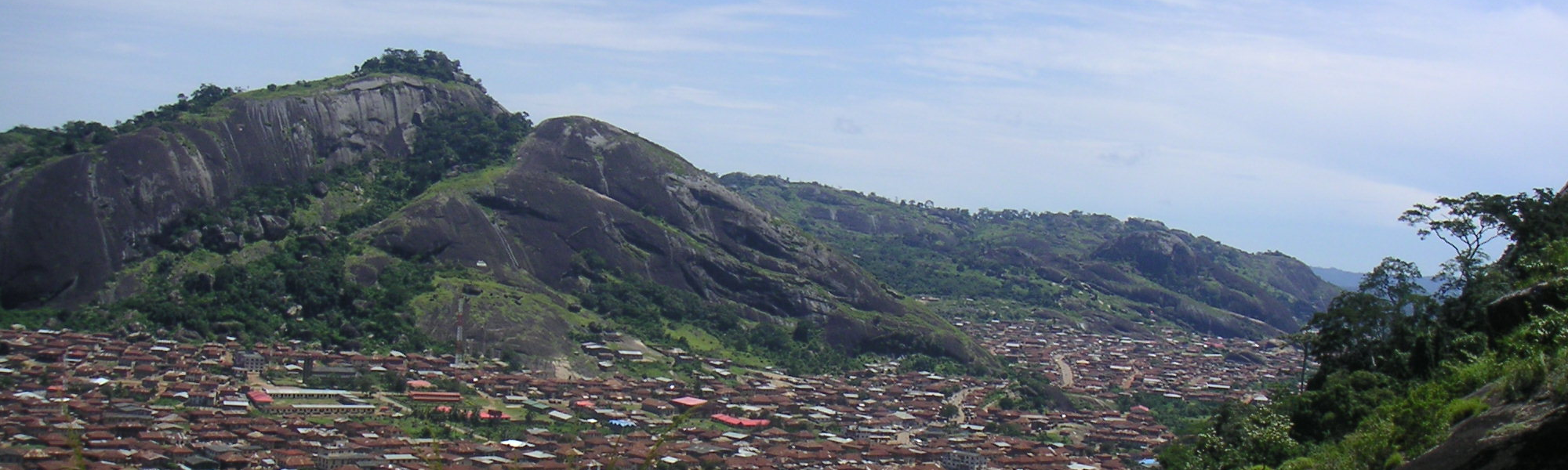
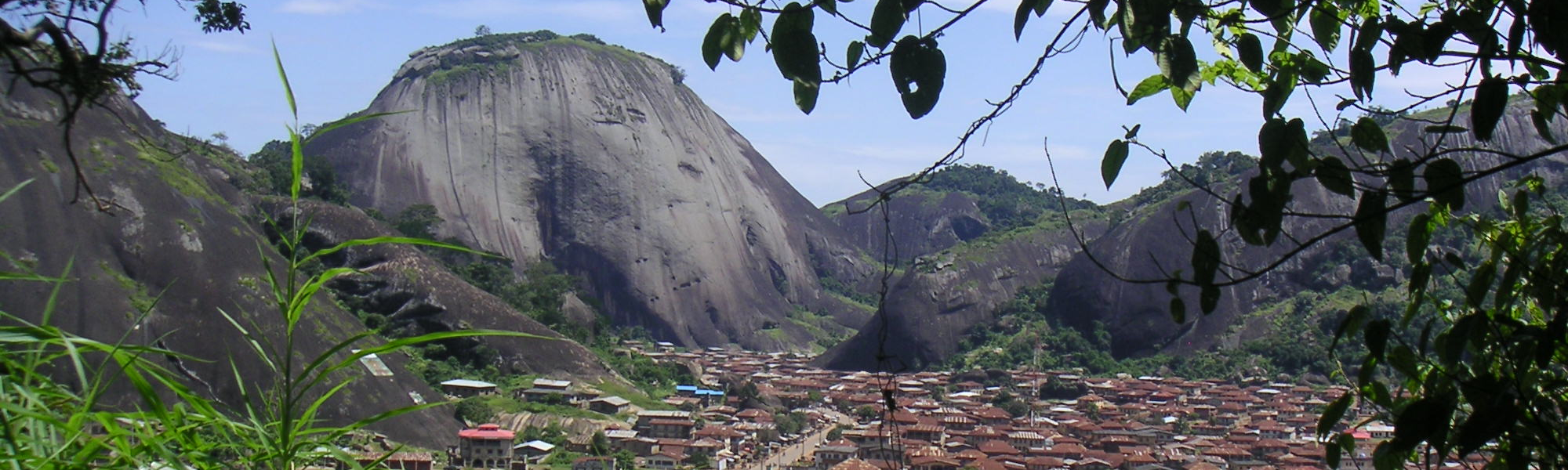
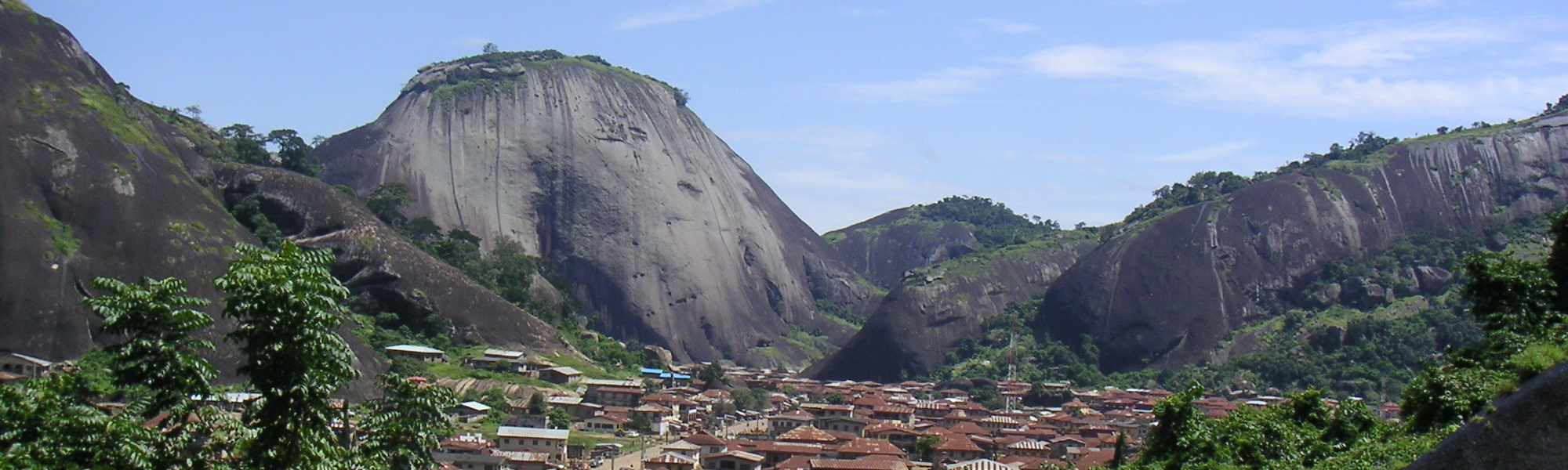
The country of the district is hilly – one might almost say mountainous when thinking of the position of Idanre Town, which is situated half way up a massive granite formation some 3000 feet in height. There are other ranges of hills situated about ten miles south of Idanre. The area is well watered throughout, being bounded on the West by the Owena River and on the East by the Ofosu River, whose source is a few miles from Idanre, the middle of the area being served by Rore River, which is a tributary of the Ofosu. The whole of the Southern part of the District from a line drawn East and West through Lejuwa and between the rivers Owena and Ofosu is a Government Forest Reserve approximately 280 square miles in area, and the rest of the district is covered with valuable forests.
Historical.
The founder of the Idanre, in common with the rest of the Yoruba people, was Odudua. He was reputed to have set out across Africa in a westerly direction. He was accompanied amongst others by Aremitan or Olofin, to which he subsequently changed his name. After his death Olofin lead (led?) away the people who were to be the original inhabitants of Idanre and Benin, the Oni of Ife being left to look after Odudua’s grave. This is the Idanre version of the founding of Ife and they allege that the only reason why they used to send messengers to Ife was to pay homage to Odudua’s grave. (See Appendix No. 1 for further legendary history).
From Ife the Idanres and Benis went to a place called Ajagba and then to Irede, having crossed over the Rore River. It was at Irede that the Binis left the Idanres and proceeded to Ado or Benin. After the departure of the Benis the Idanres first settled at a place called Utaja, which was situated quite clese to the present town of Idanre. They lived there in caves with Olofin as their leader. Olofin has the reputation of being a very warlike man but a very just one: He set up certain laws, which will be dealt with in the Judicial section of this Report. (See paragraph 44).
After Olofin’s death the Idanres moved to the present site, which was formally a hunter’s camp. The first settlers were the Owa Gbogun, (See Appendix No.2 for list of Obas) who was the son of Olofin, the Legbemo, Elemo, Kogunrowo, Asalu, Laja, Jemikin, and Jomu. They settled in quarters, which were the same as the present ones, and, with one or two exceptions, the titles of these Chiefs became to be regarded as titles of the quarters in which they settled.
Between the time of the settlement at Idanre and the advent of British rule, the Idanres engaged in three wars, which are dealt with in Appendix No. 3.
Brief History of British Rule
A treaty (See Appendix No. 4.) was made with the Owa of Idanre in 1894. The
District was originally administered apparently from Lagos in conjunction with the Ondo District but later a Travelling Commissioner was stationed at Igbo Bini in the present Okitipupa Division until he transferred his headquarters to Ondo in 1899. The travelling Commissioner’s duties appear to have been accurately described by his title and his powers, though wide, were only used if those of the Chiefs – also wide – were abused. He was responsible direct to the Governor and his actions were recorded in diaries, copies of which were sent to the Governor. In (1900 ? the Idanre District together with the Ondo District was included in the Western Province and the DistrictnCommissioner, as he then became known, became responsible to the Provincial Commissioner. In 1914 the amalgamation of Northern and Southern Nigeria and the reorganization of the Provinces placed the District in the Ijebu Province but it was later transferred to the newly made Ondo Province. The Idanre Native Court was established in 1915.
Apart from a few minor clashes between the Christians and Pagans in the District there have been no outstanding incidents of political importance since the advent of British rule. Taxation was introduced in 1921 without disturbance.
IV Administrative.
Ancient Indigenous Social Organisation.
As inquiries progressed it became apparent that every village in the District looked on Idanre as their mother town and the Owa as their head. Investigation into their ancient social system showed that the systems of the older outlying village depended so much on those in force in Idanre Town that it is necessary to explain the organization of the mother town first. The more recent settlements have no organization of their own apart from this system, which has been in force since Idanre was first founded.
This part of the report will be more easily understood if reference is made to Appendices Nos. 5 – 7. It soon become apparent that the family and head of the family played very little part in the organization of the District: The head of the family apart from controlling members of his household and settling petty family disputes was not regarded as a very important person. The first important unit in the social organization of the District were the age classes (Egbes or Otus) in the quarters (Idimi) and, as will be seen later in the report, this organization also extended to the villages. The heads of these age classes in the quarters of Idanre Town have been set out in Appendix No. 5.
As far as the age classes were concerned the Heads of the quarters (Olori Idimi) were the important persons in the social structure. Each quarter had a Quarter Head and a body of Elders (Agba) and although in some quarters there were Chiefs who were considered senior to these Quarter Heads (See Appendix No. 7), the actual affairs of the quarter were left to a great extent in the hands of the latter. There were seven quarters in Idanre and each quarter had a Quarter Head as follows: –
Name of Quarter Title of Quarter Head.
Irowo The Oshinle
Isalu The Kogunrowo
Idale The lemikan
Odoba or Okedo The Manare
Odeja The Salaja
Isunrin The Ajana
Ijomu The Orunfunsin.
The Quarter Heads were selected from any family living in the quarter, in which the deceased quarter head lived. Their duties were of general nature, comprising both judicial and executive functions. As regards their executive functions, they were responsible for the good order of their quarter and for the collection of town funds when it had been decided that these were running low. (See paragraph 17). Their judicial functions will be seen later in the report. (See paragraphs 51 and 52. Elders of the quarters were similarly selected from any family living in the quarter in which the deceased elder lived.
As these Quarter Heads (Olori Idimi) and their elders play such an important part in reorganization proposals it should be mentioned again that it was on them that the whole social structure was built and in fact still remains.
The next step in the social organization is the body of title holders who composed the Owa’s Council. This Council was composed of the Iwarefa Chiefs, who were the Lisa, Ojomu, Sama, Lobu, and Osolo, the war Chiefs, who were the Odunwo, Sama, and Ojumu, (See Appendices 7 and 8), the three classes of Edibo and certain of the Heads and Elders of the Quarter. As regards the Iwarefa Chiefs, the Lisa was considered to be the senior of these five Chiefs. He acted as the Head of the District between periods of the death of one Owa and the accession of another; he was also the head of the Iperes, which is a term used for all the people in the District who held no title, and was the Chief Judge in all cases of offences against the state. (See paragraph 49). The Ojomu was the Treasurer of the District and town and all public funds were collected by him. These funds consisted of fines inflicted on the public in any Judicial proceeding, of money collected for any public purpose, such as for the entertainment of strangers and for rewards for Ifa Priests employed during public ceremonies, and of money paid by private individuals who were about to assume titles; in this last case the Ojomu would be responsible for settling the expenses incurred during the festivities which accompanied the assumption of the title. When funds were low the Ojomu would inform the Quarter Heads (Olori Idimi) and they would make a collection from their quarters, each man paying according to his means. The Sama, Lobu and the Osolo were judicial officers and their duties will be described later in this report. (See paragraphs 44 and 47). The war Chiefs were three in number, the Odunwo being the head. They still retain their prinstine reputations as important Chiefs in the town.
The first class of the Edibo was composed of the Sashere, Ologboshere, Lisagha and the Oshore, the second class of the Edibos were Adaja, Manare, lejuwa Ayadi and Egbedi, the third class of the edibos were Oshinle, Igbatoyo, Orunfunsin, Gbogi, Losare and the Banikin. Of the second and third class of the edibo the Manare, Oshinle and the Orunfunsin were Quarter Heads (Olori Idimi) and the rest were Elders in the Quarters. (See Appendix No. 6). Besides the three classes of Edibo certain other hoads or elders in the Quarters were members of the Owa’s Council. These were the Egbediowu, Kogunrowo, ………??? Lemikan, Lijoka, Kojadun and the Saruku. Of these the Kogunrowo and the Lemikan were Quarter Heads and the rest Elders in the Quarters. Other elders of the quarters were allowed to attend Council meetings but had no say in the discussions.
This Council advised the Owa on matters concerning the Town and District and carried out any decision reached in the Council. It was not usual for the Owa to issue any executive order when the Council had first approved it. The views of the people were expressed to this Council through the Heads and Elders of the Quarters.
The Alegwas, who were his bodyguards, kept the Owa informed of day-to-day events in the town. They were fifteen in number: – The Wabie, Olisamese, Olukotun, Waye, Oshunbale, Oshonu, Shesi, Sheniyan, Oshodi, Gbano, Agbakin, ….giri, Loshan, Lijoka, and the Owanile. (The Agbakin and the Lijoka of the Alegwas are to be distinguished from similar title names which occur elsewhere).Each of these Alegwa was in charge of a company who perform menial tasks for the Owa, such as farm labour and providing firewood for use in the Owa’s house.
There were certain other minor title holders who play no great part in public affairs; these were theShingbuwa, Lomafe, Bemuwa and the Gbagengha, who were known as the Bagbe and were stewards to the Iwarefa Chiefs whenever the Owa held a meeting in his house; they tasted the apportioned out the food on these occasions.
Village Organisation.
The organization of the villages can conveniently be divided into:-
Old settlements from Idanre.
Settlements within the last fifty years.
Taking the recent settlements first, they had no organization of their own apart from the organization of age classes in Idanre. All these villages are settlements of the more progressive elements in the seven quarters. They have realized the disadvantages of the difficult access to Idanre and have moved down to villages, which they have established, along or near to the motor road or in the case of Onishere, to a main waterway. All the inhabitants of these villages belond to different quarters in Idanre and in this respect differ from the older settlements, who, in most cases, were settlements of slaves of important Chiefs in Idanre and thus preserved their original quarter organization. The recent settlements are Onishere with the sub-settlements of Erijo, Ibishere, Yalowo, Ipinlerere, Owomofewa, Inudidun, Owobambo, and Degbaju; Alade, Aiyetoro, Oloruntedo, Ajegunle, Aponmu, Ipinlerere, Aiyede, Ala and Omifunfun. Headmen have been appointed with the Owa’s approval for all these villages, but are for the most part unimportant persons when their position with regard to the social organization of Idanre is considered; e.g. the Bale of Onishere belongs to Kogunrowo’s age class in the Isalu quarter of Idanre (See Appendix No.6.) and the Bale of Omifunfun to Agbakin’s age class (See Appendix No. 5) in the same quarter. Notes on all these villages will be found in Appendix No. 9.
Old Settlements from Idanre.
The old settlements from Idanre were Okenifon, Atishin,Okerisha, Aweba, Ologede, Odole, Opa, and Ajagbale. These villages with the exception of Aweba, were founded by Idanre Chiefs. Who sent their slaves out to live in them presumably with the idea of being near their working places. In some cases sons of the Chiefs also took up their abode in the villages, but the headman of the settlements were in all cases slaves. In time theses settlements can develop age classes apart from the mother town and it is probably only in recent times that the erstwhile slaves have been permitted to join age classes in Idanre. A note on the founding of these villages and of age classes in them will be found in Appendix No. 9. These older villages still consult the Chief who holds the title of their founder or the Head of the quarter from which they settled, e. g. Sashere was the founder of Atosin and lived in the Irowo quarter in Idanre, in old days they would consult the Sashere on important matters but they now consult the Owa through the Oshinle, who is the Head of Irowo Quarter, or in the case of Okenifon through the Adaja, a former holder of which title having originally founded the village.
Besided these two classes of settlements, there are certain other small hamlets, which are inserted here merely for record purposes. These are Odoko, Abababubu, Aremu, Arowena, Apefon, Lejuwa and Abusoro, which are either old farm hamlets, which have gradually broken up, or old market places. They will in time disappear as the present inhabitants of them intend to move down to Odode with rest of Idanre.
The Guilds
Although they played no active part in the administration of the District, there existed in old days trade guilds, which were controlled by one of their numbe, who are appointed by the Owa. Formally there were guilds of hunters, blacksmiths, Ifa Priests (Babalawo), native doctors, goldsmiths, silversmiths and drummers. Besides those modern times have produced many other guilds such as blacksmiths (European trained), carpenters, bricklayers, mud wall builders, tailors, shoemakers, teachers, bankers, leatherworkers, sawyers, and washermen. The head of the guild, who was always a man living in Idanre, controlled the members of the guild in the villages. The Owa still controls the appointment of these heads of guilds. There are also cocoa farmers’ associations, which are now in the process of reconstruction.
Women’s Companies or Age Classes.
A bief not on these will be found in Appendix No. 10.
Land Tenure
As inquiries progressed it became obvious that the Idanre District differed from the Ondo District in their system of land tenure, and that the system was more akin to that of Benin Province. (See paragraphs 342 – 377 of Mr. H. L. Ward-Price’s Report on Land Tenure in the Yoruba provinces). The system of land tenure can conveniently be divided into two parts: –
Town Land for building purposes.
Country Land for farming purposes.
Town Land was originally allotted to the families by the Owa. Who is considered to be the owner of all land in the District. Such land for all intents and purposes has become private land and is inherited by the family. Town land could be given to other families or to strangers if it was found that more land than was required had been allotted to a family. If this land was not used for some years by the family to whom it had been given, it could be reclaimed by the family who gave it. It was usual to inform the Owa of all such transfers. The principle governing tenure of town land was that once a house had been built on the land, the land belonged to the owner of the house, but he could not dispose of it by sale. So far the question of renting of town land for building purposes has has not arisen but the Owa and Chiefs say that there would be no objection to this. In the same way the renting of houses to natives of Idanre and to strangers has not arises but there would also appear to be no objection to this. Sales of houses are unknown from the fact that the ownership of houses is vested in the family and not in the individual, and mortgaging town land and houses is, for a similar reason unknown.
Country Land for farming purposes was considered to be communal land i.e. land the occupation of which is under native law and custom controlled by the head ofa native community for the common benefit of such community. In effect this meant that the Owa was the head of a large family and the disposal of land was in his hands. Country land can be divided into:-
Land for food crops (i.e. yams, corn etc).
Land under permanent crops (i.e. cocoa, kola).
As regards land for food crops, if a man ……found off a piece of land which he had
cultivated for this purpose without expressing any intention of returning to it after it had been allowed to lie fallow, he would cease to have any claim on that land and any other native was permitted to use the land. That all land was, and still is, communal can be enphasised by the fact that a native living in Atoshin village is allowed to use land near Idanre, if he so wished, and provided that the Owa was informed.
Land under permanent crops was acquired in a similar way to land for food crops.
Such land was retained till such time as the permanent crops ceased to bear but it was possible for one man to use a piece of land for food crops, which was already planted with Kola trees (i. e. permanent crops) by another man, and provided that permission was granted by the person who first arrived on the land. In modern days it is not unknown for a man to start cultivating for food crop purposes a piece of land planted with cocoa trees by another man, if the trees have shown algae of …op..ung.
Sales and mortgages of crops in the land are permitted even between strangers,
provided that the strangers obtain the Owa’s permission. Sales and mortgages between natives of Idanre are not usually reported to the Owa. No stranger could acquire any land unless the Owa’s permission was first obtained. In the case of town land once a stranger had built a house he was regarded as the owner of the land, his house being being inherited by his family on his death. All strangers to whom to whom land was granted had to recognize the Owa as their overloard. Although no case has yet been known, the Owa and Chiefs assert that the Owa has the right to evict an occupier of land from a site required for public purposes, the occupier being given land elsewhere, and probably, compensation for his crops or house.
So far there have been no land problem in Idanre as there is plenty of land available
for everyone.
Inheritance
The house of the dead man was inherited by his children. The movable property was divided between the dead man’s relations (i.e. brothers and sisters) and his children. The crops in his farm were similarly divided, after the Owa had been given a share. In this division of movable property, it is interesting to note that the dead man’s relations took the greater share, the reason being that they were responsible for the debts contracted by the dead man.
Kola trees and at present time, cocoa trees are also divided between the relations and the children, the relations again takind the greater share. Coconut trees were similarly divided, the Owa taking one tree whether or not there happened to be a large number of trees in the dead man’s possession.
Ownership of Trees.
Before the advent of Government no value was attached to trees. No one was
permitted to cut down an Iroko tree as the timber from this tree was used for the Owa’s coffin. Since the advent of Government the Owa and Chiefs have received all the royalties from timber permits without any apparent complaint. It is usual but not obligatory for the sawyer to give a few planks to the man on whose farm he felled the tree. Tree felled on uncultivated land would be considered to have been felled on communal land, which … belonged to the Owa. The Owa and Chiefs have agreed that incurred no royalties should be paid to them. (See paragraph 4.. (VIV)).
Rotation of Crops.
Land in most of the district is allowed to lie fallo for between ten and fifteen years.
The Collection.
Until the present year the system appears to have been for tax receipt books to be issued nominally to certain of the larger village heads but for tax to be collected, and the receipt books kept by the Accounting Clerks. Tax so collected was paid into the Native Administration Office direct, the Native Administration Treasurer himself signing a District Head’s receipt which went to the District Head. There was moreover no proper system of checks on the accounting either of the Accounting Clerks or the Native Administration Treasurer. The weakness of such a system was shown up when the Native Administration Treasurer, two Accounting Clerks, the Oga Olopa (Poloce Officer) and an Olopa (Police) are all charged with embezzling various amounts early in the year.
A system has now been introduced whereby the tax receipt books are issued to the District Head, who issues them to the village heads. The village head is held responsible for the custody of the receipt books and cash and for the payment of the cash at regular intervals to the District Head. Accounting Clerks’ and other cash books are liable to surprise inspection at any time either in Ondo or in the villages, and the clerks are forbidden to handle cash. The District Heads’ and Accounting Clerks’ cash books are checked at the end of each month by an Administrative Officer and the value of tax receipts in hand is checked against the amount of tax received for that month. In consultation with the Native Administration Auditors, Cassleton Elliot and Company, a complete new system of books has been introduced and Cassleton Elliot and Company have stated that they consider that the new method of checking tax receipts is adequate.
With regard to the scales of tax, those now in force are as shown in Appendix 11. The attempt during 1933 to count cocoa trees for the purpose of more accurate assessment was, to say the least of it, not popular with the cocoa farmers. As a result of this the question of revising the rules of tax has been under consideration and the following scale is being proposed in separate correspondence.
Income under £50 tax 7/-
“ not less than £50 but less than £100 tax 10/-
“ “ £100 “ “ £200 “ £1.
“ “ £200 £300 “ £2.
“ “ £300 “ £400 “ £3.
“ “ £400 “ £500 “ £4.
Should these rates be approved it is proposed that they should be operated by assessment committees proposals regarding the constitution of which will be found in paragraph 42 (IV and V).
Markets and Trade Fields.
The principal market in old days and even now is at Alade; this is attended by the Akures as well as Idanres and Ondos. Alade market was held every five days. In old days trade was carried on also with Benin and Owo. Certain Chiefs were allotted to the markets, which it was customary to visit. The Adaniken looked after the people who went to Benin to trade, the Oshonu the Owo traders, the Odundun the Ondo traders and the Owayegha the Akure traders. These titles with the exception of the Oshonu have now lapsed and it would seem useless to revive them, communications between the markets having been developed. The Chiefs stationed in the markets at Benin, Akure, Ondo and Owo appear to have occupied a position similar to a vice consul in a small colony; they looked after the interests of the traders from Idanre and saw they dis not get into trouble. The only other important markets now are at Aiyetoro and Onishere, both of them serving all the smaller villages nearby. Idanre also has a small market every five days.
Proposals for the Future
I. The Idanre District, which is now included in the term ‘Ondo Native Administration’ which comprises the Ondo and Idanre Districts, be separated from that Administration and form an Administration of its own to be styled the ‘Idanre Native Administration’.
II. The Native Authority for the proposed ‘Idanre Native Administration’ be the Owa of Idanre and his Council.
III. A Council should be formed with the Owa as President and composed of the following members:-
1st Class Edibo
The Sashere
The Logboshere
The Lisagha
The Oshore
2nd Class Edibo
The Adaja
The Lejuwa
The Manare
Ayadi Bepie Egbedi
3rd Class Edibo
Oshinle
Igbatoyo
Orunfunsin
Gbogi
Losare
Baniken
Iwarefa Chiefs
The Lisa
The Ojomu
The Sama
The Lobu
The Osolo
War Chiefs
The Odunwo
The Sagho
The Ojumu
Heads and Elders of the quarters
Egbedi-owu
Kogunrogho
Legbira
Lemikan
Lijoka
Kojadun
Saruku.
(Present title holders to be excluded until such time as certain essential ceremonies by the Owa have to be performed.)
The Owa and the proposed Council have agreed that the following headmen of villages and prominent heads of religious denominations be allowed to attend Council meetings and that the views of every side of the population of the Idanre District may be heard by the Council:-
The Headmen of Atoshin, Okerisha, Aweba, Ologede, Odole, Opa, Ajagbale, Okenifon, Alade, Ala, Omifunfun, Onishere, Aiyetoro, Oloruntedo, Ajegunle, Aponmu, Ipinlerere, and Aiyede.
The three Baba-eges Head of the Christians, Omeyin, C.l…., and the Roman Catholic Missions in Idanre and the Baba-egbes of the following villages:- Atoshin, Opa, O…….., Odole, Alade and Aweba.
The Lemomu (Head of the Mohammedans), of Idanre and Onishere. Although the villages were on a different and lower standing to Idanre (see paragraph 22), there is no doubt that several of them are becoming self conscious, such villages as Alade and Onishere, although now recognizing the Owa as their District Head, may in future years attempt to throw off Idanre. It is for this reason that the villages have been permitted to have a voice in the affairs of the District, by allowing them to attend Council meetings. They are not,
however, to be considered as members of the Council the composition of which is given in III (a) above.
The Council and the District Officer should meet …….required and at least once
every three months to discuss the finances aand affairs of the District.
Assessment committee be established in each of the villages in the District and be composed of the headmen and elders of, and a member of each of the trade guilds in, the villages.
A central assessment committee be established in Idanre to coordinate the assessments of the villages- This committee to be composed of of the Oshinle, Kogunrowo, Lemikan, Manare, Salaja, Ajana, Orunfunsin (Olori Idimi) (see Appendix No.6) and the heads of trade guilds in Idanre. Assessmment lists will be posted in the villages after the central assessment committee has revised the village assessment and whoever wishes to appeal against his assessment may do so within one month of the posting of the assessment notices; at the end of one month the Council will sit to listen to appeals against assessments.
The Share (one third) of Government royalties and full Native Administration royalties, which are at present paid to the Owa and Chiefs should no longer be paid to them. The reason for this proposal is that as all land in the Idanre District is communal land vested in the Owa on behalf of the people of the District (See paragraph 29), it is considered that it would be fairer for the money realized in timber royalties to be spent on behalf of the people. The Owa and the Chiefs have agreed to this proposal.
The Chief Ojomu to take over the post of Treasurer, which he held in former days (See paragraph 17). The present title holder who is illiterate will be assisted in his duties by a Treasury Clerk. The object to be aimed at is for future holders of this title to be literate and to take over all treasury work. The services of a clerk could then be dispensed with and the salary paid to him could be paid to the Ojomu in addition to his present salary. Treasury Offices will be included in the Council Hall, expenditure on which has already provisionally been approved. (See Resident’s endorsement No. O.P. 83/22a of 28th September, 1934).
The salaries now drawn by Osolo, Sashere and the Logboshere should, together with an additional £30, be divided among the proposed Council (See paragraph 42 III (a)) excluding those members of the Council who are already in receipt of salaries. The effect of this would be that the Council members, with the exception of the Owa, Lisa and the Ojomu, would receive a sum of £10 monthly, which would be divided up at the discretion of the Council. The additional £30 would be taken from the percentage of the gross tax at present paid to Chiefs in Idanre Town and no further percentage would be paid in respect of collections in Idanre Town.
The percentage of gross tax paid to village heads would continue to be paid.
V. Judicial
43. (a) Criminal matters.
Formerly crimes were divided into three classes:-
Offences against the laws of Olofin (the founder of the Idanres).
Offences against the laws of Orosun or Iyamode, who was Olofin’s wife.
Offences against the state.
I. Offences against the laws of Olofin.
The judicial officers who heard this type of case were the Laja, Odofin, Sama, (Iwarefa), Ojomu (Iwarefa), Lorin, Ajana, Arema, and the Jogonro. They were known as the Alaworo. Their titles were confined to one family in each case. The following are examples of the laws of Olofin:-
It was forbidden for a woman to bear twins; the mother and father of the twins were punished and the twins were killed.
Drumming was prohibited at certain times of the year, an offender was punished. The usual fine was a goat.
Moulding ….. of yam heaps and the eating of yams before certain ceremonies were performed was prohibited.
In order to see that these laws were ……rced….. one man was chosen from each quarter, and they were given titles as follows:-
The Laye of the Irowo quarter
The Renja of Isalu quarter
The Ewi of Idanre quarter
The Ajero of the Isunrin quarter
The Oro of the Ijomu quarter.
The Agbakin who lived in the Irowo quarter was in charge of these police or Omedanres, as they are called. They had regular meetings every nine days when any new law and the means of enforcing that law would be addressed.
II. Offences against the laws of Orosun.
The judicial officers who heard this type of case were the Osolo (Iwarefa) Lobu (Iwarefa), Aro, Asunrin, Gbenen, and the Aranopon. They also performed the ceremonies of Orosun when the festival was held. (For festivals see Appendix No.12). The following are examples of the laws of Orosun:-
It was forbidden for a woman to conceive if she already had a child under one year old. The child was put to death and the parents were fined heavily.
The breaking of plates and pots was prohibited: the fine was a dog.
It was prohibited for an adult to pass excrement in a house: the fine was a dog.
The judicial officers of Orosun were like the Alaworos, each selected from particular family. The Owa was represented among the Alaworos by the Odofin and among the officers of Orosun by the Sama.
III. Offences against the state.
These cases were tried in the presence of the whole town with the Lisa as the chief judge. Where death was the penalty the execution was carried out by the Omedanres, who also oddered the fogging where it was prescribed. The following offences and punishments for those offences under this category:-
Murder. Murderer was tied to a tree and clubbed to death.
Being in possession of bad medicine. The offender was flogged and the medicine burnt.; he was also fined, the fine being paid into town funds.
Committing adultery with the Owa’s wives. Both parties were tied to a tree and clubbed to death. It is interesting to note that the last recorded instance of this was when a Chief Lejuwa was put to death only a few years previous to the arrival of Governor Carter in Idanre. The woman in the case was beheaded.
Certain kinds of assaults. The distinction from other common assaults was that an onlooker mentioned the name of one of the Owa’s wives and the combatants still persisted with their fight. The party found guilty at the trial was fined five kolanuts.
Insulting the Chiefs. The offender was fined one goat, which was given to the Owa.
Woman refusing to become the Owa’s wife. The culprit was banished. It was not usual for the Owa to pay any dowry.
The Owa’s wives were forbidden to sleep away from Idanre. The woman was formally killed; she now sacrifices a sheep on her return to Idanre. This happened on a recent visit of the writer to Idanre.
It is forbidden to beat the Owa’s children. The offender was fined a sheep which was given to the Owa.
Stealing. The thief was flogged round the town.
Telling lies at town meetings. The offender was flogged.
Non-attendance at a town meeting, which had been proclaimed. The absentee was fined a goat.
All criminal offences committed in outlying villages were tried in Idanre, the headman bringing in the accused person.
b. Civil Matters.
The head of the compound usually settled minor cases of debt, if the debtor and creditor lived in the same house. If they were dissatisfied with the decision of the head of the compound they went to the Olori Idimi (Quarter Head), who usually settled the matter finally.
If the debtor and the creditor lived in different quarters, the two Olori Idimis concerned settled the case…..(really?) debt cases were not as a rule taken to the Owa, but if any party was dissatisfied with the decision of the Olori Idimi they had free access to the Owa who settled it finally.
Major debt cases were usually taken direct to the Owa as were the cases in which strangers were involved. If a debtor did not or could not pay, the matter was reported to the Owa who would apportion out the debt, if it was a large one, among the debtor’s family. There seems to have been no other method of enforcing judgment debts.
The present Native Court members appears as Appendix 13. The Owa does not attend court. The court works adequately under supervision.
A note on customs relating to marriage, divorce, and adultery appears as Appendix No. 14.
Proposals for the future.
The present Idanre Native Court be reconstituted and be composed of the following members:-
(a). The Oshinle and Elders (Agba) of the Irowo Quarter (See Appendix No. 6)
The Kogunrogho and the Elders of the Isalu Quarter.
The Lemikan and the Elders of Idale Quarter.
The Manare and the Elders of the Odoba or Okedo Quarter.
The Salaja and the Elders of the Odeja Quarter.
The Ajana and the Elders of the Isunrin Quarter.
The Orunfunsin and the Elders of the Ijomu Quarter.
The Headmen and Elders of the following villages:-
Atoshin, Okerisha, Aweba, Ologede, Odole, Opa, Ajagbale, Okenifon, Alade, Ala, Omifunfun, Aiyetoro, Oloruntedo, Ajegunle, Aponmu, Ipinlerere, Aiyede, and Onishere. And the Lemomu of Idanre.
The Headmen and Elders of the villages will ssit on any case that concerns a member of their village together with the Heads and Elders of the villages of the Quarter concerned. E. g. If a man fo Atoshin village had a case in court against a man who belonged to an age class in Irowo Quarter, the case would be heard by the headman and Elders of Atoshin together with the Oshinle and Elders of the Irowo Quarter. The Lemomu (Head of Mohammedans) is retained in the …are as an adviser of Mohammedan Law.
(b). It is proposed that this Court have Grade ‘b’ powers and that it should hold sessions in any village in the Idanre District.
(c). Sitting fees to be fixed at £1 per sitting, which sum will be divided among the members attending the sitting. It should not be necessary for the Court to sit more than twice a month.
(d). Appeals from this Court should lie to the Idanre Native Court of Appeal. (See III below)
II. The Omedanres (See paragraphs 45 and 46) take over the action…. Now performed by the Court Messangers and Olopa. Salaries be pid them at the following rates:- £9 per annum for the Agbakin and £6 per annum for the rest of the Omedanres.
III. A Native Court of Appeal be established with ‘C’ Grade powers and be composed of the following members:-
The Owa President.
The Lisa, Sashere, Logbosere, Lisagha, Oshore, Ojomu, Osolo, Odunwo, Sawo, and the Ojumu. The composition of this Court was the express wish of the Owa, Chiefs and the people of the District. It was first for Orosun….sun that the Court be composed of the Owa, The Alaworos and the judicial officers of Orosun (see paragraphs 44 and 47), but certain of these men are not permitted by native law and custom to sit with the Owa and the people have now become accustomed to regard some of them as holders of priestly, as opposed to judicial, titles.
(b). Sitting fees for this Court be fixed at £2 a sitting. The Court will probably not sit more than once every two months. These sitting fees be paid to the members of the Court who do not already draw salaries, i. e. The Owa, Lisa, and the Ojomu would be excluded.
(C). Court fees to be the same as those for the Idanre Native Court, (see Appendix N. 15).
(d). Appeals from the Native Court of Appeal to lie to the Magistrate with full powers in all cases where no appeal be ….addressed by recent legislation.
(e). The appeal Court also to have original jurisdiction as to the limit of its powers, but only in cases beyond the powers of the inferior Court.
57. VI. Financial
In the past Idanre has undoubtedly been helped financially by the Ondo District and it will probable take some time before it can spend money as lavishly as it is at present, for instance the cost of the road from Odode to Aiyetoro, where that road joins the Ondo – Akure road, has been fairly large owing to the difficulties of the country. As the draf estimates for 1935 – 1936 have already been submitted, they will need a certain amount of adjustment (see AppendixNo. 16).
The following shows the financial position of the proposed Idanre Native Administration :-
Revenue. £
Head I. General Tax (50%) 635
Head II. Native Courts:-
1. Fines 66
2. Fees 163
III. Other Receipts: –
1. Vehicle Licenses 8
2. Timber Royalties 246
3. Forest Fees 100
4. Interest 12
5. Miscellaneous 10
Total 1,234
Expenditure
District Heads:- £
1. Owa of Idanre 200
2. The Lisa 60
3. 2. Liaison Messengers at £6 12
Carried forward 272
Head III. Village Heads:-
Remuneration to Council Chiefs and
percentage of gross tax collected to
Village Heads 150
Head IV Judicial:-
1. Native Court Scribe 36
2. Sitting fees to Members of Appeal Court and Native Court.
3. Remission of Fines and Fees.
Head V. Treasury
Treasurer (Chief Ojomu) 30
1 Treasury Clerk 30
Share Accounting Clerk 27
Share of Audit Expenses 7
Head VI Police
1.a. Omendanres 1 at £9 and 7 at £6 51
Head VII. Prisons.
a. Native Court Lock-up Rations 19
b. Subsistence of Native Court …….. ….
HeadVIII Various
1. Transport 9
Total Administration 677.
Head IX. Books Recurrent:-
1. Maintenance of Buildings 10
2. Maintenance of Roads and Bridges 10
3. Tools 4
4. Share of dredging Ominla River at Agbabu 12
Head X. Works Staff:-
1. Share of Road Overseer 12
Head XI. Medical and Sanitary:-
1. 1 Dresser 24
2. Drugs and Dressings 30
3. Uniform for Dresser 3
4. Contribution towards Drver’s wages,
Motor Ambulance 2
Contribution towards upkeep of Motor
Ambulance 8
Head XI. Forestry:-
1. Forest Guard 18
2. Uniform for Forest Guard 2
Head XII. Miscellaneous:-
Stationery and Office Requirements 10
Printing 5
Contingencies 2
Refunds of Tax 4
Total Development 251
Special Expenditure:-
District Council Hall and Treasury
Offices 200
Total Special Expenditure 200
Summary. £
Administration 977
Development 251
Special Expenditure 200
Total Expenditure 1, 128
£
Revenue 1,224
Expenditure 1,128
Surplus 106
Notes on Proposed Expenditure.
Head II. Para.2. The messengers will be employed in taking messages between the District Officer and the Owa, one being stationed at Idanre and one at Ondo.
Head III Item 1. This figure includes the sum of £120 which will be paid to the proposed Council (See parapgraph IX). The other £30 will bepaid out as percentage of gross tax collected to Village Heads.
Head V. Item 2 The present Assistant Treasury Clerk at Ondo will be detailed for Idanre Native Administration work. (He is the son of the Owa).
Head V. Item 3. The Accounting Clerk will be employed on work in the Ondo District when not engaged in the Idanre District.
Head VI. Item … See paragraph 56.II.
Head IX. Item … In view of the state of the finances of the proposed Idanre Native Administration, the sum of £200 inserted in the draft Estimates for 1935 – 36 has been cut down to £100.
Expenditure on the Idanre – Aiyetoro road during the current financial year should be adequate for putting the road in fairly good order.
If the proposed separation from the Ondo Native Administration is approved, it is suggested that a percentage (according to tax paid) of the Reserve Funds held by the Ondo Native Administration should be transferred to Idanre. Idanre’s share would work out roughly at £500. The present Reserve Funds amount to £2,500.
Signes by Assistant District Officer dated 20. 12. 34.
Appendix No. 1.
Legendary History.
The people of Idanre allege that they have always had a system of keeping their legendary history: it consisted in appointing one man of each generation to keep in his memory all past events of outstanding importance. This record was handed down from generation to generation.
Their legends are interesting in that they reveal a similarity to parts of the Old Testament: the historians are, however, emphatic that these legends existed long before the advent of British Administration, and they are recorded here for what they are worth.
The Story of Creation
The supreme Being was called Odu Omo ere: his offspring included Orisha, Esu and a man and a woman. They lived in Orun (Heaven). The man and woman had two children who were called Owasan, the original Babalawo, the Agunmaja, the first Blacksmith (Alagbede). The people of Orun offended the Supreme Being and were ordered to leave heaven and go down to Earth. (Aiye). Agunmaja was told to make a chain for this purpose. The chain was made of alternate links of iron and brass. When it had been completed it was let down from heaven till it touched the waters which covered the earth. On reaching the Earth the people threw some substance on the water and chickens and a chameleon were put on the water to spread this substance, which formed the ground. The winds blew and the Earth was increased to its present size.
Trees began to grow, the first leaf to appear being called Itete. The first settlement was called Wuru; the people multiplied and the area became to be known as Modu, or the land of Odu, the Supreme Being. They again offended Odu, who caused the land to sink under water. Among the people there was a man called Oluwabi and his wife went with certain animals. They were saved and the rest of the people perished. After the reappearance of the Earth Oluwabi and his wife multiplied and the Earth was again filled with people. Esu, the son of Odu visited the people and instructed them to build a tower to save themselves from any futher mishaps. The tower was to reach Heaven. A Bricklayer was appointed to supervise the work his name was ….Lore. Odu saw what Esu was doing and banished him the the space between heaven and earth. The people having lost their adviser stopped the work.
The Journeys prior to settlement at Ife.
Odudua set out on his journey with the people from the East. Their first stopping place was Odu, called after the name of their father. Among his followers were Aremitan, who changed his name to Olofin, Eleri and his son Jomu and Eyosan. They stayed at Odu for some years and then proceeded to Okolomaba, where a permanent settlement was made by some of the followers. Tapa, alleged to be the same Tapa in Ilorin Province, was the next resting place; here another permanent settlement was made. The rest of the followers then went to a place called Ebiba, which derived its name from certain leaf, which grew in great wuantities there. This place was situated on the bank of big river; a permanent settlement was also made there. From there they proceeded on their journey to Ile Ife, stopping at Ora, Ugbo and Erin on the way. No permanent settlements were made at any of these last three mentioned places.
During this journey several important persons were born. Okoro, who was the first Oba of Benin, was the first Oba of Benin was the son of Orunto, who was the son of Eyosan. Jagba was the son of Olofin and the father of the first Alafin of Oyo. Aghaba was born at Ile-Ife and settled with his people near Abeokuta. Idole, the daughter of Olofin, married Ariro and migrated to Epe (in Ondo) and subsequently to Ondo.
At Ile-Ife odudua was attacked by slokum….. of the Oyos and was cured by OOlofin with a leaf which the latter brought from near the sea. As a result of this Odudua gave Olofin the greater part of his property which consists of Ade (Crown), Irun (Cowtail), Otitibiti (cloth having supernatural powers) and beads. It was also at Ile-Ife that a bird was killed and a palm kernel was found inside it. This was planted and produced the first palm tree. On the death of Odudua, Olofin and his followers set out on their journey to Idanre. (See paragraph 7 of report.)
Appendix 2
List of Owas of Idanre showing important events in each tenure of office
Agbogun made the move from Utaja (see paragraph8) to the present site of Idanre.
Gbaganju chose the site for the Owa’s house.
Beyoja fought against Oyos. (see Appendix …5,).
Jarungan was a son of Gbaganju
Ogbogbomudu
Agunmanyan was the son of a woman who was found in the Owa’s farm and who subsequently became the Owa’s wife. She was driven away from Idanre because of her adultery with another man. She went to Benin where she became the wife of the Oba of Benin for whom shw bore a son called Osemede, who became the Oba of Benin. After the death of the Oba her son became the new Oba and the woman told him what had happened to her in Idanre. Osemede sent a message to Agunmanyan, who by that time had become the Owa of Idanre. Agunmanyan was overjoyed when he heard that his mother was still alive and went secretly to Benin to see her and his brother. After the mother’s death the Owa sent a man called Olumeri to bring back her body to Idanre by stealth, this was accomplished and it resulted in a war between the Idanres and the Benis, who according to the Idanres were driven away. Peace was made and the Oba of Benin sent a man and a woman every year to look after his mother’s grave. This custom was continued till 1895. The last woman who was sent for this purpose was called Okusoge and her daughter named Tajinwa still lives in Idanre.
Amuwaro
Bogede
Shofin
Oganyeri. He was driven from Idanre because of some chronic malady, which was cured, but he lived to return to Idanre and hold office for many years.
Oluodo
Obojo
Oluwarere
Resilebete
Elegbehoho
Ogedemeru
Orile. Cloth making was started during his tenure of office
Yiworo
Kulumo
Arowojoye. The Akure war was fought during his time, the Idanre allying themselves to the Benis. (See Appendix 3)
Ajikansekun.
Agunleye. Minor wars with the Ondos were fought and the Idanres assisted the Ijeshas to drive away the Oyos.
Arubiefin. Christianity was established and the present site of the Anglican Mission church was granted. It was also during his tenure of office that a treaty was made with the Government (See Appendix No. 4). He died in 1912.
Gbolagbeye was famous, or rather infamous, for his persecution of the Christians; he only held office for seven years. The present Native Court was established.
Aroloye is the present Owa of Idanre.
Appendix No. 3.
Inter-tribal wars
The …leyo or Oloyo war.
During the tenure of office of Beyoja, a man called Owokugboko, son of the Alafin of Oyo, visited Idanre and stayed with the Owa. During his visit, the Owa’s servants took him out to see the Owa’s farm, while he was there he was persuaded to do some farm work with the result that he cut his foot and he subsequently lost two of his toes. The Idanres allege that this was the reason why he waged war against them after he had succeeded his father. The Oyos however were defeated by the Idanres owing to the cunning of one of the Idanre warriors. He arraged that calabashes of palmwine, which had been poisoned, were left hanging on palm trees so that it might appear that the Idanres, flying in terror of their lives, had left them hanging there. The Idanres say that the Oyos were defeated owing to their liking of strong drink. The story goes on that the leader was beheaded and his head was left impaled at a place called Imogun, which is near to the Owa’s house.
The Ikadun war.
There was a town called Ikadun situated between Idanre and Onishere: it was inhabited by a people gifted with the art of making brasswork. One of the Ikadun chiefs lived at Idanre and told the Idanres of this industry of the Ikaduns; the Idanres became jealous and ordered the Ikaduns to bring their work to Idanre. This the Ikaduns refused to do with the result that the Idanres fought them, driving some of them to Irele in the Okitipupa Division, and some to Benin, and others they captured and used as slaves in Idanre. The present village of Aweba is to a large extent inhabited by erstwhile Ikaduns.
The Akure wars.
The cause of the first war was through a petty market dispute between a native of Benin and a native of Akure. A Bini was killed and the Oba of Benin, having obtained the assistance of the Idanre, fought the Akure, who were defeated. This war took place while Arowojoye (See Appendix No. 2) was Owa. The town of Akure is alleged to have been burnt.
The second war with Akure happened while Arubiafin was Owa. Some Idanres living in Akure were illtreated by the Akures. The Deji of Akure is said to have had no hand in this war.
Appendix No. 4.
Copy of Treaty made in 1894
Treaty made in the Idanre Country between His Excellency Sir Gilbert Thomas Carter, Knight Commander of the Most Distinguished Order of Saint Michael and Saint George, Governor and Commander-inChief of the Colony of Lagos, for and on behalf of Her Majesty the Queen of Great Britain and Ireland, Empress of India, her heirs and successors on the one part and the undersigned Arubiefin the Owa (King) and absolute monarch of the Idanre Country for himself, his heirs and successors on the other part.
I the undersigned Arubiefin King of the Idanre Country do hereby promise:
That there shall be peace and friendship between the subjects of the queen of England and my subjects.
2. That British subjects shall have free access to all parts of my territory in the Idanre Country and shall have the right to build houses and possess property according to the laws in force in this country, that they shall have full liberty to carry on such trade or manufacture as may be approved by the Governor of Lagos and should any difference arise between the aforementioned British subjects and myself that the dispute shall be referred to the Governor of Lagos whose decision in the matter shall be binding and final and that I will not extend the rights thus guaranteed to British subjects to any other persons without the knowledge and consent of the Governor of Lagos.
That I the said Arubiefin will at no time whatsoever cede any of my territory to any other power, or enter into any agreement, Treaty or arrangement with any Foreign Government except through and with the consent of the Government of Her Majesty the Queen of England.
So long as the above conditions are carried out and the road between Owena River and Idanre is kept in proper order the said Arubiefin shall receive a yearly present to the value of fifty bags of cowries.
Donbe at Idanre this fourth day of September one thousand eight hundred and ninety four.
His thumb mark.
Arubiefin the Owa of Idanre.
(Sgd) G- T. Carter
Governor of Lagos.
Signed in the presence of
D. A. Rowse
Acting : Col: Surveyor.
I, the undersigned do swear that I have truly and honestly interpreted the terms of the foregoing Agreement to the contracting parties in Yoruba language.
(Sgd) V. P. Boyle
Clerk and Interpreter.
Witness to signature and mark.
W. Alfred Willoughby
Acting Superintendent L.C.
Appendix No. 5.
… Showing the heads of age Classes (……….Otu) in the Quarters.
Irowo Quarter Isalu Quarter Idale Quarter Odoba or Okedo Quarter
Orangun Rinja Ewi Ajero
Legiri Agbakin Leigbo Legiri
Liken Aro Bashorun Aro
Aro Lijoka Aro Bashorun
Bashorun Loshere Loisan
Lijoka Liken Liken
Afaja
Odeja Quarter Isunrin Quarter Ijomu Quarter
Ewi Ajero Oro
Liken Bashorun Liken
Aro Liken Bashorun
Bashorun
These age classes include all the males in the quarter, both old and young. Every nine years the age classes move upwards…..i.e. Orangun’s age class in the Irowo quarter would become members of Oshinle’s age class (seeAppendix No. 6) and the Legiri would become the Orangun and his age class would become Orangun’s age class.
The police (Omedanres) who also are heads of age classes in the quarters are underlined in red.
The heads of age classes were selected from any family living in the respective quarters.
The Agbakin(Head Policeman) and the Laye (see paragraphs45 and 46) both belong to the Orangun’s age class in the Irowo quarter. The chiefs were unable to give any reason……….whither of them were in charge of age classes as were to….other ………..
Appendix No. 6.
……showing the Heads (Olori Idimi) and Elders of quarters.These formed an age class which was named after the Head of the Quarter.
Irowo Quarter Isalu Quarter Idale Quarter Odoba or Okedo Quarter
Oshinle *Kogunrowo *Lemikan Manare
Adaja *Legbira +Lomafe Egbedi
Lorin Lejuwa *Lijoka Oshorun
Arema Odolofin Kogun Sheran
Igbatoyo +Bemuwa Logboshere Oshodi
Bepie *Saruku Batuwase
Banikin Losare Olakunrowo
Ashama Gbogi Inimikin
Orunbato
Odeja Quarter Isunrin Quarter Ijomu Quarter
Salaja Ajana Orunfunsin
*Kojadun Asunrin Laja
Ayadi +Gbagengha Jogoro
*Egbedi-Owo Lijofi
+Shingbuwa Orundakin Basanmuwa
Rijedi
The Edibo of the second and third classes (see paragraph No 18) are underlined in red.
Chiefs who sat on the Owa’s Council in addition to Edibo are marked with an asterisk (*), their seniority inter se is given in paragraph 18 of the report.
Some of the Headmen of the outlying villages also belong to these companies of Elders (Agba). They took precedence after the last named Elder in each quarter.
The Gbagba…(see paragraph 21 of report) are marked with a cross. (+). Their seniority inter se is given in that paragraph. They were allowed to live in any quarter in the town.
The Oshorun of the Odoba quarter, in which the present holder now lives, was allowed to live in any quarter. He had a special town duty which consisted in cutting off the head of the cow, which was killed every year at the Ije festival, and sharing out the meet.
The heads of quarters (Olori Idimi) were selected from any family living in the quarter in which the deceased quarter head lived, and in a similar way the Elders of the quarters were also selected.
Appendix 7.
List showing the Major Town Chiefs (Iwarefa, War Chiefs and 1st Class Edibo), according to Quarters and Seniority.
Irowo Quarter Isalu Quarter Idale Quarter Odoba or Okedo.
*Sashere *Lisa *Sama *Sawo
Oshinle *Oshore *Lobu Manare
Kogunrowo *Odunwo
*Ojimu
+*Logboshere
+*Lisagha
Lemikan
Odeja Quarter Isunrin Quarter Ijomu Quarter
Salaja Ajana *Ojomu
*Osolo
Orunfunsin
The Edibo of the first class underlined in red.
All chiefs marked with asterisk entitled to wear stoles, which consisted of a narrow piece of cloth eight feet in length worn round the neck.
Chiefs marked with a cross were allowed to live in any quarter.
Appendix No. 8. :
Notes on the Selection and duties of the Major Chiefs
The Owa was selected from the family. Only the sons who had been born in the Afin (Owa’s House) were eligible for selection. The successor was nominated by a chief called the Lorin, ….sole duty this war…., out the approval of the ………..he was finally selected. These………the Chiefs’ approval having been obtained, the………….leaves on the head of the future Owa and ………..round the town the latter was kept in confinement in a….alloted for that purpose for a period of three months.
The Lisa was selected from any family living in Isalu quarter. The ……….with the townspeople, who had to obtain the approval of the Owa; in the event of the Owa not approving another ……….be selected. He was the senior of the Iwarefa chiefs……….(The term Iwarefa means six grades, the Owa……..among them). He was the senior chief in the Isaluquarter and settled any complaint which could not be settled by the Olori Idimi (quarter head) i. e. Kogunrowo. His other duties have been explained in the main report. (See paragraph 17.).
The Ojomu was selected from the Ojomu family which is a well known family in Idanre. As in the sase of Lisa ………with the towns people with the approval of the Owa. …..treasurer of the town as …stated in paragraph IV of the report. He was the senior chief in the Ijomu quarter.
The Sama who was selected from the family in same manner as the Ojomu. ….his duties as a judicial officer who tried cases of offences against the laws of Olofin (See paragraph No. 44 of the report) he was the senior chief in the Idale quarter and performed the ceremonies in connection with the Olofin festival in that quarter.
The Lobu was selected from one family and also lived in the Idale quarter. He was one of the judges who tried cases of offences against the laws of Orosun (See paragraph 47) and performed the ceremonies in connection with the Orosun festival in the Idale quarter.
The Solo also like Ojomu, Sama and Lobu, was selected from one family and lived in the Ijomu quarter, of which the Ojomu was the senior chief. He was the chief judge of offences against the laws of Orosun (See paragraph 47) and perform the ceremonies in connection with the Orosun festival in the Ijomu quarter.
The Odunwo, Sawo, and the Ojimu. These were the three war chiefs, Odunwo being their head. The Odunwo was selected from one family living in the Idale quarter, the Sawo from any family living in the Okedo quarter, and the Ojimu from any family living in the Idale quarter. They were at one time very important chiefs in the town and for this reason they have been recommended for places in the proposed Native Court of Appeal. (See paragraph 56. III).
The Sashere was selected from any family living in the Irowo quarter, of which he was the senior chief. As mentioned in paragraph 18 he was the head of the first class of the Edibo.
The Logboshere. Was selected from any family living in the town and could live in any quarter in the town. The present holder lives in the Idale quarter. He was a member of the first class of Edibo.
The Lisagha. Like the Logboshere, was also selected from any family living in the town and could also live in any quarter in the town. The present holder lives in the Idale quarter. He was also a member of the first class of Edibo.
The Oshore. He was selected from any family living in the Isalu quarter. He was a member of the first class of Edibo. All these chiefs were entitled to wear a stole.
Appendix No. 9.
Notes on the founding, showing approximately when they were founded, of the villages in the district, and of the organization in the old villages
Old Settlements.
Okenifon.
The then Adaja of the Irowo quarter in Idanre settled his slaves there about 200 years ago (200 or 300 years is used by the Idanres indiscrimately to denote many points in age): the Adaja’s name was Alutundu and the settlement was made about 40 years after that of Atoshin. While Alutundu was alive he controlled the town but after his death the control was left to members of his family, one of whom was not necessarily the newly elected Adaja, who could be elected from any family in the Irowo quarter. (see paragraph 15). In recent times this have gone direct to the Owa on any important matter concerning their village and it is usual for the Owa to …. For the Adaja before coming to any decision. The …. and his elders belong to the Oshinle’s age classes in the Irowo quarter of Idanre and the ….of the people to age classes in that quarter. They have…….classes of their own.
The Okerisha
Orilalatan, the then Kojadun, settled his slaves there …….time after the settlement of Okenifon. Similar remarks to those mentioned in regard to the Adaja apply. The headman and his elders belong to Salaja’s age class in the Odeja quarter in Idanre, and the rest of the people to age classes of their own.
Atoshin Lagokun, the then Sashere, settled his slaves there ……previ….to the settlement of Okenifon………., the Oshinle, who also lived in the Irowo quarter, has been consulted on any matter concerning the village but no decision is reached unless the Owa first gives his approval. The headman of the village is selected from one family and the Owa gives his approval to the selection of the towns people, who usually…the advice of the Ifa priests. The headman…….elders belonged to the Oshinle’s age class in the Irowo quarter of Idanre and the rest of the people to age classes in that quarter. They have three age classes of their own.
Opa
The then Shorun (see note 5 of appendix No.6) settled his slaves there. The headman is selected from any family in the village and he and his elders belonged to the …….age class in the Idale quarter of Idanre and the rest of the people to age classes in that quarter. They have four age classes of their own.
Ajagbale.
The then Lisa settled his slaves there about the same time as the other settlements were made. They used to have age classes of their own, in common with the other old villages, but modern times have disintegrated the system as many of the more progressive elements of the village have moved to newer villages. They still retain their places to the age classes in the Isalu quarter of Idanre.
Aweba.
There…..to be some confusion with regard to the origin of this village. The Aweba version is that it was founded by a man called Alo and that they settled there from Utaja (See paragraph 7) and never went to Idanre with the rest of the people. The Idanre version is that Chief Sashere settled his slaves there at the same time as the other settlements. As it is an unimportant village there is no need to go into the matter any further……the headman and the people of Aweba recognize the Owa as their overlord. As many of the present inhabitants ……are descendants of old Ikadun families, it is……… that it was founded by the Ikaduns after the Ikadun war. (See Appendix No. 3). The headman belonges to Lemikan’s age class in the Idale quarters of Idanre and the rest of the village belong to the age classes in that quarter. They also have five age classes of their own.
Ologede
Akinde, the then Logboshere, settled his slaves there about the same time as the other old villages. It is, and always has been so small that they had no age classes of their own and all belong to those in the Idale quarter of Idanre. The inhabitants intend to abandon the present village and move to Odode. (See paragraph 3)
Odole.
Alonadunjoye, the then Sashere, settled his slaves there about the same time as the other settlements. The Sashere then lived in the Idale quarter and the present inhabitants belong to age classes in that quarter, the headman being a member of yhe Lemikan’s age class. They have three age classes of their own.
Onoshere, odoko and Aremu
The names of these villages are inserted here for record purpose only, as they were mentioned in an intelligence………compiled in 1914. They are now practically inserted and should disappear entirely when the new town at Odode is completed.
Abababubu, Arowona, Apefan and Lejuwa.
These have been, or still are, small farm hamlets or market places. Apefan used to be an important market in the days when trade was carried on with Benin: It was situated on the old Benin trade route. Abababubu is a small farm hamlet situated on the Idanre-Ondo path. Abushoro is also a farm hamlet. Arowona and Apefan were mentioned in the Intelligence Book of 1914. Lejuwa is also a farm hamlet, which was founded by the then Lisa.
b. Recent Settlements.
Onishere
This settlement was made by the Owa, who wished to open up trade with the creek villages, about forty three years ago. It is inhabited by people from different quarters in Idanre. They all have their age classes in whatever quarter they used to live in Idanre. The headman belongs to the Kogunrowo’s age class in the Isalu quarter. He is selected from any family living in the village: the Owa’s approval of the towns people’s choice is necessary.
Eriju, Ebishere, Yalowo, Ipinlerere, Inudidun, Owobambo, Dogbaju, Owomofe and Poun.
These are subsettlements from Onishere. They look on the headman of Onishere as their head, although they each have their own headman. They, like Onishere, have age classes inIdanre. Poun is a very small Ijaw settlement on the river Owenna.
Omifunfun and Ofosu
Ofosun is to a large extent inhabited ny Akures, who live there with the Owa’s consent. Omifunfun is a settlement of some ten years standing. This settlement, unlike the other recent settlements, was made entirely from the Isalu quarter of Idanre. The inhabitants belong to age classes in the Isalu quarter, the headman being a member of the Agbakin’s age class in that quarter.
Ala
This settlement was made at the same time as that of Omifunfun. In common with the other recent settlements the inhabitants came from different quarters in the town. They belong to age classes in whatever quarter they used to, and in many cases still do, live in Idanre.
Alade
The inhabitants of Alade, the majority of whom are Christians, moved down from Idanre in 1926. They retain their positions in age classes in Idanre. It is situated about three quarters of a mile from the motor road from Idanre to Aiyetoro. It has taken its present name from the name of a marketplace which has been well known for many years.
Aiyetoro or Owenna, Aponmu, Oloruntedo, Ajegunle, Ipinlerere and Aiyede.
These villages are actually situated in the Ekiti Division, according to the gazette boundary. There is however a well defined administrative boundary boundary which is recognized by the Akures and Idanres. All these settlements have been made within the last fifteen years and in common with the rest of the recently established villages have no age classes of their own, the people retaining their positions in those of the mother town.
Appendix 10
Women’s Companies or Age classes
a. In Idanre Town.
The four important women chiefs in the town were:- The Lobun, Lisa Lobun, Jomu Lobun and the Sashere Lobun. There were minor titles under them. Their duties consisted in controlling the markets, which meant that they saw that the market was kept clean and the womwn attending the market did not fight. They also performed ceremonies in consultation with the Ifa, the idea of these ceremonies being to prevent quarrels or fights during the forthcoming year in the town. They settled petty market disputes but had no power of fining the guity party. Any case they were unable to settle was referred to the quarter heads concerned. The four major chiefs could be selected from any family in the town, provided that the family was well known and was rich.
N.B. The term ‘Obun’ means a market.
……..these chiefs there were head chiefs in each quarter, who were called Agbakins. They looked after the women living in their quarters and saw they did not get into trouble while away from the market. Any dispute in the quarter, which the Agbakin was unable to settle, was referred to the Lobun and thence to the quarter head, if they are unable to settle it.
b. In the Villages.
The women of the villages still retain their positions in the Idanre companies and the older villages have formed companies of their own, they had no titles, however, and were merely called heads of the women (Olori Obirin).
There were usually only two companies, one composed of the older women and one of the young women. In some villages the head women was called ‘Iyalode’, which is a term introduced by the Christian elements of the population and is similar to the term ‘Babaegbe’, which is used for the heads of male Christians in the village.
Appendix 11.
Ondo Division.
Assessment for Tribute and Taxes 1934 – 35 Ondo Division
Schedule 11
_____________________________________________________________________________________________________________
Province Ondo
Division Ondo
Area Whole Area
Adult Males. Farmers fixed incomes under £50 1934 – 35. 7/-
Adult males 1934 – 35 7/-
No. S. S. P’s memo. Approving tax at 7/- S.P. 7737/58 of 14th July, 1931.
Remarks Rates recommended for men on speci rates such as artisans, trader etc. and men with ascertainable incomes. (see schedule 11 over)
Men of ascertainable income not less than £50 but less than £100 pay 10/-
“ “ £100 “ £200 pay £1
Men with ascertainable income not less than £200 but less than £300 pay £2.
And so on, a tax of £1 being payable for every additional £100 or part thereof, provided that persons engaged in any of the trades and increases set out below may, at the option of and if so determined by the resident, pay tax at the rate shown below against such trades or businesses.
Persons engaged in trades etc.
Tailors and petty traders pay 10/-
Blacksmiths pay 10/-
Carpenters pay 15/-
Shoemakers pay 9/-
Barbers pay 5/-
Traders (including Shopkeepers) pay 20/-
Drummers pay 7/-
Leatherworkers pay 9/-
Butchers pay 14/-
Letter writers pay 12/-
Sawyers pay 12/-
Washerman pay 5/-
Bricklayers pay 9/-
Doctors pay 9/-
Cycle repairers pay 10/-
Goldsmiths pay 16/-
Lorry owners pay 20/- per each lorry owned.
Appendix 12.
Festivals
The Orosun Festival is held in May and is performed by the priests of Orosun, Osolo presiding. (See paragraph 47). It…to be a fertility cult to insure that the following year would produce good harvests and many children. A ….and several fowls are sacrifices and the priests are not allowed to eat while the festival in being held.
The Olofin festival is held in June and is performed by the alaworos (see paragraph 44). In old days a man was sacrificed but now a cow has taken the man’s place. The quick settlement of disputes and the cure of diseases during the forthcoming year was the reason for its performances.
The Ogun festival is held in October and is performed by the Blacksmiths in the town. Dogs are sacrificed and the reason for its performance is to prevent armed assaults in the forthcoming year.
The Ije festival is performed by the Owa in December. It is a performance ceremony of dead relations.
The Use or Ulesun festival is performed by the Owa and is a festival for the children of the town. A place called Iwowa is visited and bats are killed: the bats are given to the children to eat.
The Erun festival which is held in September, is also performed by the Owa. It is a thanksgiving ceremony to Olofin for giving the people new yams. Druming is prohibited for about two months before the ceremony.
The Uwodi ceremony is held in July and is performed by the Omendanres. (see paragraph 46). It is performed for the peace of the town.
The Ogbagbara festival is a festival for young girls in the town and is held in July. It is the Olofin ceremony for young girls and is performed after the main festival. The villages join Idanre when these ceremonies are held with the exception that the villages which had been originally settlements of slaves do not attend the Olofin and the Orosun ceremonies. In most of these slave settlements the Egungun festival is celebrated; this ceremony is common all over Yorubaland.
Appendix 13. Members of the Present Native Court of Idanre
Names:
The Owa
The Lisa
TheShingbuwa
The Ojomu
The Sashere
The Alli, the Lemomu (Mohammedan title)
The Orunbato
The Osolo
The Oshore
The Ajana
The Adaja
The Manare
Ayinubi (Not a title)
The Lemikan
The Shonu
The Egbedi
The Egbedi-owu
The Logboshere
The Bepie
Appendix 14. Marriage, Divorce and Adultery
a. Marriage I. Old custom.
When the parents’ consent to a marriage had been obtained the ..ture husband brought two bundles of firewood with which to seal the contract: one of the bundles was given to the father and one to the mother. During the year preceeding the marriage the husband also gave the parents five yams and five kolas on five separate occasions, on the last of which he added a leg of antelope. He also assisted the father if he happened to be building a house. When the parents pronounced the girl to be marriageable the husband brought forty one kolas, twenty one being given to the father and twenty to the mother. The girl received on this occasion two loaves of pounded yam (Iyan) and five legs of antelope, which would be divided amongst the girl’s friends. Besides these presents the husband also gave the parents before marriage a quantity of anointing oil, five big yams (Igunje), one leg of antelope, three bundles of firewood, and to the girl he gave a …present of a leg of antelope, five kolas and a cock. On the day the girl was taken to the husband’s house a woman in the parent’s house was chosen to accompany her. The father and mother did not attend the marriage ceremonies, which lasted between seven and ten days. The husband gave the girl a piece of cloth on this occasion. This etiquette applied to the rich and poor alike. No marriage fees were paid. On the death of either of the girl’s parents the husband contributed a goat to the funeral ceremonies.
II. Modern practice.
The future husband gives the father of the girl a sum varying from £3 – £5, the mother presents of yams and £2. 10 in cash, and the girl present a cloth, gold earrings, gold necklaces, beads and £2 in cash. The presents to the girl have become to be regarded as marriage fees and be recoverable in the Native Court, amounts up to £5 in this respect being claimed. The chiefs admit that the rules with regard to the present practice of paying dowry are very vague and that it has been known for a woman to refund as little as 10/- to her husband on divorce.
b. Divorce.
The chiefs allege that divorce was unknown in old times from the fact that it was prohibited: probably divorce was difficult for a woman to obtain and if it was granted, presumably by the Owa, no dowry was returned. A man also probably did not take the trouble to divorce his wife, who usually went to live with her mother, and if she found another husband it would be left to her to seek divorce.
Divorce is now easy and the husband can obtain it by taking action in the Native Court for refund of dowry, the usual amount being £7, if the wife has born a child, and £12.10, if she has had no children by that husband. A husband can be granted divorce for such slender reason as incompatibility of temperament. The wife is granted divorce if she can prove that her husband has maltreated her, is impotent, always quarrels with her, or that he has become poor.
Although the chiefs say that there was no rule with regard to the custody of children on divorce in old days the present rules were probably then in use. The husband is granted the custody of any child born before divorce or now as it is before dowry is refunded. He should also be entitled to the custody of any child in the mother’s womb at the time of divorce, whether or not he was the father of that child. Again if the woman leaves her husband and lives with another man without refunding dowry, she is still considered to be married to the former husband and he is entitled to the custody of the children born by the other man. It is not usual, however, for the woman to hand over any child until it has been weaned.
c. Adultery.
At former times, the adulterer paid damage to the husband in kind, which consisted of such articles as gun powder, guns, salt, cloths and in some cases cowries. No other punishment was prescribed.
It has been tentatively suggested to the chiefs that the question of the payment of dowry (including refunds of dowry when a woman wishes to divorce her husband), and adultery fees be discussed at the first council meeting next year. The present difficulties appear to be:-
There is no check on the amount of dowry paid by a man. Sums varying from 15/- £12 and claimed in the Court when divorce takes place, and if a man can produce sufficient evidence to prove his claim the court decides that that one…. should be paid. This is obviously open to abuse and it is not unknown for a man to suborn witnesses for this purpose. The chiefs agree that a simple solution to the problem would be that all dowry transaction should be made before a quarter chief and that claims for refunds of dowry should not be heard in the court unless the dowry transaction had been so performed. There would however appear to be difficulties in adopting this procedure from the fact that it would tend to restrict actions in the Native Court
Presents to the girl have become to be regarded as marriage fees and recoverable in the
court apart from dowry, which is paid to the parents.
The Native Court rules at present in force allows this sum to be reclaimed. (See
Attachment to this Appendix).
II. There is no doubt that the adultery fees are now far in excess of those paid formerly and
that husbands and wives not infrequently abuse this rule by bringing charges of adultery against innocent men and thus benefitting themselves financially. It is possible that the payment of this fee into Native Administration revenue instead of the husband would check these conspiracies to a certain extent. This step, however, would be unpopular with the people.
The present rules with regard to divorce and adultery are attached.
Attachment to Appendix 14.
Dowry: Any one who spends nenessary dowry ….the sum of £7 in cash with plain proof shall be entitled to a refund of £12.10:0 provided the woman has not a child for the husband, if …….live, the dowry will be reduced to £7 only.
2. Fixed Marriage Fee. The fixed marriage fee shall be as follows:-
£5 to the girl, £1 to her father and £1 to her mother.
Any girl who, after receiving the marriage fee (as stated above), refuses to marry her husband shall be sentences to 3 months ……in the Native court for “Receiving the marriage fee under false pretenses”. The marriage fee shall be paid back to the husband before she can be allowed to refund the dowry.
If a man pays marriage fee and marries the wife and divorce takes place within 12 calendar months of the marriage, the marriage fee shall be claimed, but after 12 months it cannot be claimed.
3.Adultery. Adultery fee on a virgin shall be £5. Ordinary adultery fee shall be £3.10:0 as usual (if the case is brought to the Native Court).
d. a girl who is put in the state of pregnancy or has her virginity lost by another man before she is married to her husband and refuses to confess who has had connection with her shall be summoned to the Native Court and give 3 days to confess. After the third day, if she does not confess, she shall pay £5 compensation.
4. If a woman divorces three husbands within 5 years without proper reasons, she shall be fined £5 of sentenced to 6 months I.R.B……. Adultery shall be treated as a criminal charge in the Following cases:-
(A).1. If a virgin girl commits adultery with a man other than her intended husband. In this case the man concerned shall be fined up to £2 in addition to any compensation awarded to the intended husband.
2. If the girl is proved to be betrothed to a man and has connection with more than one other man she as well as the man concerned shall be fined up to £2 in addition to any compensation awarded the intended husband Compensation can only be paid once.
(B) If a married woman commits adultery more than once.
1. On the second occasion both she and the man concerned shall be fined £1 each in addition to the £3.10:0 compensation to the husband.
2. On the third and any subsequent occasion both the man and the woman shall be fined £3 each and no compensation will be paid to the husband, who should obtain a divorce.
Divorce.
If a judgement is given for divorce on payment of return of dowry, the return of dowry must be paid before the woman goes to live with her new husband.
If she does go to live with the new husband before return dowry is paid she will be dealt with for contempt of Court.
Appendix No. 15.Scale of Fees.
10% of judgement debts collected to be paid by the winner or lower at the discretion of the Court
10% of value of Estate if administered by the Court.
Civil Matters.
On issue of Summons, where the claim does not exceed £10 5/-
…… where the claim exceeds £10 10/-
where the claim is not for the recovery of money
or other goods but for other relief or assistance 5/-
If the claim alose (?) more than five years before the application for
a summon Double fee.
Criminal Matters
On issue of summons or warrant, unless issued at a special direction
of the President or Vice-President of the Court. 5/-
Civil and Criminal Matters.
On issue of summons for witness 1/-
On adjournment of hearing at request of a party by applicant 1/-
Service of Court Processes
For service of Court summons or warrant inside Idanre Town 1/-
For service of Summons or warrant outside Idanre Town 2/6
Appendix No. 16 Southern Provinces.
Native Administration Estimates, 1935 – 36.
Province Ondo
Head No. 1. Item No. 1. Details of Revenue = General Tax 50%
Ondo Estimate 1935 – 36 = 2,565 Idanre Estimate 1935 – 1936 = 635
Total 1935 – 1936. = 3,200
Head No. II Item
Details of Revenue
Native Courts :-
Fines = Ondo Estimate = 284 Idanre Estimate = 66 Total 1935 – 36 = 350
Fees = 737 165 900
Head No. III .
Details of Revenue Other Receipts:-
1 Slaughter Fee Ondo Estimate 1935-36 = 70 Idanre Estimate 1935 -36 = Nil. Total 1935-1936. = 70
2. Vehicle Licences 38 2 40
3. Timber Royalties 754 246 1,000
4. Forest Fees 350 100 450
5. Interest 50 12 62
6. Miscellaneous 40 10 50
7. Market Dues 10 Nil 10
4,898 1,234 6,132
Appendix No. 17. List of Villages Visited.
August 1st – 3rd. Idanre
September 7th – 11th Idanre
September 10th Alade
September 13th Atoshin (Okenifon and Okeorisha)
October 5th – 7th Aiyetoro (Oloruntedo, Ajegunle, Aponmu, Ipinlerere and Aiyede).
October 21st – 26th Onishere, Eriju, Ibishere, Yalowo, Ipinlerere, Inudidun, Owobambo, Owomofe, Dogbaju, Poun, Omifunfun, Opa and Ajagbale).
November 6th – 10th Idanre (Aweba, Ologede, Ala, Odole, Abushoro and writing report).
November 15th Odode (Resident discussing proposals with Owa, chiefs and prople).
Signed.
MAP
Re-reading of the Intelligence Report on Idanre District.
A critical re-appraisal.
By Charles Akinde Ph.D.
The Osore of Idanre Kingdom
Preface.
Every writer has a peculiar way to approach an issue. The issue of Idanre history is no exemption.
The few books that have appeared on the town in the past few years have largely been narrative; The paucity of literature on the town has costed Idanre its rejection firsthand as a world heritage site by UNESCO even though it was acknowledged that there are unique elements that would have made the landscape one of the world heritage sites in Nigeria.
The present situation therefore calls for critical reappraisal of the history of the district handed down to us by the past generation.
It follows that the first written document on Idanre was the one by the colonial office collated by Mr. Bovell-Jones the then an assistant District officer titled, An Intelligence Report on the Idanre District in the Ondo Division of the Ondo Province. It is therefore pertinent to begin the critique from the point of view of what we gather from that report.
There was a small pamphlet written by two progressive and forward looking men, Messrs Akindoju and Olagundoye in 1952 which contained some fragments of what is known about the district today. These people may have got a glimpse of the intelligence report by Bovell Jones since they were the first set of civil servants in Idanre under the Colonial Administratioin. Mr. (Later Chief) Akindoju was for instance, a native court clerk at that time and Mr. Olagundoye was a………. There was also a book compiled and published in 1991 by a journalist, Mr. Samuel ‘Femi Odamo titled Idanre-Beauty and Culture on the Hills.. The book was more or less a restatement of the materials largely collected from the Intelligent Report by Bovell-Jones.
Perhaps the most important document published on the District in recent times, is the one published by High Chief Agboola Akintan titled, The History of Idanre (Ufe’ke) Earliest times to the present. These documents will form the bases of any reappraisal of the History of Idanre District. .
Introduction (Preamble)
The Intelligence Report and comments.
No. S. P. 10996/21 29/3/1936
Secretary’s Office Southern Provinces Nigeria. Enugun 29th March, 1935.
The Honourable,
The Chief Secretary to the Government,
Lagos.
From the AG. Resident, Ondo Province.
Akure, 25th January 1935.
Intelligence Report on Idanre District: Ondo Province.
I am directed by the acting Lieutenant-Governor to forward an Intelligence Report on the Idanre District of the Ondo Division of the Ondo Province, compiled by Mr. T. B. Bovell-Jones, Assitant District Officer, together with the Resident’s covering report.
2. In spite of the arguments in paragraphs 21-33 of the report and paragrapgh 19 of the covering report His Honour doubts very much whether there is any real difference between the Idanre and Ondo systems of land tenure but it is at present impossible to obtain an unbiased account of the latter. With regard to the last sentence in paragraph 30 of the report, the Resident is being asked to inquire of the Owa what happens in the reverse case if an Idanre native wants to cultivate land in the Atosin village area.
3. His Honour is gratified to note from paragraph 36 of the report the practical demonstration of public spirit given by the Owa and Chiefs, and wishes that a little more of it could be inculcated at Ondo, where it would go a long way towards solving the Odigbo problem. (Your M. P. 23610/S.250/63 of 18. 11. 34 refers).
4. It is not clear whether the District Heads mentioned in paragraph 39 of the report are a Government creation or a native appointment. No explanation of their position is given in the report only the Lisa, apart from the Owa, appears under this head. His Honour dislikes the complication of the tax passing through the hands of the District Head, a system which led to the loss of some §600 in Benin, and would prefer to see the tax paid direct to the Treasury by the Village Heads. The views of the Resident are being ascertained on this point.
5. The Resident is being asked whether it is proposed that the scale of tax shown in paragraph 40 of the report should take the place of the trade schedule in Appendix 11. His Honour would welcome such a change as he is not in favour of trade schedules which do not take into consideration the difference in prosperity of persons engaged in the same trade. His Honour is also glad to see that specific cocoa assessment has been dropped since he considers that a man should be assessed on his income from whatever source it is derived.
6. His Honour agrees with the Resident in paragraph 23(d) of his covering report that specific representation of the various religious denominations as proposed in paragraph 42(111) (b) of the report is unnecessary and undesirable.
7. His Honour will be interested to hear how exactly the sessional system proposed in paragraph 56 1(b) of the report is carried out in practice and the Resident is being asked to report in due course.
8. The Resident is being informed that a cautious policy should be adopted with regard to the question of the rules regarding dowry and adultery dealt with on pages 58-61 of the report. His Honour would prefer to see no rules but gradual modification of custom by case law.
9. His Honour, who knew Idanre well 20 years ago, has read this report with special interest and and considers that Mr. Bovell-Jones is to be congratulated on the thorough way in which he has done his work. Subject to His Excellency’s covering sanction His Honour has approved provisionally the proposals set out in paragraph 41 of the Resident’s covering report.
Signed. Acting Secretary,
Southern Province.
A COVERING REPORT TO AN INTELLIGENCE REPORT ON IDANRE DISTRICT OF THE ONDO DIVISION
INTRODUCTORY
This report is a covering report to an Intelligence Report compiled by Mr. T. B. Bovell-Jones, Assistant District Officer, on the Idanre District of the Ondo ivision of the Ondo Province. The Idanre District at present forms a part of the Ondo Divisional Native Administration but proposals will be made herein for its separation and constitution as a separate Native Administration.
Area and Population
The area of the district is approximately 619 square miles and the population is as follows.
Males Females Children Total
2895 3247 5169 11,311.
The density of population is 18 to the square mile.
History
It is related that the people of Idanre migrated from Ile Ife at the same time and together with the people who subsequently founded Benin. It is said that the whoile migration was led by one Olofin and……..departure of the people destined for Benin remained with the Idanres as their leader. Various sites were occupied but the Idanres, after the division occupied a site known as Utaja not far from the site of existing Idanre town. Here they lived in caves until the death of Olofin when they moved to their present site. From this time the Idanres seem to have led a peaceful existence, which can probably be accounted for by the inaccessibility of their town which is situated high up amidst enormous and precipitous granite formations. A few minor wars were indulged in but there is no record of any invaders having reached the town or of the Idanres having been scattered.
In 1894 a treaty was signed between His Excellency Sir Gilbert Thomas Carter K.C.M.G., Governor and Commander-in-Chief of the Colony of Lagos and Arubiefin the Owa of Idanre who is described therein as “the absolute Monarch of the Idanre Country”. The Owa still holds this treaty, which he regards as one of his most treasured possessions. A copy of the treaty appears as Appendix No. 4 to Mr. Bovell-Jones’ report. After the signing of the treaty there are no outstanding events to record during the period of British Administration.
ADMINISTRATION.
The old organization
The old organization has persisted to the present day and although the people of Idanre seem unable to account for certain details of the organization or to account for its development yet they are quite certain of what it actually is. It may be recorded that Idanre consists almost entirely of one big town and it is the organization of the town itself which will now be discussed. The organization of such settlements from the mother town as there are will be discussed separately.
The family does not and never has played an important part in the indigenous organization and although family heads are recognized yet, as such, they have no administrative standing. The basic unit of organization may be said to be the quarter and the internal organization of the quarter is dependent on a system of age-grades. Cognate with this organization but at times superimposed thereon is a somewhat complicated system of chieftainship or title-holders and it is the growth of this and the reason for certain of its aspects which the people are unable to explain.
Every adult male automatically becomes a member of an age class in his own quarter and every nine years the classes progress upwards. A titled person who is selected from any family within the quarter controls each class. This person generally progresses with his age class assuming the title of the leader of the most senior class as he moves upward except in the most senior age class of all at the head of which is the quarter head. A list of the heads of the classes is given in appendix No.5 of Mr. Bovell-Jones’ report.
The quarter heads are selected from any family in the quarter and are in charge of the affairs of their respective quarters. They are titled men and collectively known as the Olori Idimi. A body of elders known as Agba, the most important of which bear titles, assists them in their duties. It is in fact the titleholders only who are actually considered of importance and the remainder appears largely to be included as inactive members as a matter of courtesy and respect for age. A list of the quarter heads and the titled men in each quarter is given in Appendix No. 6 to Mr. Bovell-Jones’ report.
So far as further grades of title-holders are concerned there are four:-
The Iwarefa
The Edibo 1st grade
The Edibo 2nd grade
The Edibo 3rd grade
The seniority of these grades between themselves is indefinite but the Iwarefa and the 1st Grade of Edibo are certainly the most important. They are moreover supernumerary to the quarter titles. The titles of the 2nd and 3rd Grade Edibos appear in the quarter council, or Agba, titles but it seems that seniority varied on the quarter councils and the Owa’s Council. It is possible that some or all of these titles were originally and perhaps still are Afin (Owa’s house) titles but the people do not admit this. The point is not, however, considered to be of great importance at the present time.
The Owa or the head of the Idanre people is the senior Iwarefa title holder andf the remainder are:-
The Lisa
The Ojomu
The Sama
The Lobu
The Osolo.
The 1st Grade Edibo titles are:-
The Sashere
The Logboshere
The Lisagha
The Oshore.
Three more titles of importance exist and are also supernumerary to the quarter council titles. These are war titles and are:-
The Odongho
The Sagho
TheOjumu
The Neren
The Maran.
the affairs of Idanre town itself and as will be shown later of the settlements also are administered by the Owa who is assisted by a council composed as follows:-
Iwarefa Chiefs
The Lisa
The Ojomu
The Sama
The Lobu
The Osolo
1st Grade Edibo.
The Sashere
The Logboshere
The Lisagha
The Oshore .
War Chiefs
The Odongho
The Sagho
The Ojumu
TheNeren
The Maran
2nd Grade Edibo Chiefs
The Adaja
The Lejuwa
The Manare
The Ayadi
The Bepie
The Egbedi.
3rd Grade Edibo Chiefs
The Osshile
The Igbatoyo
The Orunfunsin
The Gbogi
The Losare
The Baniken
Heads and Elders of Quarters
The Egbedi-Owu
The Kogunrogho
The Legbira
The Lemikan
The Lijoka
The Saruku
It will be observed that if this council is compared with the quarter title holders given by Mr. Bovell-Jones in Appendix No. 6 that the Usunren quarter is not represented at all and that the quarter head of the Odeja quarter is not a member although three junior in rank are members. No eplanation of this can be given by the Owa or his people and it is just stated that it has always been so and that no alteration is desired.
All villages within the Idanre area are small and all are settlements from mother town. They may be divided into categories:-
(a) old settlements
(b) more recent settlements within the last fifty years.
14. The old settlements or (a) were settlements of slaves placed there by some prominent title-holder in Idanre. Originally they had no separate organization but in course of time they developed age classes of their own and subsequently, probably only in recent years, have been admitted to the age classes of Idanre itself. Generally they look to the descendant of the founder of the village as their representative in any matters in respect of which they may wish to approach the Owa. Each now has headman or Bale appointed with the consent of the Owa.
15. The more recent settlements or (b) have been founded by the more progressive elements of Idanre who realize the hardship of the inaccessibility of their town and desire, for reasons of trade, to be near a road fit for motor transport. It is indeed probable that the vast majority of Idanre town will soon quit the present site for a more accessible site at the foot of the hill. A lay-out has been prepared, a motor road constructed thereto and already numerous houses are in course of construction.
16. These recent settlements have little organization of their own and the members thereof still retain their positions in the social structure of the mother town. A headman or Bale has, however, been appointed for each with the consent of the Owa and each Bale is accustomed to discuss the affairs of the settlement with such elders or prominent men as there may be. The Bales do not generally rank high in the internal affairs of Idanre town but, although all the settlements fully acknowledge the Owa as their head, yet a spirit of self consciousness is growing. Proposals will, therefore, be made to give both these settlements and those of (a) some measures of recognition on the council.
Trade Guilds
17. Trade guilds were a somewhat prominent feature in the old organization of Idanre although they played no active part in the administration. These still exist and their number has increased in recent years to meet the needs of more modern trades and industries. Each is controlled by one of their number (member?) in Idanre town who is appointed by the Owa.
Women’s organization
18. Although there were women title-holders and women’s age grades they appear to have taken no active part in administration. A note on their activities is contained in Appendix No. 10 to Mr. Bovell-Jones’ report.
Land Tenure
19. A description of land tenure in the Idanre area is contained in paragraphs 27-33 of Mr. Bovell-Jones’ report. This is of interest and importance for it shows that the system differs from that of the Ondo district and other parts of this province and appears more akin to that prevailing in the Benin Province. Detailed enquiries have been made and there seems no reason to believe that the information recorded is incorrect. It is considered, therefore, that it should be accepted.
20. In this connexion and with reference to paragraph 36 of Mr. Bovell-Jones report it is interesting to not that the Owa and his Council have agreed that all forestry royalties should be paid to Native Administration revenue and not only a proportion as is done at present.
The Present Position
21. At present the Owa is the Native Authority for the Idanre District. He is in receipt of a salary as also are the Lisa, the Ojomu, the Osolo, Sashere and Logboshere. These title-holders are at present the the more active in matters concerning Native Administration and no active recognition is given to the remaining members of the council. How far the Council is actually used by the Owa at present is indeterminate. The Bales are responsible for tax collection from their respective settlers but beyond this they take no active part in the Native Administration.
Proposals for the future
22. It has been shown that the indigenous organization is still in existence and the Owa and his people are anxious that it should be recognized and actively employed.
23. It is proposed, therefore, that:-
(a) the Idanre distrct shall be constituted a separate Native Administration.
(b) the Native Authority for the district shall be the Owa of Idanre and his Council.
©the composition of the council shall be as shown in paragraph 12 with the Owa as president.
(d) the headmen of the settlements attend council meetings in order that they may be able to represent the interests of their people as and when occasion arises. It will be noticed that, in paragraph 42 III (b) of Mr. Bovell-Jones’ report, it is advocated that the various heads of religious denominations should similarly attend but it is considered unnecessary to make such special provision for these communities are adequately represented by normal council members.
(e) council meetings should be held as and when required but not less than once every three months. The District Officer should attend whenever possible.
(f) a council hall and offices be created on the site of the new town at a cost not exceeding §200.
III. Judicial
The ancient judicial system
24. Criminal offences of old were divided into three classes:-
(a) Offences against the laws of Olofin (the founder of the Idanres).
(b) Offences against the laws of Orosun or Iyamode, who was Olofin’s wife.
(c) Offences against the state.
The offences in the first two classes set out in paragraphs 44-48 of Mr. Bovell-Jones’ report were of the nature of religious offences and were tried by a class of titled men or priests known as the Alaworos. It is surprising, in these circumstances, to find certain Iwarefa title holders amongst them but there are no explanation.) Such functions of the Alaworos are, however, defunct and such of the “laws” as still constitute offences are treated as normal criminal offences.
25. The offences in the third class were tried in the presence of the whole town and the Lisa officiated as chief judge. The offences thus tried are set out in paragraph 49 of Mr. Bovell-Jones’ report. And were those of a serious nature.
26. The remainders were settled in the quarters as were minor civil matters in the presence of the quarter heads and their “Agbas” or councils. Major civil matters were usually referred direct to the Owa and his council and persons dissatisfied with decisions given in the quarters could similarly refer to the Owa and council for a final settlement.
The present system
27. There is at present a native court of B. Grade with the Owa as president. A list of members is given in Appendix No. 13 of Mr. Bovell-Jones’ report. The Owa does not, however, attend Court. It operates satisfactorily under supervision. Appeal lies direct to an Administrative Officer.
Proposals for the future
A suggestion was first made to the Owa and people that the original religious judicial organization should be utilised as a basis for the future but the suggestion was not accepted as it was considered that such organization was largely defunct and that it would be inadequate for modern requirements.
29. The Owa then proposed that the quarter organisations should be utilized for the formation of a minor native court and that the title-holders outside the quarter organization should constitute a court of a higher grade for affairs beyond the jurisdiction of the minor court and for a native court of appeal. These suggestions are based very largely on the indigenous system and are consonant with the demands of the present day and with the express desires of the Owa and people that no member of the minor court should be a member of the appeal court.
30. It is, therefore, proposed that: –
(a) there shall be a native court of D (limited) Grade constituted for the Idanre district with a venue at Idanre town and with powers to hold sittings anywhere within the district.
(b) the membership shall consist of :-
(1) each quarter head and members of each quarter “Agba” as shown in Appendix No. 6 to Mr. Bovell-Jones’ report.
(2) the headmen and elders of each of the following settlements :-
Atoshin, Okeorisha, Aweba, Ologede, Odole, Opa, Ajagbale, Okenifon, Alade, Ala, Omifunfun, Aiyetoro, Oloruntedo, Ajegunle, Aponmu, Ipinlerere, Aiyede, and Onishere.
(3) Lemomu of Idanre.
The members described in (2) are included especially for cases in which settlements are involved and the Lemomu, (3) who is a member at present, especially as an adviser in cases in which Mohammedan law is involved.
(c) there shall be constituted a Native Court of c (limited) Grade to serve the Idanre district with a venue at Idanre town. This court to have original jurisdiction in all cases which are beyond the powers of the minor court (a) up to the limit of its own powers and appellate jurisdiction in all appeals from the minor court (a).:-
(d) the membership shall consist of :-
(1) The Owa as president
(2) The Lisa, Sashere, Logboshere, Lisagha, Oshore, Ojomu, Osolo, Odunwo, Sawo, and the Ojumu.
(e) appeal from (c) shall lie lie to an Administrative Officer. (Note. This differs from the recommendation of the report where the appeal is recommended to lie to a Magistrate).
(f) sitting fees in (a) to be at the rate of £1 a sitting and (c) at the rate of £2 a sitting. These sums to be divided amongst members present in accordance with custom. Salaried members will not share.
(g) the duties of Court Messengers and Native Administration police be performed by the Omedanres as described in paragraph 45-46 of Mr. Bovell-Jones’ report. The Agbakin to receive £9 per annum and the remainder £6 per annum each.
(h) fees in each Native Court to be as shown in Appendix No. 15 to Mr. Bovell-Jones’ report except that the fees proposed for service should be omitted for the present as the question is now under discussion from a wider aspect.
IV. Financial
31. There is no doubt that in the past the Idanre district, has been assisted by funds from the Ondo district and it will be necessary now for them to economise.
32. At present the Owa draws a salary of £200 which represents 31.55% of the Native Administration share of the tax. This is high but in is recommended that it be retained by the present holder. In the case of subsequent holders it is recommended that it be reduced to 16% of the Native Administration share of the tax.
33. The Lisa (the second chief in the town and Owa’s deputy) at present draws a salary of £60 per annum and it is recommended that this be retained by the present holder and that the position be reviewed at a later date as regards future holders.
34. At present four chiefs, the Osolo and Ojomu of the Iwarefa grade and the Sashere and Logboshere of the 1st grade Edibo draw salaries of £30 per annum each. There is no reason why these these title-holders should be sigled out for special treatment except the Ojomu to whom reference is made in paragraph 37 of this report and it is recommended that these cease to draw these salaries and that a lump sum of £120 per annum be made available for the members of the council. It is recommended that this sum cover all services and that no 10% of tax should be paid in Idanre town. The 10% of tax collected by Bales of settlements should continue to be paid as at present. This will amount to some £30.
35. The Owa and council have agreed to these proposals, the losers with considerable regret.
36. the total of the existing reserve funds of the Ondo Native Administration is £2,500. It is recommended that this be divided in proportion to normal revenue which would give the new Idanre Native Administration approximately £500. It is recommended that any liquid surplus shall be similarly divided.
37. In paragraph 17 of Mr. Bovell-Jones’ report the Ojomu is described as the Treasurer and it is recommended that he again assume this position. The present Ojomu is illiterate so will have to be assisted by a treasury clerk. The salary recommended for the Ojomu at present is £30 but if, as the Owa and people desire, subsequent holders are literate the salary can be increased at the expense of the clerk who will become of less value.
38. Draft estimates are shown in paragraph 57 of Mr. Bovell-Jones’ report and in appendix No. 16 thereto.
39. The present rates of taxes as shown in Appendix No. 11 to Mr. Bovell-Jones’ report are not satisfactory and gave rise to correspondence in 1933 and 1934. The matter has been discussed in the course of the intelligence enquiries and, as a result, the scale of taxation detailed in paragraph 40 of Mr. Bovell-Jones’ report is being submitted for His Honour’s consideration in separate correspondence.
40. It is desired by the Owa and people that, should this scale be approved, it should be operated by assessment committees whose composition is proposed as follows:-
(a) For the villages. Headman and elders plus 1 member of each of the trade guilds in the villages.
(b) For the district. The quarter heads of Idanre town plus the heads of the trade guilds in Idanre. The assessments made by (a) will be submitted to (b) for consideration and co-ordination if necessary. All final assessments will be published and it is proposed that one month after publication a meeting of the full council shall be convened to hear any appeals which may arise in regard thereto.
V. Conclusion
41. His Honour is asked to approve the following:-
(a) the administrative proposals as set out in paragraphs 23 (a) – (f) of this report.
(b)the judicial proposals as set out in paragraphs 30 (a) – (h) of this report.
(c) the financial proposals set out in paragraphs 32 – 34 and 36 – 37.
(d) the estimates as given by Mr. Bovell-Jones in paragraph 57 of his report.
(e) the payment of 100% forestry royalties to Native Administration. (See paragraph 20 of this report).
(f) the composition of the assessment committees (paragraphs 39 and 40 of this report).
Signed AG: Resident, Ondo Province.
Akure, 25th January, 1935.
M.L.F.
AN INTELLIGENCE REPORT ON THE IDANRE DISTRICT IN THE ONDO DIVISION OF THE ONDO PROVINCE BY T. B. BOVELL-JONES, ASSIATANT DISTRICT OFFICER.
(Hand written comments) and cover letters)
One submitted.
COVER LETTER ONE
s. s.ps letter p. 1- 3
Resident’s recommendation in par 41 of p.19.
Par. 9 of p. 3 may be endossed?
Rules as to marriage at 58-61 of the report are interesting.
Signed Jones 5/4/35.
COVER LETTER TWO
Approved (it is merely the existing …).
page 18. The D.O. should always have the opportunity of attending when he desires, and should attend regularly……..he can do so. A copy of the agenda and ….. should be …to him.
….Page 16 (c). If land cases in this area use formal .. go to High Court (Supreme Court) the appeal should lie to the Magistrate.
It is a pity that Mr. Carr, who is a good officer, should continue so prolix, of pages 5 and 6. I cannot imagine, .. why they want to waste time and paper typing out the Ondo N. ….in extensor (pages 63 – 70 of the report).
30052/22
8th April, 35.
Intelligence Report on Idanre District, Ondo Province
The Honourable
The Secretary,
Southern Provinces,
Enugu.
Referring to your letter No. S.P. 10996/21 of the 29th of March, I am directed by the Governor to convey His Excellency’s approval of the recommendation made in paragraph 41 of the Resident’s covering report.
2. The District Officer should always have the opportunity of attending meetings of the Idanre Council when he so desires, and he should attend regularly as far as he can do so. A copy of the agenda and minutes should be furnished to him.
3. With reference to paragraph 30 (c) of the Resident’s report I am to say that if land cases in this area used formally to go to the High Court (supreme Court) the appeal should lie to the Magistrate.
Signed. (Sgt) C. N. A. Clarke (f) Chief Secretary to the Government.
COVER LETTER THREE
No. …..1…./…..
Secretary’s Office,
Southern Provinces,
Enugu, Nigeria.
26th April, 1935.
The Honourable, The Chief Secretary of the Government,
Lagos.
Intelligence Report on Idanre District, Ondo Province.
With reference to paragraph 3 of your letter No. 3005…(22) of the 4th of April, 1935, I am directed by the Acting Lieutenant-Governor to inform you that the Resident has confirmed that land cases in this area were not taken to the Supreme Court in the past and appeals will therefore lie to an Administrative Officer in all cases.
Sogned . Acting Secretary,
Southern Provinces.
(seen 3/5/35)
INDEX
Re-organisation Report Idanre District
Report Page
1. Introductory 1
II. Georgraphical 1 – 2
III. Historical 2 – 4
IV. Administrative 4 – 15
Proposals for the future 15 – 19
V. Judicial 19 – 23
Proposals for the future 23 – 25
VI. Financial 25 – 28
APPENDICES
1. Legendary History 29 – 31
2. List of Owas of Idanre showing important events
in each tenure of office 32 – 33
3. Inter-Tribal wars 34 – 35
4. Copy of Treaty made in 1894 36 – 37
5. List showing the heads of age-classes (Egbe or Otu)
in the quarters 38
6. List showing the Heads and Elders of quarters 39 – 40
7. List showing major Town Chiefs. 41
8. Notes on the selection and duties of the major Chiefs 42 – 44
9. Notes on the founding of the villages in the District. 45 – 49
10. Women’s Companies or age classes 50
11. Schedule of present scales of tax 51 – 52
12. Festivals 53 – 54
13. List of Members of the present Native
Court of Idanre 55
14. Notes on Marriage, Divorce and Adultery 56 – 61
15. Scales of Fees in the Native Court 62
16. Copy of Draft Native Administration
Estimates, 1935-36 62 – 69
17. List of villages vicited 70
Sketch Map of Idanre District.
IDANRE DISTRICT
INTRODUCTORY.
The Idanre District is one of the two Districts of the Ondo Division. Although Education and Christianity have gained a footing in the District, pagan beliefs and superstitions still control the actions of the people. The Owa of Idanre, who is a Christian and is recognized by the people of the district as their ‘Oba’, is a progressive Chief in as much as he is willing to adopt (adapt) any suggestion for the betterment of his people but at the same time his belief in pagan rituals is unshaken. His control over his District is a real one and he is much respected.
Subject to approval, it is proposed that the Idanre District should form a separate Native Administration, having control over its own funds through the Owa and his Council, the establishment of which will be mentioned later in the report. (See paragraph 42). This is the wish of the Owa and all the people of the District.
The more progressive elements of Idanre Town, which is situates on a hill and can only be approached by foot, have left Idanre and have built or are building well-planned villages on the motor road; such villages as Alade, Aponmu, and Aiyetoro have only moved down from Idanre in recent years. The mother town compares unfavourably with these new villages from a sanitary point of view and it is merely a matter of time before the rest of Idanre moves to a site at the foot of Idanre hill. This site has been surveyed and a layout arranged. The new Dispensary, which has been recently approved, will be built at the foot of the hill, and the Owa intends building a house there in the near future. The new town is called Odode.
Geographical.
The area of the District is 619 square miles with a population of 11,311, giving a density of about ….persons to the square mile. The district is bounded on the South and West by the Ondo District and the Okitipupa Division, on the East by the Owo Division and Benin Province, and on the North by the Ekiti Division.
The country of the district is hilly – one might almost say mountainous when thinking of the position of Idanre Town, which is situated half way up a massive granite formation some 3000 feet in height. There are other ranges of hills situated about ten miles south of Idanre. The area is well watered throughout, being bounded on the West by the Owena River and on the East by the Ofosu River, whose source is a few miles from Idanre, the middle of the area being served by Rore River, which is a tributary of the Ofosu. The whole of the Southern part of the District from a line drawn East and West through Lejuwa and between the rivers Owena and Ofosu is a Government Forest Reserve approximately 280 square miles in area, and the rest of the district is covered with valuable forests.
Historical.
The founder of the Idanre, in common with the rest of the Yoruba people, was Odudua. He was reputed to have set out across Africa in a westerly direction. He was accompanied amongst others by Aremitan or Olofin, to which he subsequently changed his name. After his death Olofin lead (led?) away the people who were to be the original inhabitants of Idanre and Benin, the Oni of Ife being left to look after Odudua’s grave. This is the Idanre version of the founding of Ife and they allege that the only reason why they used to send messengers to Ife was to pay homage to Odudua’s grave. (See Appendix No. 1 for further legendary history).
From Ife the Idanres and Benis went to a place called Ajagba and then to Irede, having crossed over the Rore River. It was at Irede that the Binis left the Idanres and proceeded to Ado or Benin. After the departure of the Benis the Idanres first settled at a place called Utaja, which was situated quite clese to the present town of Idanre. They lived there in caves with Olofin as their leader. Olofin has the reputation of being a very warlike man but a very just one: He set up certain laws, which will be dealt with in the Judicial section of this Report. (See paragraph 44).
After Olofin’s death the Idanres moved to the present site, which was formally a hunter’s camp. The first settlers were the Owa Gbogun, (See Appendix No.2 for list of Obas) who was the son of Olofin, the Legbemo, Elemo, Kogunrowo, Asalu, Laja, Jemikin, and Jomu. They settled in quarters, which were the same as the present ones, and, with one or two exceptions, the titles of these Chiefs became to be regarded as titles of the quarters in which they settled.
Between the time of the settlement at Idanre and the advent of British rule, the Idanres engaged in three wars, which are dealt with in Appendix No. 3.
Brief History of British Rule
A treaty (See Appendix No. 4.) was made with the Owa of Idanre in 1894. The
District was originally administered apparently from Lagos in conjunction with the Ondo District but later a Travelling Commissioner was stationed at Igbo Bini in the present Okitipupa Division until he transferred his headquarters to Ondo in 1899. The travelling Commissioner’s duties appear to have been accurately described by his title and his powers, though wide, were only used if those of the Chiefs – also wide – were abused. He was responsible direct to the Governor and his actions were recorded in diaries, copies of which were sent to the Governor. In (1900 ? the Idanre District together with the Ondo District was included in the Western Province and the DistrictnCommissioner, as he then became known, became responsible to the Provincial Commissioner. In 1914 the amalgamation of Northern and Southern Nigeria and the reorganization of the Provinces placed the District in the Ijebu Province but it was later transferred to the newly made Ondo Province. The Idanre Native Court was established in 1915.
Apart from a few minor clashes between the Christians and Pagans in the District there have been no outstanding incidents of political importance since the advent of British rule. Taxation was introduced in 1921 without disturbance.
IV Administrative.
Ancient Indigenous Social Organisation.
As inquiries progressed it became apparent that every village in the District looked on Idanre as their mother town and the Owa as their head. Investigation into their ancient social system showed that the systems of the older outlying village depended so much on those in force in Idanre Town that it is necessary to explain the organization of the mother town first. The more recent settlements have no organization of their own apart from this system, which has been in force since Idanre was first founded.
This part of the report will be more easily understood if reference is made to Appendices Nos. 5 – 7. It soon become apparent that the family and head of the family played very little part in the organization of the District: The head of the family apart from controlling members of his household and settling petty family disputes was not regarded as a very important person. The first important unit in the social organization of the District were the age classes (Egbes or Otus) in the quarters (Idimi) and, as will be seen later in the report, this organization also extended to the villages. The heads of these age classes in the quarters of Idanre Town have been set out in Appendix No. 5.
As far as the age classes were concerned the Heads of the quarters (Olori Idimi) were the important persons in the social structure. Each quarter had a Quarter Head and a body of Elders (Agba) and although in some quarters there were Chiefs who were considered senior to these Quarter Heads (See Appendix No. 7), the actual affairs of the quarter were left to a great extent in the hands of the latter. There were seven quarters in Idanre and each quarter had a Quarter Head as follows: –
Name of Quarter Title of Quarter Head.
Irowo The Oshinle
Isalu The Kogunrowo
Idale The lemikan
Odoba or Okedo The Manare
Odeja The Salaja
Isunrin The Ajana
Ijomu The Orunfunsin.
The Quarter Heads were selected from any family living in the quarter, in which the deceased quarter head lived. Their duties were of general nature, comprising both judicial and executive functions. As regards their executive functions, they were responsible for the good order of their quarter and for the collection of town funds when it had been decided that these were running low. (See paragraph 17). Their judicial functions will be seen later in the report. (See paragraphs 51 and 52. Elders of the quarters were similarly selected from any family living in the quarter in which the deceased elder lived.
As these Quarter Heads (Olori Idimi) and their elders play such an important part in reorganization proposals it should be mentioned again that it was on them that the whole social structure was built and in fact still remains.
The next step in the social organization is the body of title holders who composed the Owa’s Council. This Council was composed of the Iwarefa Chiefs, who were the Lisa, Ojomu, Sama, Lobu, and Osolo, the war Chiefs, who were the Odunwo, Sama, and Ojumu, (See Appendices 7 and 8), the three classes of Edibo and certain of the Heads and Elders of the Quarter. As regards the Iwarefa Chiefs, the Lisa was considered to be the senior of these five Chiefs. He acted as the Head of the District between periods of the death of one Owa and the accession of another; he was also the head of the Iperes, which is a term used for all the people in the District who held no title, and was the Chief Judge in all cases of offences against the state. (See paragraph 49). The Ojomu was the Treasurer of the District and town and all public funds were collected by him. These funds consisted of fines inflicted on the public in any Judicial proceeding, of money collected for any public purpose, such as for the entertainment of strangers and for rewards for Ifa Priests employed during public ceremonies, and of money paid by private individuals who were about to assume titles; in this last case the Ojomu would be responsible for settling the expenses incurred during the festivities which accompanied the assumption of the title. When funds were low the Ojomu would inform the Quarter Heads (Olori Idimi) and they would make a collection from their quarters, each man paying according to his means. The Sama, Lobu and the Osolo were judicial officers and their duties will be described later in this report. (See paragraphs 44 and 47). The war Chiefs were three in number, the Odunwo being the head. They still retain their prinstine reputations as important Chiefs in the town.
The first class of the Edibo was composed of the Sashere, Ologboshere, Lisagha and the Oshore, the second class of the Edibos were Adaja, Manare, lejuwa Ayadi and Egbedi, the third class of the edibos were Oshinle, Igbatoyo, Orunfunsin, Gbogi, Losare and the Banikin. Of the second and third class of the edibo the Manare, Oshinle and the Orunfunsin were Quarter Heads (Olori Idimi) and the rest were Elders in the Quarters. (See Appendix No. 6). Besides the three classes of Edibo certain other hoads or elders in the Quarters were members of the Owa’s Council. These were the Egbediowu, Kogunrowo, ………??? Lemikan, Lijoka, Kojadun and the Saruku. Of these the Kogunrowo and the Lemikan were Quarter Heads and the rest Elders in the Quarters. Other elders of the quarters were allowed to attend Council meetings but had no say in the discussions.
This Council advised the Owa on matters concerning the Town and District and carried out any decision reached in the Council. It was not usual for the Owa to issue any executive order when the Council had first approved it. The views of the people were expressed to this Council through the Heads and Elders of the Quarters.
The Alegwas, who were his bodyguards, kept the Owa informed of day-to-day events in the town. They were fifteen in number: – The Wabie, Olisamese, Olukotun, Waye, Oshunbale, Oshonu, Shesi, Sheniyan, Oshodi, Gbano, Agbakin, ….giri, Loshan, Lijoka, and the Owanile. (The Agbakin and the Lijoka of the Alegwas are to be distinguished from similar title names which occur elsewhere).Each of these Alegwa was in charge of a company who perform menial tasks for the Owa, such as farm labour and providing firewood for use in the Owa’s house.
There were certain other minor title holders who play no great part in public affairs; these were theShingbuwa, Lomafe, Bemuwa and the Gbagengha, who were known as the Bagbe and were stewards to the Iwarefa Chiefs whenever the Owa held a meeting in his house; they tasted the apportioned out the food on these occasions.
Village Organisation.
The organization of the villages can conveniently be divided into:-
Old settlements from Idanre.
Settlements within the last fifty years.
Taking the recent settlements first, they had no organization of their own apart from the organization of age classes in Idanre. All these villages are settlements of the more progressive elements in the seven quarters. They have realized the disadvantages of the difficult access to Idanre and have moved down to villages, which they have established, along or near to the motor road or in the case of Onishere, to a main waterway. All the inhabitants of these villages belond to different quarters in Idanre and in this respect differ from the older settlements, who, in most cases, were settlements of slaves of important Chiefs in Idanre and thus preserved their original quarter organization. The recent settlements are Onishere with the sub-settlements of Erijo, Ibishere, Yalowo, Ipinlerere, Owomofewa, Inudidun, Owobambo, and Degbaju; Alade, Aiyetoro, Oloruntedo, Ajegunle, Aponmu, Ipinlerere, Aiyede, Ala and Omifunfun. Headmen have been appointed with the Owa’s approval for all these villages, but are for the most part unimportant persons when their position with regard to the social organization of Idanre is considered; e.g. the Bale of Onishere belongs to Kogunrowo’s age class in the Isalu quarter of Idanre (See Appendix No.6.) and the Bale of Omifunfun to Agbakin’s age class (See Appendix No. 5) in the same quarter. Notes on all these villages will be found in Appendix No. 9.
Old Settlements from Idanre.
The old settlements from Idanre were Okenifon, Atishin,Okerisha, Aweba, Ologede, Odole, Opa, and Ajagbale. These villages with the exception of Aweba, were founded by Idanre Chiefs. Who sent their slaves out to live in them presumably with the idea of being near their working places. In some cases sons of the Chiefs also took up their abode in the villages, but the headman of the settlements were in all cases slaves. In time theses settlements can develop age classes apart from the mother town and it is probably only in recent times that the erstwhile slaves have been permitted to join age classes in Idanre. A note on the founding of these villages and of age classes in them will be found in Appendix No. 9. These older villages still consult the Chief who holds the title of their founder or the Head of the quarter from which they settled, e. g. Sashere was the founder of Atosin and lived in the Irowo quarter in Idanre, in old days they would consult the Sashere on important matters but they now consult the Owa through the Oshinle, who is the Head of Irowo Quarter, or in the case of Okenifon through the Adaja, a former holder of which title having originally founded the village.
Besided these two classes of settlements, there are certain other small hamlets, which are inserted here merely for record purposes. These are Odoko, Abababubu, Aremu, Arowena, Apefon, Lejuwa and Abusoro, which are either old farm hamlets, which have gradually broken up, or old market places. They will in time disappear as the present inhabitants of them intend to move down to Odode with rest of Idanre.
The Guilds
Although they played no active part in the administration of the District, there existed in old days trade guilds, which were controlled by one of their numbe, who are appointed by the Owa. Formally there were guilds of hunters, blacksmiths, Ifa Priests (Babalawo), native doctors, goldsmiths, silversmiths and drummers. Besides those modern times have produced many other guilds such as blacksmiths (European trained), carpenters, bricklayers, mud wall builders, tailors, shoemakers, teachers, bankers, leatherworkers, sawyers, and washermen. The head of the guild, who was always a man living in Idanre, controlled the members of the guild in the villages. The Owa still controls the appointment of these heads of guilds. There are also cocoa farmers’ associations, which are now in the process of reconstruction.
Women’s Companies or Age Classes.
A bief not on these will be found in Appendix No. 10.
Land Tenure
As inquiries progressed it became obvious that the Idanre District differed from the Ondo District in their system of land tenure, and that the system was more akin to that of Benin Province. (See paragraphs 342 – 377 of Mr. H. L. Ward-Price’s Report on Land Tenure in the Yoruba provinces). The system of land tenure can conveniently be divided into two parts: –
Town Land for building purposes.
Country Land for farming purposes.
Town Land was originally allotted to the families by the Owa. Who is considered to be the owner of all land in the District. Such land for all intents and purposes has become private land and is inherited by the family. Town land could be given to other families or to strangers if it was found that more land than was required had been allotted to a family. If this land was not used for some years by the family to whom it had been given, it could be reclaimed by the family who gave it. It was usual to inform the Owa of all such transfers. The principle governing tenure of town land was that once a house had been built on the land, the land belonged to the owner of the house, but he could not dispose of it by sale. So far the question of renting of town land for building purposes has has not arisen but the Owa and Chiefs say that there would be no objection to this. In the same way the renting of houses to natives of Idanre and to strangers has not arises but there would also appear to be no objection to this. Sales of houses are unknown from the fact that the ownership of houses is vested in the family and not in the individual, and mortgaging town land and houses is, for a similar reason unknown.
Country Land for farming purposes was considered to be communal land i.e. land the occupation of which is under native law and custom controlled by the head ofa native community for the common benefit of such community. In effect this meant that the Owa was the head of a large family and the disposal of land was in his hands. Country land can be divided into:-
Land for food crops (i.e. yams, corn etc).
Land under permanent crops (i.e. cocoa, kola).
As regards land for food crops, if a man ……found off a piece of land which he had
cultivated for this purpose without expressing any intention of returning to it after it had been allowed to lie fallow, he would cease to have any claim on that land and any other native was permitted to use the land. That all land was, and still is, communal can be enphasised by the fact that a native living in Atoshin village is allowed to use land near Idanre, if he so wished, and provided that the Owa was informed.
Land under permanent crops was acquired in a similar way to land for food crops.
Such land was retained till such time as the permanent crops ceased to bear but it was possible for one man to use a piece of land for food crops, which was already planted with Kola trees (i. e. permanent crops) by another man, and provided that permission was granted by the person who first arrived on the land. In modern days it is not unknown for a man to start cultivating for food crop purposes a piece of land planted with cocoa trees by another man, if the trees have shown algae of …op..ung.
Sales and mortgages of crops in the land are permitted even between strangers,
provided that the strangers obtain the Owa’s permission. Sales and mortgages between natives of Idanre are not usually reported to the Owa. No stranger could acquire any land unless the Owa’s permission was first obtained. In the case of town land once a stranger had built a house he was regarded as the owner of the land, his house being being inherited by his family on his death. All strangers to whom to whom land was granted had to recognize the Owa as their overloard. Although no case has yet been known, the Owa and Chiefs assert that the Owa has the right to evict an occupier of land from a site required for public purposes, the occupier being given land elsewhere, and probably, compensation for his crops or house.
So far there have been no land problem in Idanre as there is plenty of land available
for everyone.
Inheritance
The house of the dead man was inherited by his children. The movable property was divided between the dead man’s relations (i.e. brothers and sisters) and his children. The crops in his farm were similarly divided, after the Owa had been given a share. In this division of movable property, it is interesting to note that the dead man’s relations took the greater share, the reason being that they were responsible for the debts contracted by the dead man.
Kola trees and at present time, cocoa trees are also divided between the relations and the children, the relations again takind the greater share. Coconut trees were similarly divided, the Owa taking one tree whether or not there happened to be a large number of trees in the dead man’s possession.
Ownership of Trees.
Before the advent of Government no value was attached to trees. No one was
permitted to cut down an Iroko tree as the timber from this tree was used for the Owa’s coffin. Since the advent of Government the Owa and Chiefs have received all the royalties from timber permits without any apparent complaint. It is usual but not obligatory for the sawyer to give a few planks to the man on whose farm he felled the tree. Tree felled on uncultivated land would be considered to have been felled on communal land, which … belonged to the Owa. The Owa and Chiefs have agreed that incurred no royalties should be paid to them. (See paragraph 4.. (VIV)).
Rotation of Crops.
Land in most of the district is allowed to lie fallo for between ten and fifteen years.
The Collection.
Until the present year the system appears to have been for tax receipt books to be issued nominally to certain of the larger village heads but for tax to be collected, and the receipt books kept by the Accounting Clerks. Tax so collected was paid into the Native Administration Office direct, the Native Administration Treasurer himself signing a District Head’s receipt which went to the District Head. There was moreover no proper system of checks on the accounting either of the Accounting Clerks or the Native Administration Treasurer. The weakness of such a system was shown up when the Native Administration Treasurer, two Accounting Clerks, the Oga Olopa (Poloce Officer) and an Olopa (Police) are all charged with embezzling various amounts early in the year.
A system has now been introduced whereby the tax receipt books are issued to the District Head, who issues them to the village heads. The village head is held responsible for the custody of the receipt books and cash and for the payment of the cash at regular intervals to the District Head. Accounting Clerks’ and other cash books are liable to surprise inspection at any time either in Ondo or in the villages, and the clerks are forbidden to handle cash. The District Heads’ and Accounting Clerks’ cash books are checked at the end of each month by an Administrative Officer and the value of tax receipts in hand is checked against the amount of tax received for that month. In consultation with the Native Administration Auditors, Cassleton Elliot and Company, a complete new system of books has been introduced and Cassleton Elliot and Company have stated that they consider that the new method of checking tax receipts is adequate.
With regard to the scales of tax, those now in force are as shown in Appendix 11. The attempt during 1933 to count cocoa trees for the purpose of more accurate assessment was, to say the least of it, not popular with the cocoa farmers. As a result of this the question of revising the rules of tax has been under consideration and the following scale is being proposed in separate correspondence.
Income under £50 tax 7/-
“ not less than £50 but less than £100 tax 10/-
“ “ £100 “ “ £200 “ £1.
“ “ £200 £300 “ £2.
“ “ £300 “ £400 “ £3.
“ “ £400 “ £500 “ £4.
Should these rates be approved it is proposed that they should be operated by assessment committees proposals regarding the constitution of which will be found in paragraph 42 (IV and V).
Markets and Trade Fields.
The principal market in old days and even now is at Alade; this is attended by the Akures as well as Idanres and Ondos. Alade market was held every five days. In old days trade was carried on also with Benin and Owo. Certain Chiefs were allotted to the markets, which it was customary to visit. The Adaniken looked after the people who went to Benin to trade, the Oshonu the Owo traders, the Odundun the Ondo traders and the Owayegha the Akure traders. These titles with the exception of the Oshonu have now lapsed and it would seem useless to revive them, communications between the markets having been developed. The Chiefs stationed in the markets at Benin, Akure, Ondo and Owo appear to have occupied a position similar to a vice consul in a small colony; they looked after the interests of the traders from Idanre and saw they dis not get into trouble. The only other important markets now are at Aiyetoro and Onishere, both of them serving all the smaller villages nearby. Idanre also has a small market every five days.
Proposals for the Future
I. The Idanre District, which is now included in the term ‘Ondo Native Administration’ which comprises the Ondo and Idanre Districts, be separated from that Administration and form an Administration of its own to be styled the ‘Idanre Native Administration’.
II. The Native Authority for the proposed ‘Idanre Native Administration’ be the Owa of Idanre and his Council.
III. A Council should be formed with the Owa as President and composed of the following members:-
1st Class Edibo
The Sashere
The Logboshere
The Lisagha
The Oshore
2nd Class Edibo
The Adaja
The Lejuwa
The Manare
Ayadi Bepie Egbedi
3rd Class Edibo
Oshinle
Igbatoyo
Orunfunsin
Gbogi
Losare
Baniken
Iwarefa Chiefs
The Lisa
The Ojomu
The Sama
The Lobu
The Osolo
War Chiefs
The Odunwo
The Sagho
The Ojumu
Heads and Elders of the quarters
Egbedi-owu
Kogunrogho
Legbira
Lemikan
Lijoka
Kojadun
Saruku.
(Present title holders to be excluded until such time as certain essential ceremonies by the Owa have to be performed.)
The Owa and the proposed Council have agreed that the following headmen of villages and prominent heads of religious denominations be allowed to attend Council meetings and that the views of every side of the population of the Idanre District may be heard by the Council:-
The Headmen of Atoshin, Okerisha, Aweba, Ologede, Odole, Opa, Ajagbale, Okenifon, Alade, Ala, Omifunfun, Onishere, Aiyetoro, Oloruntedo, Ajegunle, Aponmu, Ipinlerere, and Aiyede.
The three Baba-eges Head of the Christians, Omeyin, C.l…., and the Roman Catholic Missions in Idanre and the Baba-egbes of the following villages:- Atoshin, Opa, O…….., Odole, Alade and Aweba.
The Lemomu (Head of the Mohammedans), of Idanre and Onishere. Although the villages were on a different and lower standing to Idanre (see paragraph 22), there is no doubt that several of them are becoming self conscious, such villages as Alade and Onishere, although now recognizing the Owa as their District Head, may in future years attempt to throw off Idanre. It is for this reason that the villages have been permitted to have a voice in the affairs of the District, by allowing them to attend Council meetings. They are not,
however, to be considered as members of the Council the composition of which is given in III (a) above.
The Council and the District Officer should meet …….required and at least once
every three months to discuss the finances aand affairs of the District.
Assessment committee be established in each of the villages in the District and be composed of the headmen and elders of, and a member of each of the trade guilds in, the villages.
A central assessment committee be established in Idanre to coordinate the assessments of the villages- This committee to be composed of of the Oshinle, Kogunrowo, Lemikan, Manare, Salaja, Ajana, Orunfunsin (Olori Idimi) (see Appendix No.6) and the heads of trade guilds in Idanre. Assessmment lists will be posted in the villages after the central assessment committee has revised the village assessment and whoever wishes to appeal against his assessment may do so within one month of the posting of the assessment notices; at the end of one month the Council will sit to listen to appeals against assessments.
The Share (one third) of Government royalties and full Native Administration royalties, which are at present paid to the Owa and Chiefs should no longer be paid to them. The reason for this proposal is that as all land in the Idanre District is communal land vested in the Owa on behalf of the people of the District (See paragraph 29), it is considered that it would be fairer for the money realized in timber royalties to be spent on behalf of the people. The Owa and the Chiefs have agreed to this proposal.
The Chief Ojomu to take over the post of Treasurer, which he held in former days (See paragraph 17). The present title holder who is illiterate will be assisted in his duties by a Treasury Clerk. The object to be aimed at is for future holders of this title to be literate and to take over all treasury work. The services of a clerk could then be dispensed with and the salary paid to him could be paid to the Ojomu in addition to his present salary. Treasury Offices will be included in the Council Hall, expenditure on which has already provisionally been approved. (See Resident’s endorsement No. O.P. 83/22a of 28th September, 1934).
The salaries now drawn by Osolo, Sashere and the Logboshere should, together with an additional £30, be divided among the proposed Council (See paragraph 42 III (a)) excluding those members of the Council who are already in receipt of salaries. The effect of this would be that the Council members, with the exception of the Owa, Lisa and the Ojomu, would receive a sum of £10 monthly, which would be divided up at the discretion of the Council. The additional £30 would be taken from the percentage of the gross tax at present paid to Chiefs in Idanre Town and no further percentage would be paid in respect of collections in Idanre Town.
The percentage of gross tax paid to village heads would continue to be paid.
V. Judicial
43. (a) Criminal matters.
Formerly crimes were divided into three classes:-
Offences against the laws of Olofin (the founder of the Idanres).
Offences against the laws of Orosun or Iyamode, who was Olofin’s wife.
Offences against the state.
I. Offences against the laws of Olofin.
The judicial officers who heard this type of case were the Laja, Odofin, Sama, (Iwarefa), Ojomu (Iwarefa), Lorin, Ajana, Arema, and the Jogonro. They were known as the Alaworo. Their titles were confined to one family in each case. The following are examples of the laws of Olofin:-
It was forbidden for a woman to bear twins; the mother and father of the twins were punished and the twins were killed.
Drumming was prohibited at certain times of the year, an offender was punished. The usual fine was a goat.
Moulding ….. of yam heaps and the eating of yams before certain ceremonies were performed was prohibited.
In order to see that these laws were ……rced….. one man was chosen from each quarter, and they were given titles as follows:-
The Laye of the Irowo quarter
The Renja of Isalu quarter
The Ewi of Idanre quarter
The Ajero of the Isunrin quarter
The Oro of the Ijomu quarter.
The Agbakin who lived in the Irowo quarter was in charge of these police or Omedanres, as they are called. They had regular meetings every nine days when any new law and the means of enforcing that law would be addressed.
II. Offences against the laws of Orosun.
The judicial officers who heard this type of case were the Osolo (Iwarefa) Lobu (Iwarefa), Aro, Asunrin, Gbenen, and the Aranopon. They also performed the ceremonies of Orosun when the festival was held. (For festivals see Appendix No.12). The following are examples of the laws of Orosun:-
It was forbidden for a woman to conceive if she already had a child under one year old. The child was put to death and the parents were fined heavily.
The breaking of plates and pots was prohibited: the fine was a dog.
It was prohibited for an adult to pass excrement in a house: the fine was a dog.
The judicial officers of Orosun were like the Alaworos, each selected from particular family. The Owa was represented among the Alaworos by the Odofin and among the officers of Orosun by the Sama.
III. Offences against the state.
These cases were tried in the presence of the whole town with the Lisa as the chief judge. Where death was the penalty the execution was carried out by the Omedanres, who also oddered the fogging where it was prescribed. The following offences and punishments for those offences under this category:-
Murder. Murderer was tied to a tree and clubbed to death.
Being in possession of bad medicine. The offender was flogged and the medicine burnt.; he was also fined, the fine being paid into town funds.
Committing adultery with the Owa’s wives. Both parties were tied to a tree and clubbed to death. It is interesting to note that the last recorded instance of this was when a Chief Lejuwa was put to death only a few years previous to the arrival of Governor Carter in Idanre. The woman in the case was beheaded.
Certain kinds of assaults. The distinction from other common assaults was that an onlooker mentioned the name of one of the Owa’s wives and the combatants still persisted with their fight. The party found guilty at the trial was fined five kolanuts.
Insulting the Chiefs. The offender was fined one goat, which was given to the Owa.
Woman refusing to become the Owa’s wife. The culprit was banished. It was not usual for the Owa to pay any dowry.
The Owa’s wives were forbidden to sleep away from Idanre. The woman was formally killed; she now sacrifices a sheep on her return to Idanre. This happened on a recent visit of the writer to Idanre.
It is forbidden to beat the Owa’s children. The offender was fined a sheep which was given to the Owa.
Stealing. The thief was flogged round the town.
Telling lies at town meetings. The offender was flogged.
Non-attendance at a town meeting, which had been proclaimed. The absentee was fined a goat.
All criminal offences committed in outlying villages were tried in Idanre, the headman bringing in the accused person.
b. Civil Matters.
The head of the compound usually settled minor cases of debt, if the debtor and creditor lived in the same house. If they were dissatisfied with the decision of the head of the compound they went to the Olori Idimi (Quarter Head), who usually settled the matter finally.
If the debtor and the creditor lived in different quarters, the two Olori Idimis concerned settled the case…..(really?) debt cases were not as a rule taken to the Owa, but if any party was dissatisfied with the decision of the Olori Idimi they had free access to the Owa who settled it finally.
Major debt cases were usually taken direct to the Owa as were the cases in which strangers were involved. If a debtor did not or could not pay, the matter was reported to the Owa who would apportion out the debt, if it was a large one, among the debtor’s family. There seems to have been no other method of enforcing judgment debts.
The present Native Court members appears as Appendix 13. The Owa does not attend court. The court works adequately under supervision.
A note on customs relating to marriage, divorce, and adultery appears as Appendix No. 14.
Proposals for the future.
The present Idanre Native Court be reconstituted and be composed of the following members:-
(a). The Oshinle and Elders (Agba) of the Irowo Quarter (See Appendix No. 6)
The Kogunrogho and the Elders of the Isalu Quarter.
The Lemikan and the Elders of Idale Quarter.
The Manare and the Elders of the Odoba or Okedo Quarter.
The Salaja and the Elders of the Odeja Quarter.
The Ajana and the Elders of the Isunrin Quarter.
The Orunfunsin and the Elders of the Ijomu Quarter.
The Headmen and Elders of the following villages:-
Atoshin, Okerisha, Aweba, Ologede, Odole, Opa, Ajagbale, Okenifon, Alade, Ala, Omifunfun, Aiyetoro, Oloruntedo, Ajegunle, Aponmu, Ipinlerere, Aiyede, and Onishere. And the Lemomu of Idanre.
The Headmen and Elders of the villages will ssit on any case that concerns a member of their village together with the Heads and Elders of the villages of the Quarter concerned. E. g. If a man fo Atoshin village had a case in court against a man who belonged to an age class in Irowo Quarter, the case would be heard by the headman and Elders of Atoshin together with the Oshinle and Elders of the Irowo Quarter. The Lemomu (Head of Mohammedans) is retained in the …are as an adviser of Mohammedan Law.
(b). It is proposed that this Court have Grade ‘b’ powers and that it should hold sessions in any village in the Idanre District.
(c). Sitting fees to be fixed at £1 per sitting, which sum will be divided among the members attending the sitting. It should not be necessary for the Court to sit more than twice a month.
(d). Appeals from this Court should lie to the Idanre Native Court of Appeal. (See III below)
II. The Omedanres (See paragraphs 45 and 46) take over the action…. Now performed by the Court Messangers and Olopa. Salaries be pid them at the following rates:- £9 per annum for the Agbakin and £6 per annum for the rest of the Omedanres.
III. A Native Court of Appeal be established with ‘C’ Grade powers and be composed of the following members:-
The Owa President.
The Lisa, Sashere, Logbosere, Lisagha, Oshore, Ojomu, Osolo, Odunwo, Sawo, and the Ojumu. The composition of this Court was the express wish of the Owa, Chiefs and the people of the District. It was first for Orosun….sun that the Court be composed of the Owa, The Alaworos and the judicial officers of Orosun (see paragraphs 44 and 47), but certain of these men are not permitted by native law and custom to sit with the Owa and the people have now become accustomed to regard some of them as holders of priestly, as opposed to judicial, titles.
(b). Sitting fees for this Court be fixed at £2 a sitting. The Court will probably not sit more than once every two months. These sitting fees be paid to the members of the Court who do not already draw salaries, i. e. The Owa, Lisa, and the Ojomu would be excluded.
(C). Court fees to be the same as those for the Idanre Native Court, (see Appendix N. 15).
(d). Appeals from the Native Court of Appeal to lie to the Magistrate with full powers in all cases where no appeal be ….addressed by recent legislation.
(e). The appeal Court also to have original jurisdiction as to the limit of its powers, but only in cases beyond the powers of the inferior Court.
57. VI. Financial
In the past Idanre has undoubtedly been helped financially by the Ondo District and it will probable take some time before it can spend money as lavishly as it is at present, for instance the cost of the road from Odode to Aiyetoro, where that road joins the Ondo – Akure road, has been fairly large owing to the difficulties of the country. As the draf estimates for 1935 – 1936 have already been submitted, they will need a certain amount of adjustment (see AppendixNo. 16).
The following shows the financial position of the proposed Idanre Native Administration :-
Revenue. £
Head I. General Tax (50%) 635
Head II. Native Courts:-
1. Fines 66
2. Fees 163
III. Other Receipts: –
1. Vehicle Licenses 8
2. Timber Royalties 246
3. Forest Fees 100
4. Interest 12
5. Miscellaneous 10
Total 1,234
Expenditure
District Heads:- £
1. Owa of Idanre 200
2. The Lisa 60
3. 2. Liaison Messengers at £6 12
Carried forward 272
Head III. Village Heads:-
Remuneration to Council Chiefs and
percentage of gross tax collected to
Village Heads 150
Head IV Judicial:-
1. Native Court Scribe 36
2. Sitting fees to Members of Appeal Court and Native Court.
3. Remission of Fines and Fees.
Head V. Treasury
Treasurer (Chief Ojomu) 30
1 Treasury Clerk 30
Share Accounting Clerk 27
Share of Audit Expenses 7
Head VI Police
1.a. Omendanres 1 at £9 and 7 at £6 51
Head VII. Prisons.
a. Native Court Lock-up Rations 19
b. Subsistence of Native Court …….. ….
HeadVIII Various
1. Transport 9
Total Administration 677.
Head IX. Books Recurrent:-
1. Maintenance of Buildings 10
2. Maintenance of Roads and Bridges 10
3. Tools 4
4. Share of dredging Ominla River at Agbabu 12
Head X. Works Staff:-
1. Share of Road Overseer 12
Head XI. Medical and Sanitary:-
1. 1 Dresser 24
2. Drugs and Dressings 30
3. Uniform for Dresser 3
4. Contribution towards Drver’s wages,
Motor Ambulance 2
Contribution towards upkeep of Motor
Ambulance 8
Head XI. Forestry:-
1. Forest Guard 18
2. Uniform for Forest Guard 2
Head XII. Miscellaneous:-
Stationery and Office Requirements 10
Printing 5
Contingencies 2
Refunds of Tax 4
Total Development 251
Special Expenditure:-
District Council Hall and Treasury
Offices 200
Total Special Expenditure 200
Summary. £
Administration 977
Development 251
Special Expenditure 200
Total Expenditure 1, 128
£
Revenue 1,224
Expenditure 1,128
Surplus 106
Notes on Proposed Expenditure.
Head II. Para.2. The messengers will be employed in taking messages between the District Officer and the Owa, one being stationed at Idanre and one at Ondo.
Head III Item 1. This figure includes the sum of £120 which will be paid to the proposed Council (See parapgraph IX). The other £30 will bepaid out as percentage of gross tax collected to Village Heads.
Head V. Item 2 The present Assistant Treasury Clerk at Ondo will be detailed for Idanre Native Administration work. (He is the son of the Owa).
Head V. Item 3. The Accounting Clerk will be employed on work in the Ondo District when not engaged in the Idanre District.
Head VI. Item … See paragraph 56.II.
Head IX. Item … In view of the state of the finances of the proposed Idanre Native Administration, the sum of £200 inserted in the draft Estimates for 1935 – 36 has been cut down to £100.
Expenditure on the Idanre – Aiyetoro road during the current financial year should be adequate for putting the road in fairly good order.
If the proposed separation from the Ondo Native Administration is approved, it is suggested that a percentage (according to tax paid) of the Reserve Funds held by the Ondo Native Administration should be transferred to Idanre. Idanre’s share would work out roughly at £500. The present Reserve Funds amount to £2,500.
Signes by Assistant District Officer dated 20. 12. 34.
Appendix No. 1.
Legendary History.
The people of Idanre allege that they have always had a system of keeping their legendary history: it consisted in appointing one man of each generation to keep in his memory all past events of outstanding importance. This record was handed down from generation to generation.
Their legends are interesting in that they reveal a similarity to parts of the Old Testament: the historians are, however, emphatic that these legends existed long before the advent of British Administration, and they are recorded here for what they are worth.
The Story of Creation
The supreme Being was called Odu Omo ere: his offspring included Orisha, Esu and a man and a woman. They lived in Orun (Heaven). The man and woman had two children who were called Owasan, the original Babalawo, the Agunmaja, the first Blacksmith (Alagbede). The people of Orun offended the Supreme Being and were ordered to leave heaven and go down to Earth. (Aiye). Agunmaja was told to make a chain for this purpose. The chain was made of alternate links of iron and brass. When it had been completed it was let down from heaven till it touched the waters which covered the earth. On reaching the Earth the people threw some substance on the water and chickens and a chameleon were put on the water to spread this substance, which formed the ground. The winds blew and the Earth was increased to its present size.
Trees began to grow, the first leaf to appear being called Itete. The first settlement was called Wuru; the people multiplied and the area became to be known as Modu, or the land of Odu, the Supreme Being. They again offended Odu, who caused the land to sink under water. Among the people there was a man called Oluwabi and his wife went with certain animals. They were saved and the rest of the people perished. After the reappearance of the Earth Oluwabi and his wife multiplied and the Earth was again filled with people. Esu, the son of Odu visited the people and instructed them to build a tower to save themselves from any futher mishaps. The tower was to reach Heaven. A Bricklayer was appointed to supervise the work his name was ….Lore. Odu saw what Esu was doing and banished him the the space between heaven and earth. The people having lost their adviser stopped the work.
The Journeys prior to settlement at Ife.
Odudua set out on his journey with the people from the East. Their first stopping place was Odu, called after the name of their father. Among his followers were Aremitan, who changed his name to Olofin, Eleri and his son Jomu and Eyosan. They stayed at Odu for some years and then proceeded to Okolomaba, where a permanent settlement was made by some of the followers. Tapa, alleged to be the same Tapa in Ilorin Province, was the next resting place; here another permanent settlement was made. The rest of the followers then went to a place called Ebiba, which derived its name from certain leaf, which grew in great wuantities there. This place was situated on the bank of big river; a permanent settlement was also made there. From there they proceeded on their journey to Ile Ife, stopping at Ora, Ugbo and Erin on the way. No permanent settlements were made at any of these last three mentioned places.
During this journey several important persons were born. Okoro, who was the first Oba of Benin, was the first Oba of Benin was the son of Orunto, who was the son of Eyosan. Jagba was the son of Olofin and the father of the first Alafin of Oyo. Aghaba was born at Ile-Ife and settled with his people near Abeokuta. Idole, the daughter of Olofin, married Ariro and migrated to Epe (in Ondo) and subsequently to Ondo.
At Ile-Ife odudua was attacked by slokum….. of the Oyos and was cured by OOlofin with a leaf which the latter brought from near the sea. As a result of this Odudua gave Olofin the greater part of his property which consists of Ade (Crown), Irun (Cowtail), Otitibiti (cloth having supernatural powers) and beads. It was also at Ile-Ife that a bird was killed and a palm kernel was found inside it. This was planted and produced the first palm tree. On the death of Odudua, Olofin and his followers set out on their journey to Idanre. (See paragraph 7 of report.)
Appendix 2
List of Owas of Idanre showing important events in each tenure of office
Agbogun made the move from Utaja (see paragraph8) to the present site of Idanre.
Gbaganju chose the site for the Owa’s house.
Beyoja fought against Oyos. (see Appendix …5,).
Jarungan was a son of Gbaganju
Ogbogbomudu
Agunmanyan was the son of a woman who was found in the Owa’s farm and who subsequently became the Owa’s wife. She was driven away from Idanre because of her adultery with another man. She went to Benin where she became the wife of the Oba of Benin for whom shw bore a son called Osemede, who became the Oba of Benin. After the death of the Oba her son became the new Oba and the woman told him what had happened to her in Idanre. Osemede sent a message to Agunmanyan, who by that time had become the Owa of Idanre. Agunmanyan was overjoyed when he heard that his mother was still alive and went secretly to Benin to see her and his brother. After the mother’s death the Owa sent a man called Olumeri to bring back her body to Idanre by stealth, this was accomplished and it resulted in a war between the Idanres and the Benis, who according to the Idanres were driven away. Peace was made and the Oba of Benin sent a man and a woman every year to look after his mother’s grave. This custom was continued till 1895. The last woman who was sent for this purpose was called Okusoge and her daughter named Tajinwa still lives in Idanre.
Amuwaro
Bogede
Shofin
Oganyeri. He was driven from Idanre because of some chronic malady, which was cured, but he lived to return to Idanre and hold office for many years.
Oluodo
Obojo
Oluwarere
Resilebete
Elegbehoho
Ogedemeru
Orile. Cloth making was started during his tenure of office
Yiworo
Kulumo
Arowojoye. The Akure war was fought during his time, the Idanre allying themselves to the Benis. (See Appendix 3)
Ajikansekun.
Agunleye. Minor wars with the Ondos were fought and the Idanres assisted the Ijeshas to drive away the Oyos.
Arubiefin. Christianity was established and the present site of the Anglican Mission church was granted. It was also during his tenure of office that a treaty was made with the Government (See Appendix No. 4). He died in 1912.
Gbolagbeye was famous, or rather infamous, for his persecution of the Christians; he only held office for seven years. The present Native Court was established.
Aroloye is the present Owa of Idanre.
Appendix No. 3.
Inter-tribal wars
The …leyo or Oloyo war.
During the tenure of office of Beyoja, a man called Owokugboko, son of the Alafin of Oyo, visited Idanre and stayed with the Owa. During his visit, the Owa’s servants took him out to see the Owa’s farm, while he was there he was persuaded to do some farm work with the result that he cut his foot and he subsequently lost two of his toes. The Idanres allege that this was the reason why he waged war against them after he had succeeded his father. The Oyos however were defeated by the Idanres owing to the cunning of one of the Idanre warriors. He arraged that calabashes of palmwine, which had been poisoned, were left hanging on palm trees so that it might appear that the Idanres, flying in terror of their lives, had left them hanging there. The Idanres say that the Oyos were defeated owing to their liking of strong drink. The story goes on that the leader was beheaded and his head was left impaled at a place called Imogun, which is near to the Owa’s house.
The Ikadun war.
There was a town called Ikadun situated between Idanre and Onishere: it was inhabited by a people gifted with the art of making brasswork. One of the Ikadun chiefs lived at Idanre and told the Idanres of this industry of the Ikaduns; the Idanres became jealous and ordered the Ikaduns to bring their work to Idanre. This the Ikaduns refused to do with the result that the Idanres fought them, driving some of them to Irele in the Okitipupa Division, and some to Benin, and others they captured and used as slaves in Idanre. The present village of Aweba is to a large extent inhabited by erstwhile Ikaduns.
The Akure wars.
The cause of the first war was through a petty market dispute between a native of Benin and a native of Akure. A Bini was killed and the Oba of Benin, having obtained the assistance of the Idanre, fought the Akure, who were defeated. This war took place while Arowojoye (See Appendix No. 2) was Owa. The town of Akure is alleged to have been burnt.
The second war with Akure happened while Arubiafin was Owa. Some Idanres living in Akure were illtreated by the Akures. The Deji of Akure is said to have had no hand in this war.
Appendix No. 4.
Copy of Treaty made in 1894
Treaty made in the Idanre Country between His Excellency Sir Gilbert Thomas Carter, Knight Commander of the Most Distinguished Order of Saint Michael and Saint George, Governor and Commander-inChief of the Colony of Lagos, for and on behalf of Her Majesty the Queen of Great Britain and Ireland, Empress of India, her heirs and successors on the one part and the undersigned Arubiefin the Owa (King) and absolute monarch of the Idanre Country for himself, his heirs and successors on the other part.
I the undersigned Arubiefin King of the Idanre Country do hereby promise:
That there shall be peace and friendship between the subjects of the queen of England and my subjects.
2. That British subjects shall have free access to all parts of my territory in the Idanre Country and shall have the right to build houses and possess property according to the laws in force in this country, that they shall have full liberty to carry on such trade or manufacture as may be approved by the Governor of Lagos and should any difference arise between the aforementioned British subjects and myself that the dispute shall be referred to the Governor of Lagos whose decision in the matter shall be binding and final and that I will not extend the rights thus guaranteed to British subjects to any other persons without the knowledge and consent of the Governor of Lagos.
That I the said Arubiefin will at no time whatsoever cede any of my territory to any other power, or enter into any agreement, Treaty or arrangement with any Foreign Government except through and with the consent of the Government of Her Majesty the Queen of England.
So long as the above conditions are carried out and the road between Owena River and Idanre is kept in proper order the said Arubiefin shall receive a yearly present to the value of fifty bags of cowries.
Donbe at Idanre this fourth day of September one thousand eight hundred and ninety four.
His thumb mark.
Arubiefin the Owa of Idanre.
(Sgd) G- T. Carter
Governor of Lagos.
Signed in the presence of
D. A. Rowse
Acting : Col: Surveyor.
I, the undersigned do swear that I have truly and honestly interpreted the terms of the foregoing Agreement to the contracting parties in Yoruba language.
(Sgd) V. P. Boyle
Clerk and Interpreter.
Witness to signature and mark.
W. Alfred Willoughby
Acting Superintendent L.C.
Appendix No. 5.
… Showing the heads of age Classes (……….Otu) in the Quarters.
Irowo Quarter Isalu Quarter Idale Quarter Odoba or Okedo Quarter
Orangun Rinja Ewi Ajero
Legiri Agbakin Leigbo Legiri
Liken Aro Bashorun Aro
Aro Lijoka Aro Bashorun
Bashorun Loshere Loisan
Lijoka Liken Liken
Afaja
Odeja Quarter Isunrin Quarter Ijomu Quarter
Ewi Ajero Oro
Liken Bashorun Liken
Aro Liken Bashorun
Bashorun
These age classes include all the males in the quarter, both old and young. Every nine years the age classes move upwards…..i.e. Orangun’s age class in the Irowo quarter would become members of Oshinle’s age class (seeAppendix No. 6) and the Legiri would become the Orangun and his age class would become Orangun’s age class.
The police (Omedanres) who also are heads of age classes in the quarters are underlined in red.
The heads of age classes were selected from any family living in the respective quarters.
The Agbakin(Head Policeman) and the Laye (see paragraphs45 and 46) both belong to the Orangun’s age class in the Irowo quarter. The chiefs were unable to give any reason……….whither of them were in charge of age classes as were to….other ………..
Appendix No. 6.
……showing the Heads (Olori Idimi) and Elders of quarters.These formed an age class which was named after the Head of the Quarter.
Irowo Quarter Isalu Quarter Idale Quarter Odoba or Okedo Quarter
Oshinle *Kogunrowo *Lemikan Manare
Adaja *Legbira +Lomafe Egbedi
Lorin Lejuwa *Lijoka Oshorun
Arema Odolofin Kogun Sheran
Igbatoyo +Bemuwa Logboshere Oshodi
Bepie *Saruku Batuwase
Banikin Losare Olakunrowo
Ashama Gbogi Inimikin
Orunbato
Odeja Quarter Isunrin Quarter Ijomu Quarter
Salaja Ajana Orunfunsin
*Kojadun Asunrin Laja
Ayadi +Gbagengha Jogoro
*Egbedi-Owo Lijofi
+Shingbuwa Orundakin Basanmuwa
Rijedi
The Edibo of the second and third classes (see paragraph No 18) are underlined in red.
Chiefs who sat on the Owa’s Council in addition to Edibo are marked with an asterisk (*), their seniority inter se is given in paragraph 18 of the report.
Some of the Headmen of the outlying villages also belong to these companies of Elders (Agba). They took precedence after the last named Elder in each quarter.
The Gbagba…(see paragraph 21 of report) are marked with a cross. (+). Their seniority inter se is given in that paragraph. They were allowed to live in any quarter in the town.
The Oshorun of the Odoba quarter, in which the present holder now lives, was allowed to live in any quarter. He had a special town duty which consisted in cutting off the head of the cow, which was killed every year at the Ije festival, and sharing out the meet.
The heads of quarters (Olori Idimi) were selected from any family living in the quarter in which the deceased quarter head lived, and in a similar way the Elders of the quarters were also selected.
Appendix 7.
List showing the Major Town Chiefs (Iwarefa, War Chiefs and 1st Class Edibo), according to Quarters and Seniority.
Irowo Quarter Isalu Quarter Idale Quarter Odoba or Okedo.
*Sashere *Lisa *Sama *Sawo
Oshinle *Oshore *Lobu Manare
Kogunrowo *Odunwo
*Ojimu
+*Logboshere
+*Lisagha
Lemikan
Odeja Quarter Isunrin Quarter Ijomu Quarter
Salaja Ajana *Ojomu
*Osolo
Orunfunsin
The Edibo of the first class underlined in red.
All chiefs marked with asterisk entitled to wear stoles, which consisted of a narrow piece of cloth eight feet in length worn round the neck.
Chiefs marked with a cross were allowed to live in any quarter.
Appendix No. 8. :
Notes on the Selection and duties of the Major Chiefs
The Owa was selected from the family. Only the sons who had been born in the Afin (Owa’s House) were eligible for selection. The successor was nominated by a chief called the Lorin, ….sole duty this war…., out the approval of the ………..he was finally selected. These………the Chiefs’ approval having been obtained, the………….leaves on the head of the future Owa and ………..round the town the latter was kept in confinement in a….alloted for that purpose for a period of three months.
The Lisa was selected from any family living in Isalu quarter. The ……….with the townspeople, who had to obtain the approval of the Owa; in the event of the Owa not approving another ……….be selected. He was the senior of the Iwarefa chiefs……….(The term Iwarefa means six grades, the Owa……..among them). He was the senior chief in the Isaluquarter and settled any complaint which could not be settled by the Olori Idimi (quarter head) i. e. Kogunrowo. His other duties have been explained in the main report. (See paragraph 17.).
The Ojomu was selected from the Ojomu family which is a well known family in Idanre. As in the sase of Lisa ………with the towns people with the approval of the Owa. …..treasurer of the town as …stated in paragraph IV of the report. He was the senior chief in the Ijomu quarter.
The Sama who was selected from the family in same manner as the Ojomu. ….his duties as a judicial officer who tried cases of offences against the laws of Olofin (See paragraph No. 44 of the report) he was the senior chief in the Idale quarter and performed the ceremonies in connection with the Olofin festival in that quarter.
The Lobu was selected from one family and also lived in the Idale quarter. He was one of the judges who tried cases of offences against the laws of Orosun (See paragraph 47) and performed the ceremonies in connection with the Orosun festival in the Idale quarter.
The Solo also like Ojomu, Sama and Lobu, was selected from one family and lived in the Ijomu quarter, of which the Ojomu was the senior chief. He was the chief judge of offences against the laws of Orosun (See paragraph 47) and perform the ceremonies in connection with the Orosun festival in the Ijomu quarter.
The Odunwo, Sawo, and the Ojimu. These were the three war chiefs, Odunwo being their head. The Odunwo was selected from one family living in the Idale quarter, the Sawo from any family living in the Okedo quarter, and the Ojimu from any family living in the Idale quarter. They were at one time very important chiefs in the town and for this reason they have been recommended for places in the proposed Native Court of Appeal. (See paragraph 56. III).
The Sashere was selected from any family living in the Irowo quarter, of which he was the senior chief. As mentioned in paragraph 18 he was the head of the first class of the Edibo.
The Logboshere. Was selected from any family living in the town and could live in any quarter in the town. The present holder lives in the Idale quarter. He was a member of the first class of Edibo.
The Lisagha. Like the Logboshere, was also selected from any family living in the town and could also live in any quarter in the town. The present holder lives in the Idale quarter. He was also a member of the first class of Edibo.
The Oshore. He was selected from any family living in the Isalu quarter. He was a member of the first class of Edibo. All these chiefs were entitled to wear a stole.
Appendix No. 9.
Notes on the founding, showing approximately when they were founded, of the villages in the district, and of the organization in the old villages
Old Settlements.
Okenifon.
The then Adaja of the Irowo quarter in Idanre settled his slaves there about 200 years ago (200 or 300 years is used by the Idanres indiscrimately to denote many points in age): the Adaja’s name was Alutundu and the settlement was made about 40 years after that of Atoshin. While Alutundu was alive he controlled the town but after his death the control was left to members of his family, one of whom was not necessarily the newly elected Adaja, who could be elected from any family in the Irowo quarter. (see paragraph 15). In recent times this have gone direct to the Owa on any important matter concerning their village and it is usual for the Owa to …. For the Adaja before coming to any decision. The …. and his elders belong to the Oshinle’s age classes in the Irowo quarter of Idanre and the ….of the people to age classes in that quarter. They have…….classes of their own.
The Okerisha
Orilalatan, the then Kojadun, settled his slaves there …….time after the settlement of Okenifon. Similar remarks to those mentioned in regard to the Adaja apply. The headman and his elders belong to Salaja’s age class in the Odeja quarter in Idanre, and the rest of the people to age classes of their own.
Atoshin Lagokun, the then Sashere, settled his slaves there ……previ….to the settlement of Okenifon………., the Oshinle, who also lived in the Irowo quarter, has been consulted on any matter concerning the village but no decision is reached unless the Owa first gives his approval. The headman of the village is selected from one family and the Owa gives his approval to the selection of the towns people, who usually…the advice of the Ifa priests. The headman…….elders belonged to the Oshinle’s age class in the Irowo quarter of Idanre and the rest of the people to age classes in that quarter. They have three age classes of their own.
Opa
The then Shorun (see note 5 of appendix No.6) settled his slaves there. The headman is selected from any family in the village and he and his elders belonged to the …….age class in the Idale quarter of Idanre and the rest of the people to age classes in that quarter. They have four age classes of their own.
Ajagbale.
The then Lisa settled his slaves there about the same time as the other settlements were made. They used to have age classes of their own, in common with the other old villages, but modern times have disintegrated the system as many of the more progressive elements of the village have moved to newer villages. They still retain their places to the age classes in the Isalu quarter of Idanre.
Aweba.
There…..to be some confusion with regard to the origin of this village. The Aweba version is that it was founded by a man called Alo and that they settled there from Utaja (See paragraph 7) and never went to Idanre with the rest of the people. The Idanre version is that Chief Sashere settled his slaves there at the same time as the other settlements. As it is an unimportant village there is no need to go into the matter any further……the headman and the people of Aweba recognize the Owa as their overlord. As many of the present inhabitants ……are descendants of old Ikadun families, it is……… that it was founded by the Ikaduns after the Ikadun war. (See Appendix No. 3). The headman belonges to Lemikan’s age class in the Idale quarters of Idanre and the rest of the village belong to the age classes in that quarter. They also have five age classes of their own.
Ologede
Akinde, the then Logboshere, settled his slaves there about the same time as the other old villages. It is, and always has been so small that they had no age classes of their own and all belong to those in the Idale quarter of Idanre. The inhabitants intend to abandon the present village and move to Odode. (See paragraph 3)
Odole.
Alonadunjoye, the then Sashere, settled his slaves there about the same time as the other settlements. The Sashere then lived in the Idale quarter and the present inhabitants belong to age classes in that quarter, the headman being a member of yhe Lemikan’s age class. They have three age classes of their own.
Onoshere, odoko and Aremu
The names of these villages are inserted here for record purpose only, as they were mentioned in an intelligence………compiled in 1914. They are now practically inserted and should disappear entirely when the new town at Odode is completed.
Abababubu, Arowona, Apefan and Lejuwa.
These have been, or still are, small farm hamlets or market places. Apefan used to be an important market in the days when trade was carried on with Benin: It was situated on the old Benin trade route. Abababubu is a small farm hamlet situated on the Idanre-Ondo path. Abushoro is also a farm hamlet. Arowona and Apefan were mentioned in the Intelligence Book of 1914. Lejuwa is also a farm hamlet, which was founded by the then Lisa.
b. Recent Settlements.
Onishere
This settlement was made by the Owa, who wished to open up trade with the creek villages, about forty three years ago. It is inhabited by people from different quarters in Idanre. They all have their age classes in whatever quarter they used to live in Idanre. The headman belongs to the Kogunrowo’s age class in the Isalu quarter. He is selected from any family living in the village: the Owa’s approval of the towns people’s choice is necessary.
Eriju, Ebishere, Yalowo, Ipinlerere, Inudidun, Owobambo, Dogbaju, Owomofe and Poun.
These are subsettlements from Onishere. They look on the headman of Onishere as their head, although they each have their own headman. They, like Onishere, have age classes inIdanre. Poun is a very small Ijaw settlement on the river Owenna.
Omifunfun and Ofosu
Ofosun is to a large extent inhabited ny Akures, who live there with the Owa’s consent. Omifunfun is a settlement of some ten years standing. This settlement, unlike the other recent settlements, was made entirely from the Isalu quarter of Idanre. The inhabitants belong to age classes in the Isalu quarter, the headman being a member of the Agbakin’s age class in that quarter.
Ala
This settlement was made at the same time as that of Omifunfun. In common with the other recent settlements the inhabitants came from different quarters in the town. They belong to age classes in whatever quarter they used to, and in many cases still do, live in Idanre.
Alade
The inhabitants of Alade, the majority of whom are Christians, moved down from Idanre in 1926. They retain their positions in age classes in Idanre. It is situated about three quarters of a mile from the motor road from Idanre to Aiyetoro. It has taken its present name from the name of a marketplace which has been well known for many years.
Aiyetoro or Owenna, Aponmu, Oloruntedo, Ajegunle, Ipinlerere and Aiyede.
These villages are actually situated in the Ekiti Division, according to the gazette boundary. There is however a well defined administrative boundary boundary which is recognized by the Akures and Idanres. All these settlements have been made within the last fifteen years and in common with the rest of the recently established villages have no age classes of their own, the people retaining their positions in those of the mother town.
Appendix 10
Women’s Companies or Age classes
a. In Idanre Town.
The four important women chiefs in the town were:- The Lobun, Lisa Lobun, Jomu Lobun and the Sashere Lobun. There were minor titles under them. Their duties consisted in controlling the markets, which meant that they saw that the market was kept clean and the womwn attending the market did not fight. They also performed ceremonies in consultation with the Ifa, the idea of these ceremonies being to prevent quarrels or fights during the forthcoming year in the town. They settled petty market disputes but had no power of fining the guity party. Any case they were unable to settle was referred to the quarter heads concerned. The four major chiefs could be selected from any family in the town, provided that the family was well known and was rich.
N.B. The term ‘Obun’ means a market.
……..these chiefs there were head chiefs in each quarter, who were called Agbakins. They looked after the women living in their quarters and saw they did not get into trouble while away from the market. Any dispute in the quarter, which the Agbakin was unable to settle, was referred to the Lobun and thence to the quarter head, if they are unable to settle it.
b. In the Villages.
The women of the villages still retain their positions in the Idanre companies and the older villages have formed companies of their own, they had no titles, however, and were merely called heads of the women (Olori Obirin).
There were usually only two companies, one composed of the older women and one of the young women. In some villages the head women was called ‘Iyalode’, which is a term introduced by the Christian elements of the population and is similar to the term ‘Babaegbe’, which is used for the heads of male Christians in the village.
Appendix 11.
Ondo Division.
Assessment for Tribute and Taxes 1934 – 35 Ondo Division
Schedule 11
_____________________________________________________________________________________________________________
Province Ondo
Division Ondo
Area Whole Area
Adult Males. Farmers fixed incomes under £50 1934 – 35. 7/-
Adult males 1934 – 35 7/-
No. S. S. P’s memo. Approving tax at 7/- S.P. 7737/58 of 14th July, 1931.
Remarks Rates recommended for men on speci rates such as artisans, trader etc. and men with ascertainable incomes. (see schedule 11 over)
Men of ascertainable income not less than £50 but less than £100 pay 10/-
“ “ £100 “ £200 pay £1
Men with ascertainable income not less than £200 but less than £300 pay £2.
And so on, a tax of £1 being payable for every additional £100 or part thereof, provided that persons engaged in any of the trades and increases set out below may, at the option of and if so determined by the resident, pay tax at the rate shown below against such trades or businesses.
Persons engaged in trades etc.
Tailors and petty traders pay 10/-
Blacksmiths pay 10/-
Carpenters pay 15/-
Shoemakers pay 9/-
Barbers pay 5/-
Traders (including Shopkeepers) pay 20/-
Drummers pay 7/-
Leatherworkers pay 9/-
Butchers pay 14/-
Letter writers pay 12/-
Sawyers pay 12/-
Washerman pay 5/-
Bricklayers pay 9/-
Doctors pay 9/-
Cycle repairers pay 10/-
Goldsmiths pay 16/-
Lorry owners pay 20/- per each lorry owned.
Appendix 12.
Festivals
The Orosun Festival is held in May and is performed by the priests of Orosun, Osolo presiding. (See paragraph 47). It…to be a fertility cult to insure that the following year would produce good harvests and many children. A ….and several fowls are sacrifices and the priests are not allowed to eat while the festival in being held.
The Olofin festival is held in June and is performed by the alaworos (see paragraph 44). In old days a man was sacrificed but now a cow has taken the man’s place. The quick settlement of disputes and the cure of diseases during the forthcoming year was the reason for its performances.
The Ogun festival is held in October and is performed by the Blacksmiths in the town. Dogs are sacrificed and the reason for its performance is to prevent armed assaults in the forthcoming year.
The Ije festival is performed by the Owa in December. It is a performance ceremony of dead relations.
The Use or Ulesun festival is performed by the Owa and is a festival for the children of the town. A place called Iwowa is visited and bats are killed: the bats are given to the children to eat.
The Erun festival which is held in September, is also performed by the Owa. It is a thanksgiving ceremony to Olofin for giving the people new yams. Druming is prohibited for about two months before the ceremony.
The Uwodi ceremony is held in July and is performed by the Omendanres. (see paragraph 46). It is performed for the peace of the town.
The Ogbagbara festival is a festival for young girls in the town and is held in July. It is the Olofin ceremony for young girls and is performed after the main festival. The villages join Idanre when these ceremonies are held with the exception that the villages which had been originally settlements of slaves do not attend the Olofin and the Orosun ceremonies. In most of these slave settlements the Egungun festival is celebrated; this ceremony is common all over Yorubaland.
Appendix 13. Members of the Present Native Court of Idanre
Names:
The Owa
The Lisa
TheShingbuwa
The Ojomu
The Sashere
The Alli, the Lemomu (Mohammedan title)
The Orunbato
The Osolo
The Oshore
The Ajana
The Adaja
The Manare
Ayinubi (Not a title)
The Lemikan
The Shonu
The Egbedi
The Egbedi-owu
The Logboshere
The Bepie
Appendix 14. Marriage, Divorce and Adultery
a. Marriage I. Old custom.
When the parents’ consent to a marriage had been obtained the ..ture husband brought two bundles of firewood with which to seal the contract: one of the bundles was given to the father and one to the mother. During the year preceeding the marriage the husband also gave the parents five yams and five kolas on five separate occasions, on the last of which he added a leg of antelope. He also assisted the father if he happened to be building a house. When the parents pronounced the girl to be marriageable the husband brought forty one kolas, twenty one being given to the father and twenty to the mother. The girl received on this occasion two loaves of pounded yam (Iyan) and five legs of antelope, which would be divided amongst the girl’s friends. Besides these presents the husband also gave the parents before marriage a quantity of anointing oil, five big yams (Igunje), one leg of antelope, three bundles of firewood, and to the girl he gave a …present of a leg of antelope, five kolas and a cock. On the day the girl was taken to the husband’s house a woman in the parent’s house was chosen to accompany her. The father and mother did not attend the marriage ceremonies, which lasted between seven and ten days. The husband gave the girl a piece of cloth on this occasion. This etiquette applied to the rich and poor alike. No marriage fees were paid. On the death of either of the girl’s parents the husband contributed a goat to the funeral ceremonies.
II. Modern practice.
The future husband gives the father of the girl a sum varying from £3 – £5, the mother presents of yams and £2. 10 in cash, and the girl present a cloth, gold earrings, gold necklaces, beads and £2 in cash. The presents to the girl have become to be regarded as marriage fees and be recoverable in the Native Court, amounts up to £5 in this respect being claimed. The chiefs admit that the rules with regard to the present practice of paying dowry are very vague and that it has been known for a woman to refund as little as 10/- to her husband on divorce.
b. Divorce.
The chiefs allege that divorce was unknown in old times from the fact that it was prohibited: probably divorce was difficult for a woman to obtain and if it was granted, presumably by the Owa, no dowry was returned. A man also probably did not take the trouble to divorce his wife, who usually went to live with her mother, and if she found another husband it would be left to her to seek divorce.
Divorce is now easy and the husband can obtain it by taking action in the Native Court for refund of dowry, the usual amount being £7, if the wife has born a child, and £12.10, if she has had no children by that husband. A husband can be granted divorce for such slender reason as incompatibility of temperament. The wife is granted divorce if she can prove that her husband has maltreated her, is impotent, always quarrels with her, or that he has become poor.
Although the chiefs say that there was no rule with regard to the custody of children on divorce in old days the present rules were probably then in use. The husband is granted the custody of any child born before divorce or now as it is before dowry is refunded. He should also be entitled to the custody of any child in the mother’s womb at the time of divorce, whether or not he was the father of that child. Again if the woman leaves her husband and lives with another man without refunding dowry, she is still considered to be married to the former husband and he is entitled to the custody of the children born by the other man. It is not usual, however, for the woman to hand over any child until it has been weaned.
c. Adultery.
At former times, the adulterer paid damage to the husband in kind, which consisted of such articles as gun powder, guns, salt, cloths and in some cases cowries. No other punishment was prescribed.
It has been tentatively suggested to the chiefs that the question of the payment of dowry (including refunds of dowry when a woman wishes to divorce her husband), and adultery fees be discussed at the first council meeting next year. The present difficulties appear to be:-
There is no check on the amount of dowry paid by a man. Sums varying from 15/- £12 and claimed in the Court when divorce takes place, and if a man can produce sufficient evidence to prove his claim the court decides that that one…. should be paid. This is obviously open to abuse and it is not unknown for a man to suborn witnesses for this purpose. The chiefs agree that a simple solution to the problem would be that all dowry transaction should be made before a quarter chief and that claims for refunds of dowry should not be heard in the court unless the dowry transaction had been so performed. There would however appear to be difficulties in adopting this procedure from the fact that it would tend to restrict actions in the Native Court
Presents to the girl have become to be regarded as marriage fees and recoverable in the
court apart from dowry, which is paid to the parents.
The Native Court rules at present in force allows this sum to be reclaimed. (See
Attachment to this Appendix).
II. There is no doubt that the adultery fees are now far in excess of those paid formerly and
that husbands and wives not infrequently abuse this rule by bringing charges of adultery against innocent men and thus benefitting themselves financially. It is possible that the payment of this fee into Native Administration revenue instead of the husband would check these conspiracies to a certain extent. This step, however, would be unpopular with the people.
The present rules with regard to divorce and adultery are attached.
Attachment to Appendix 14.
Dowry: Any one who spends nenessary dowry ….the sum of £7 in cash with plain proof shall be entitled to a refund of £12.10:0 provided the woman has not a child for the husband, if …….live, the dowry will be reduced to £7 only.
2. Fixed Marriage Fee. The fixed marriage fee shall be as follows:-
£5 to the girl, £1 to her father and £1 to her mother.
Any girl who, after receiving the marriage fee (as stated above), refuses to marry her husband shall be sentences to 3 months ……in the Native court for “Receiving the marriage fee under false pretenses”. The marriage fee shall be paid back to the husband before she can be allowed to refund the dowry.
If a man pays marriage fee and marries the wife and divorce takes place within 12 calendar months of the marriage, the marriage fee shall be claimed, but after 12 months it cannot be claimed.
3.Adultery. Adultery fee on a virgin shall be £5. Ordinary adultery fee shall be £3.10:0 as usual (if the case is brought to the Native Court).
d. a girl who is put in the state of pregnancy or has her virginity lost by another man before she is married to her husband and refuses to confess who has had connection with her shall be summoned to the Native Court and give 3 days to confess. After the third day, if she does not confess, she shall pay £5 compensation.
4. If a woman divorces three husbands within 5 years without proper reasons, she shall be fined £5 of sentenced to 6 months I.R.B……. Adultery shall be treated as a criminal charge in the Following cases:-
(A).1. If a virgin girl commits adultery with a man other than her intended husband. In this case the man concerned shall be fined up to £2 in addition to any compensation awarded to the intended husband.
2. If the girl is proved to be betrothed to a man and has connection with more than one other man she as well as the man concerned shall be fined up to £2 in addition to any compensation awarded the intended husband Compensation can only be paid once.
(B) If a married woman commits adultery more than once.
1. On the second occasion both she and the man concerned shall be fined £1 each in addition to the £3.10:0 compensation to the husband.
2. On the third and any subsequent occasion both the man and the woman shall be fined £3 each and no compensation will be paid to the husband, who should obtain a divorce.
Divorce.
If a judgement is given for divorce on payment of return of dowry, the return of dowry must be paid before the woman goes to live with her new husband.
If she does go to live with the new husband before return dowry is paid she will be dealt with for contempt of Court.
Appendix No. 15.Scale of Fees.
10% of judgement debts collected to be paid by the winner or lower at the discretion of the Court
10% of value of Estate if administered by the Court.
Civil Matters.
On issue of Summons, where the claim does not exceed £10 5/-
…… where the claim exceeds £10 10/-
where the claim is not for the recovery of money
or other goods but for other relief or assistance 5/-
If the claim alose (?) more than five years before the application for
a summon Double fee.
Criminal Matters
On issue of summons or warrant, unless issued at a special direction
of the President or Vice-President of the Court. 5/-
Civil and Criminal Matters.
On issue of summons for witness 1/-
On adjournment of hearing at request of a party by applicant 1/-
Service of Court Processes
For service of Court summons or warrant inside Idanre Town 1/-
For service of Summons or warrant outside Idanre Town 2/6
Appendix No. 16 Southern Provinces.
Native Administration Estimates, 1935 – 36.
Province Ondo
Head No. 1. Item No. 1. Details of Revenue = General Tax 50%
Ondo Estimate 1935 – 36 = 2,565 Idanre Estimate 1935 – 1936 = 635
Total 1935 – 1936. = 3,200
Head No. II Item
Details of Revenue
Native Courts :-
Fines = Ondo Estimate = 284 Idanre Estimate = 66 Total 1935 – 36 = 350
Fees = 737 165 900
Head No. III .
Details of Revenue Other Receipts:-
1 Slaughter Fee Ondo Estimate 1935-36 = 70 Idanre Estimate 1935 -36 = Nil. Total 1935-1936. = 70
2. Vehicle Licences 38 2 40
3. Timber Royalties 754 246 1,000
4. Forest Fees 350 100 450
5. Interest 50 12 62
6. Miscellaneous 40 10 50
7. Market Dues 10 Nil 10
4,898 1,234 6,132
Appendix No. 17. List of Villages Visited.
August 1st – 3rd. Idanre
September 7th – 11th Idanre
September 10th Alade
September 13th Atoshin (Okenifon and Okeorisha)
October 5th – 7th Aiyetoro (Oloruntedo, Ajegunle, Aponmu, Ipinlerere and Aiyede).
October 21st – 26th Onishere, Eriju, Ibishere, Yalowo, Ipinlerere, Inudidun, Owobambo, Owomofe, Dogbaju, Poun, Omifunfun, Opa and Ajagbale).
November 6th – 10th Idanre (Aweba, Ologede, Ala, Odole, Abushoro and writing report).
November 15th Odode (Resident discussing proposals with Owa, chiefs and prople).
Signed.
MAP
A critical re-appraisal.
By Charles Akinde Ph.D.
The Osore of Idanre Kingdom
Preface.
Every writer has a peculiar way to approach an issue. The issue of Idanre history is no exemption.
The few books that have appeared on the town in the past few years have largely been narrative; The paucity of literature on the town has costed Idanre its rejection firsthand as a world heritage site by UNESCO even though it was acknowledged that there are unique elements that would have made the landscape one of the world heritage sites in Nigeria.
The present situation therefore calls for critical reappraisal of the history of the district handed down to us by the past generation.
It follows that the first written document on Idanre was the one by the colonial office collated by Mr. Bovell-Jones the then an assistant District officer titled, An Intelligence Report on the Idanre District in the Ondo Division of the Ondo Province. It is therefore pertinent to begin the critique from the point of view of what we gather from that report.
There was a small pamphlet written by two progressive and forward looking men, Messrs Akindoju and Olagundoye in 1952 which contained some fragments of what is known about the district today. These people may have got a glimpse of the intelligence report by Bovell Jones since they were the first set of civil servants in Idanre under the Colonial Administratioin. Mr. (Later Chief) Akindoju was for instance, a native court clerk at that time and Mr. Olagundoye was a………. There was also a book compiled and published in 1991 by a journalist, Mr. Samuel ‘Femi Odamo titled Idanre-Beauty and Culture on the Hills.. The book was more or less a restatement of the materials largely collected from the Intelligent Report by Bovell-Jones.
Perhaps the most important document published on the District in recent times, is the one published by High Chief Agboola Akintan titled, The History of Idanre (Ufe’ke) Earliest times to the present. These documents will form the bases of any reappraisal of the History of Idanre District. .
Introduction (Preamble)
The Intelligence Report and comments.
No. S. P. 10996/21 29/3/1936
Secretary’s Office Southern Provinces Nigeria. Enugun 29th March, 1935.
The Honourable,
The Chief Secretary to the Government,
Lagos.
From the AG. Resident, Ondo Province.
Akure, 25th January 1935.
Intelligence Report on Idanre District: Ondo Province.
I am directed by the acting Lieutenant-Governor to forward an Intelligence Report on the Idanre District of the Ondo Division of the Ondo Province, compiled by Mr. T. B. Bovell-Jones, Assitant District Officer, together with the Resident’s covering report.
2. In spite of the arguments in paragraphs 21-33 of the report and paragrapgh 19 of the covering report His Honour doubts very much whether there is any real difference between the Idanre and Ondo systems of land tenure but it is at present impossible to obtain an unbiased account of the latter. With regard to the last sentence in paragraph 30 of the report, the Resident is being asked to inquire of the Owa what happens in the reverse case if an Idanre native wants to cultivate land in the Atosin village area.
3. His Honour is gratified to note from paragraph 36 of the report the practical demonstration of public spirit given by the Owa and Chiefs, and wishes that a little more of it could be inculcated at Ondo, where it would go a long way towards solving the Odigbo problem. (Your M. P. 23610/S.250/63 of 18. 11. 34 refers).
4. It is not clear whether the District Heads mentioned in paragraph 39 of the report are a Government creation or a native appointment. No explanation of their position is given in the report only the Lisa, apart from the Owa, appears under this head. His Honour dislikes the complication of the tax passing through the hands of the District Head, a system which led to the loss of some §600 in Benin, and would prefer to see the tax paid direct to the Treasury by the Village Heads. The views of the Resident are being ascertained on this point.
5. The Resident is being asked whether it is proposed that the scale of tax shown in paragraph 40 of the report should take the place of the trade schedule in Appendix 11. His Honour would welcome such a change as he is not in favour of trade schedules which do not take into consideration the difference in prosperity of persons engaged in the same trade. His Honour is also glad to see that specific cocoa assessment has been dropped since he considers that a man should be assessed on his income from whatever source it is derived.
6. His Honour agrees with the Resident in paragraph 23(d) of his covering report that specific representation of the various religious denominations as proposed in paragraph 42(111) (b) of the report is unnecessary and undesirable.
7. His Honour will be interested to hear how exactly the sessional system proposed in paragraph 56 1(b) of the report is carried out in practice and the Resident is being asked to report in due course.
8. The Resident is being informed that a cautious policy should be adopted with regard to the question of the rules regarding dowry and adultery dealt with on pages 58-61 of the report. His Honour would prefer to see no rules but gradual modification of custom by case law.
9. His Honour, who knew Idanre well 20 years ago, has read this report with special interest and and considers that Mr. Bovell-Jones is to be congratulated on the thorough way in which he has done his work. Subject to His Excellency’s covering sanction His Honour has approved provisionally the proposals set out in paragraph 41 of the Resident’s covering report.
Signed. Acting Secretary,
Southern Province.
A COVERING REPORT TO AN INTELLIGENCE REPORT ON IDANRE DISTRICT OF THE ONDO DIVISION
INTRODUCTORY
This report is a covering report to an Intelligence Report compiled by Mr. T. B. Bovell-Jones, Assistant District Officer, on the Idanre District of the Ondo ivision of the Ondo Province. The Idanre District at present forms a part of the Ondo Divisional Native Administration but proposals will be made herein for its separation and constitution as a separate Native Administration.
Area and Population
The area of the district is approximately 619 square miles and the population is as follows.
Males Females Children Total
2895 3247 5169 11,311.
The density of population is 18 to the square mile.
History
It is related that the people of Idanre migrated from Ile Ife at the same time and together with the people who subsequently founded Benin. It is said that the whoile migration was led by one Olofin and……..departure of the people destined for Benin remained with the Idanres as their leader. Various sites were occupied but the Idanres, after the division occupied a site known as Utaja not far from the site of existing Idanre town. Here they lived in caves until the death of Olofin when they moved to their present site. From this time the Idanres seem to have led a peaceful existence, which can probably be accounted for by the inaccessibility of their town which is situated high up amidst enormous and precipitous granite formations. A few minor wars were indulged in but there is no record of any invaders having reached the town or of the Idanres having been scattered.
In 1894 a treaty was signed between His Excellency Sir Gilbert Thomas Carter K.C.M.G., Governor and Commander-in-Chief of the Colony of Lagos and Arubiefin the Owa of Idanre who is described therein as “the absolute Monarch of the Idanre Country”. The Owa still holds this treaty, which he regards as one of his most treasured possessions. A copy of the treaty appears as Appendix No. 4 to Mr. Bovell-Jones’ report. After the signing of the treaty there are no outstanding events to record during the period of British Administration.
ADMINISTRATION.
The old organization
The old organization has persisted to the present day and although the people of Idanre seem unable to account for certain details of the organization or to account for its development yet they are quite certain of what it actually is. It may be recorded that Idanre consists almost entirely of one big town and it is the organization of the town itself which will now be discussed. The organization of such settlements from the mother town as there are will be discussed separately.
The family does not and never has played an important part in the indigenous organization and although family heads are recognized yet, as such, they have no administrative standing. The basic unit of organization may be said to be the quarter and the internal organization of the quarter is dependent on a system of age-grades. Cognate with this organization but at times superimposed thereon is a somewhat complicated system of chieftainship or title-holders and it is the growth of this and the reason for certain of its aspects which the people are unable to explain.
Every adult male automatically becomes a member of an age class in his own quarter and every nine years the classes progress upwards. A titled person who is selected from any family within the quarter controls each class. This person generally progresses with his age class assuming the title of the leader of the most senior class as he moves upward except in the most senior age class of all at the head of which is the quarter head. A list of the heads of the classes is given in appendix No.5 of Mr. Bovell-Jones’ report.
The quarter heads are selected from any family in the quarter and are in charge of the affairs of their respective quarters. They are titled men and collectively known as the Olori Idimi. A body of elders known as Agba, the most important of which bear titles, assists them in their duties. It is in fact the titleholders only who are actually considered of importance and the remainder appears largely to be included as inactive members as a matter of courtesy and respect for age. A list of the quarter heads and the titled men in each quarter is given in Appendix No. 6 to Mr. Bovell-Jones’ report.
So far as further grades of title-holders are concerned there are four:-
The Iwarefa
The Edibo 1st grade
The Edibo 2nd grade
The Edibo 3rd grade
The seniority of these grades between themselves is indefinite but the Iwarefa and the 1st Grade of Edibo are certainly the most important. They are moreover supernumerary to the quarter titles. The titles of the 2nd and 3rd Grade Edibos appear in the quarter council, or Agba, titles but it seems that seniority varied on the quarter councils and the Owa’s Council. It is possible that some or all of these titles were originally and perhaps still are Afin (Owa’s house) titles but the people do not admit this. The point is not, however, considered to be of great importance at the present time.
The Owa or the head of the Idanre people is the senior Iwarefa title holder andf the remainder are:-
The Lisa
The Ojomu
The Sama
The Lobu
The Osolo.
The 1st Grade Edibo titles are:-
The Sashere
The Logboshere
The Lisagha
The Oshore.
Three more titles of importance exist and are also supernumerary to the quarter council titles. These are war titles and are:-
The Odongho
The Sagho
TheOjumu
The Neren
The Maran.
the affairs of Idanre town itself and as will be shown later of the settlements also are administered by the Owa who is assisted by a council composed as follows:-
Iwarefa Chiefs
The Lisa
The Ojomu
The Sama
The Lobu
The Osolo
1st Grade Edibo.
The Sashere
The Logboshere
The Lisagha
The Oshore .
War Chiefs
The Odongho
The Sagho
The Ojumu
TheNeren
The Maran
2nd Grade Edibo Chiefs
The Adaja
The Lejuwa
The Manare
The Ayadi
The Bepie
The Egbedi.
3rd Grade Edibo Chiefs
The Osshile
The Igbatoyo
The Orunfunsin
The Gbogi
The Losare
The Baniken
Heads and Elders of Quarters
The Egbedi-Owu
The Kogunrogho
The Legbira
The Lemikan
The Lijoka
The Saruku
It will be observed that if this council is compared with the quarter title holders given by Mr. Bovell-Jones in Appendix No. 6 that the Usunren quarter is not represented at all and that the quarter head of the Odeja quarter is not a member although three junior in rank are members. No eplanation of this can be given by the Owa or his people and it is just stated that it has always been so and that no alteration is desired.
All villages within the Idanre area are small and all are settlements from mother town. They may be divided into categories:-
(a) old settlements
(b) more recent settlements within the last fifty years.
14. The old settlements or (a) were settlements of slaves placed there by some prominent title-holder in Idanre. Originally they had no separate organization but in course of time they developed age classes of their own and subsequently, probably only in recent years, have been admitted to the age classes of Idanre itself. Generally they look to the descendant of the founder of the village as their representative in any matters in respect of which they may wish to approach the Owa. Each now has headman or Bale appointed with the consent of the Owa.
15. The more recent settlements or (b) have been founded by the more progressive elements of Idanre who realize the hardship of the inaccessibility of their town and desire, for reasons of trade, to be near a road fit for motor transport. It is indeed probable that the vast majority of Idanre town will soon quit the present site for a more accessible site at the foot of the hill. A lay-out has been prepared, a motor road constructed thereto and already numerous houses are in course of construction.
16. These recent settlements have little organization of their own and the members thereof still retain their positions in the social structure of the mother town. A headman or Bale has, however, been appointed for each with the consent of the Owa and each Bale is accustomed to discuss the affairs of the settlement with such elders or prominent men as there may be. The Bales do not generally rank high in the internal affairs of Idanre town but, although all the settlements fully acknowledge the Owa as their head, yet a spirit of self consciousness is growing. Proposals will, therefore, be made to give both these settlements and those of (a) some measures of recognition on the council.
Trade Guilds
17. Trade guilds were a somewhat prominent feature in the old organization of Idanre although they played no active part in the administration. These still exist and their number has increased in recent years to meet the needs of more modern trades and industries. Each is controlled by one of their number (member?) in Idanre town who is appointed by the Owa.
Women’s organization
18. Although there were women title-holders and women’s age grades they appear to have taken no active part in administration. A note on their activities is contained in Appendix No. 10 to Mr. Bovell-Jones’ report.
Land Tenure
19. A description of land tenure in the Idanre area is contained in paragraphs 27-33 of Mr. Bovell-Jones’ report. This is of interest and importance for it shows that the system differs from that of the Ondo district and other parts of this province and appears more akin to that prevailing in the Benin Province. Detailed enquiries have been made and there seems no reason to believe that the information recorded is incorrect. It is considered, therefore, that it should be accepted.
20. In this connexion and with reference to paragraph 36 of Mr. Bovell-Jones report it is interesting to not that the Owa and his Council have agreed that all forestry royalties should be paid to Native Administration revenue and not only a proportion as is done at present.
The Present Position
21. At present the Owa is the Native Authority for the Idanre District. He is in receipt of a salary as also are the Lisa, the Ojomu, the Osolo, Sashere and Logboshere. These title-holders are at present the the more active in matters concerning Native Administration and no active recognition is given to the remaining members of the council. How far the Council is actually used by the Owa at present is indeterminate. The Bales are responsible for tax collection from their respective settlers but beyond this they take no active part in the Native Administration.
Proposals for the future
22. It has been shown that the indigenous organization is still in existence and the Owa and his people are anxious that it should be recognized and actively employed.
23. It is proposed, therefore, that:-
(a) the Idanre distrct shall be constituted a separate Native Administration.
(b) the Native Authority for the district shall be the Owa of Idanre and his Council.
©the composition of the council shall be as shown in paragraph 12 with the Owa as president.
(d) the headmen of the settlements attend council meetings in order that they may be able to represent the interests of their people as and when occasion arises. It will be noticed that, in paragraph 42 III (b) of Mr. Bovell-Jones’ report, it is advocated that the various heads of religious denominations should similarly attend but it is considered unnecessary to make such special provision for these communities are adequately represented by normal council members.
(e) council meetings should be held as and when required but not less than once every three months. The District Officer should attend whenever possible.
(f) a council hall and offices be created on the site of the new town at a cost not exceeding §200.
III. Judicial
The ancient judicial system
24. Criminal offences of old were divided into three classes:-
(a) Offences against the laws of Olofin (the founder of the Idanres).
(b) Offences against the laws of Orosun or Iyamode, who was Olofin’s wife.
(c) Offences against the state.
The offences in the first two classes set out in paragraphs 44-48 of Mr. Bovell-Jones’ report were of the nature of religious offences and were tried by a class of titled men or priests known as the Alaworos. It is surprising, in these circumstances, to find certain Iwarefa title holders amongst them but there are no explanation.) Such functions of the Alaworos are, however, defunct and such of the “laws” as still constitute offences are treated as normal criminal offences.
25. The offences in the third class were tried in the presence of the whole town and the Lisa officiated as chief judge. The offences thus tried are set out in paragraph 49 of Mr. Bovell-Jones’ report. And were those of a serious nature.
26. The remainders were settled in the quarters as were minor civil matters in the presence of the quarter heads and their “Agbas” or councils. Major civil matters were usually referred direct to the Owa and his council and persons dissatisfied with decisions given in the quarters could similarly refer to the Owa and council for a final settlement.
The present system
27. There is at present a native court of B. Grade with the Owa as president. A list of members is given in Appendix No. 13 of Mr. Bovell-Jones’ report. The Owa does not, however, attend Court. It operates satisfactorily under supervision. Appeal lies direct to an Administrative Officer.
Proposals for the future
A suggestion was first made to the Owa and people that the original religious judicial organization should be utilised as a basis for the future but the suggestion was not accepted as it was considered that such organization was largely defunct and that it would be inadequate for modern requirements.
29. The Owa then proposed that the quarter organisations should be utilized for the formation of a minor native court and that the title-holders outside the quarter organization should constitute a court of a higher grade for affairs beyond the jurisdiction of the minor court and for a native court of appeal. These suggestions are based very largely on the indigenous system and are consonant with the demands of the present day and with the express desires of the Owa and people that no member of the minor court should be a member of the appeal court.
30. It is, therefore, proposed that: –
(a) there shall be a native court of D (limited) Grade constituted for the Idanre district with a venue at Idanre town and with powers to hold sittings anywhere within the district.
(b) the membership shall consist of :-
(1) each quarter head and members of each quarter “Agba” as shown in Appendix No. 6 to Mr. Bovell-Jones’ report.
(2) the headmen and elders of each of the following settlements :-
Atoshin, Okeorisha, Aweba, Ologede, Odole, Opa, Ajagbale, Okenifon, Alade, Ala, Omifunfun, Aiyetoro, Oloruntedo, Ajegunle, Aponmu, Ipinlerere, Aiyede, and Onishere.
(3) Lemomu of Idanre.
The members described in (2) are included especially for cases in which settlements are involved and the Lemomu, (3) who is a member at present, especially as an adviser in cases in which Mohammedan law is involved.
(c) there shall be constituted a Native Court of c (limited) Grade to serve the Idanre district with a venue at Idanre town. This court to have original jurisdiction in all cases which are beyond the powers of the minor court (a) up to the limit of its own powers and appellate jurisdiction in all appeals from the minor court (a).:-
(d) the membership shall consist of :-
(1) The Owa as president
(2) The Lisa, Sashere, Logboshere, Lisagha, Oshore, Ojomu, Osolo, Odunwo, Sawo, and the Ojumu.
(e) appeal from (c) shall lie lie to an Administrative Officer. (Note. This differs from the recommendation of the report where the appeal is recommended to lie to a Magistrate).
(f) sitting fees in (a) to be at the rate of £1 a sitting and (c) at the rate of £2 a sitting. These sums to be divided amongst members present in accordance with custom. Salaried members will not share.
(g) the duties of Court Messengers and Native Administration police be performed by the Omedanres as described in paragraph 45-46 of Mr. Bovell-Jones’ report. The Agbakin to receive £9 per annum and the remainder £6 per annum each.
(h) fees in each Native Court to be as shown in Appendix No. 15 to Mr. Bovell-Jones’ report except that the fees proposed for service should be omitted for the present as the question is now under discussion from a wider aspect.
IV. Financial
31. There is no doubt that in the past the Idanre district, has been assisted by funds from the Ondo district and it will be necessary now for them to economise.
32. At present the Owa draws a salary of £200 which represents 31.55% of the Native Administration share of the tax. This is high but in is recommended that it be retained by the present holder. In the case of subsequent holders it is recommended that it be reduced to 16% of the Native Administration share of the tax.
33. The Lisa (the second chief in the town and Owa’s deputy) at present draws a salary of £60 per annum and it is recommended that this be retained by the present holder and that the position be reviewed at a later date as regards future holders.
34. At present four chiefs, the Osolo and Ojomu of the Iwarefa grade and the Sashere and Logboshere of the 1st grade Edibo draw salaries of £30 per annum each. There is no reason why these these title-holders should be sigled out for special treatment except the Ojomu to whom reference is made in paragraph 37 of this report and it is recommended that these cease to draw these salaries and that a lump sum of £120 per annum be made available for the members of the council. It is recommended that this sum cover all services and that no 10% of tax should be paid in Idanre town. The 10% of tax collected by Bales of settlements should continue to be paid as at present. This will amount to some £30.
35. The Owa and council have agreed to these proposals, the losers with considerable regret.
36. the total of the existing reserve funds of the Ondo Native Administration is £2,500. It is recommended that this be divided in proportion to normal revenue which would give the new Idanre Native Administration approximately £500. It is recommended that any liquid surplus shall be similarly divided.
37. In paragraph 17 of Mr. Bovell-Jones’ report the Ojomu is described as the Treasurer and it is recommended that he again assume this position. The present Ojomu is illiterate so will have to be assisted by a treasury clerk. The salary recommended for the Ojomu at present is £30 but if, as the Owa and people desire, subsequent holders are literate the salary can be increased at the expense of the clerk who will become of less value.
38. Draft estimates are shown in paragraph 57 of Mr. Bovell-Jones’ report and in appendix No. 16 thereto.
39. The present rates of taxes as shown in Appendix No. 11 to Mr. Bovell-Jones’ report are not satisfactory and gave rise to correspondence in 1933 and 1934. The matter has been discussed in the course of the intelligence enquiries and, as a result, the scale of taxation detailed in paragraph 40 of Mr. Bovell-Jones’ report is being submitted for His Honour’s consideration in separate correspondence.
40. It is desired by the Owa and people that, should this scale be approved, it should be operated by assessment committees whose composition is proposed as follows:-
(a) For the villages. Headman and elders plus 1 member of each of the trade guilds in the villages.
(b) For the district. The quarter heads of Idanre town plus the heads of the trade guilds in Idanre. The assessments made by (a) will be submitted to (b) for consideration and co-ordination if necessary. All final assessments will be published and it is proposed that one month after publication a meeting of the full council shall be convened to hear any appeals which may arise in regard thereto.
V. Conclusion
41. His Honour is asked to approve the following:-
(a) the administrative proposals as set out in paragraphs 23 (a) – (f) of this report.
(b)the judicial proposals as set out in paragraphs 30 (a) – (h) of this report.
(c) the financial proposals set out in paragraphs 32 – 34 and 36 – 37.
(d) the estimates as given by Mr. Bovell-Jones in paragraph 57 of his report.
(e) the payment of 100% forestry royalties to Native Administration. (See paragraph 20 of this report).
(f) the composition of the assessment committees (paragraphs 39 and 40 of this report).
Signed AG: Resident, Ondo Province.
Akure, 25th January, 1935.
M.L.F.
AN INTELLIGENCE REPORT ON THE IDANRE DISTRICT IN THE ONDO DIVISION OF THE ONDO PROVINCE BY T. B. BOVELL-JONES, ASSIATANT DISTRICT OFFICER.
(Hand written comments) and cover letters)
One submitted.
COVER LETTER ONE
s. s.ps letter p. 1- 3
Resident’s recommendation in par 41 of p.19.
Par. 9 of p. 3 may be endossed?
Rules as to marriage at 58-61 of the report are interesting.
Signed Jones 5/4/35.
COVER LETTER TWO
Approved (it is merely the existing …).
page 18. The D.O. should always have the opportunity of attending when he desires, and should attend regularly……..he can do so. A copy of the agenda and ….. should be …to him.
….Page 16 (c). If land cases in this area use formal .. go to High Court (Supreme Court) the appeal should lie to the Magistrate.
It is a pity that Mr. Carr, who is a good officer, should continue so prolix, of pages 5 and 6. I cannot imagine, .. why they want to waste time and paper typing out the Ondo N. ….in extensor (pages 63 – 70 of the report).
30052/22
8th April, 35.
Intelligence Report on Idanre District, Ondo Province
The Honourable
The Secretary,
Southern Provinces,
Enugu.
Referring to your letter No. S.P. 10996/21 of the 29th of March, I am directed by the Governor to convey His Excellency’s approval of the recommendation made in paragraph 41 of the Resident’s covering report.
2. The District Officer should always have the opportunity of attending meetings of the Idanre Council when he so desires, and he should attend regularly as far as he can do so. A copy of the agenda and minutes should be furnished to him.
3. With reference to paragraph 30 (c) of the Resident’s report I am to say that if land cases in this area used formally to go to the High Court (supreme Court) the appeal should lie to the Magistrate.
Signed. (Sgt) C. N. A. Clarke (f) Chief Secretary to the Government.
COVER LETTER THREE
No. …..1…./…..
Secretary’s Office,
Southern Provinces,
Enugu, Nigeria.
26th April, 1935.
The Honourable, The Chief Secretary of the Government,
Lagos.
Intelligence Report on Idanre District, Ondo Province.
With reference to paragraph 3 of your letter No. 3005…(22) of the 4th of April, 1935, I am directed by the Acting Lieutenant-Governor to inform you that the Resident has confirmed that land cases in this area were not taken to the Supreme Court in the past and appeals will therefore lie to an Administrative Officer in all cases.
Sogned . Acting Secretary,
Southern Provinces.
(seen 3/5/35)
INDEX
Re-organisation Report Idanre District
Report Page
1. Introductory 1
II. Georgraphical 1 – 2
III. Historical 2 – 4
IV. Administrative 4 – 15
Proposals for the future 15 – 19
V. Judicial 19 – 23
Proposals for the future 23 – 25
VI. Financial 25 – 28
APPENDICES
1. Legendary History 29 – 31
2. List of Owas of Idanre showing important events
in each tenure of office 32 – 33
3. Inter-Tribal wars 34 – 35
4. Copy of Treaty made in 1894 36 – 37
5. List showing the heads of age-classes (Egbe or Otu)
in the quarters 38
6. List showing the Heads and Elders of quarters 39 – 40
7. List showing major Town Chiefs. 41
8. Notes on the selection and duties of the major Chiefs 42 – 44
9. Notes on the founding of the villages in the District. 45 – 49
10. Women’s Companies or age classes 50
11. Schedule of present scales of tax 51 – 52
12. Festivals 53 – 54
13. List of Members of the present Native
Court of Idanre 55
14. Notes on Marriage, Divorce and Adultery 56 – 61
15. Scales of Fees in the Native Court 62
16. Copy of Draft Native Administration
Estimates, 1935-36 62 – 69
17. List of villages vicited 70
Sketch Map of Idanre District.
IDANRE DISTRICT
INTRODUCTORY.
The Idanre District is one of the two Districts of the Ondo Division. Although Education and Christianity have gained a footing in the District, pagan beliefs and superstitions still control the actions of the people. The Owa of Idanre, who is a Christian and is recognized by the people of the district as their ‘Oba’, is a progressive Chief in as much as he is willing to adopt (adapt) any suggestion for the betterment of his people but at the same time his belief in pagan rituals is unshaken. His control over his District is a real one and he is much respected.
Subject to approval, it is proposed that the Idanre District should form a separate Native Administration, having control over its own funds through the Owa and his Council, the establishment of which will be mentioned later in the report. (See paragraph 42). This is the wish of the Owa and all the people of the District.
The more progressive elements of Idanre Town, which is situates on a hill and can only be approached by foot, have left Idanre and have built or are building well-planned villages on the motor road; such villages as Alade, Aponmu, and Aiyetoro have only moved down from Idanre in recent years. The mother town compares unfavourably with these new villages from a sanitary point of view and it is merely a matter of time before the rest of Idanre moves to a site at the foot of Idanre hill. This site has been surveyed and a layout arranged. The new Dispensary, which has been recently approved, will be built at the foot of the hill, and the Owa intends building a house there in the near future. The new town is called Odode.
Geographical.
The area of the District is 619 square miles with a population of 11,311, giving a density of about ….persons to the square mile. The district is bounded on the South and West by the Ondo District and the Okitipupa Division, on the East by the Owo Division and Benin Province, and on the North by the Ekiti Division.
The country of the district is hilly – one might almost say mountainous when thinking of the position of Idanre Town, which is situated half way up a massive granite formation some 3000 feet in height. There are other ranges of hills situated about ten miles south of Idanre. The area is well watered throughout, being bounded on the West by the Owena River and on the East by the Ofosu River, whose source is a few miles from Idanre, the middle of the area being served by Rore River, which is a tributary of the Ofosu. The whole of the Southern part of the District from a line drawn East and West through Lejuwa and between the rivers Owena and Ofosu is a Government Forest Reserve approximately 280 square miles in area, and the rest of the district is covered with valuable forests.
Historical.
The founder of the Idanre, in common with the rest of the Yoruba people, was Odudua. He was reputed to have set out across Africa in a westerly direction. He was accompanied amongst others by Aremitan or Olofin, to which he subsequently changed his name. After his death Olofin lead (led?) away the people who were to be the original inhabitants of Idanre and Benin, the Oni of Ife being left to look after Odudua’s grave. This is the Idanre version of the founding of Ife and they allege that the only reason why they used to send messengers to Ife was to pay homage to Odudua’s grave. (See Appendix No. 1 for further legendary history).
From Ife the Idanres and Benis went to a place called Ajagba and then to Irede, having crossed over the Rore River. It was at Irede that the Binis left the Idanres and proceeded to Ado or Benin. After the departure of the Benis the Idanres first settled at a place called Utaja, which was situated quite clese to the present town of Idanre. They lived there in caves with Olofin as their leader. Olofin has the reputation of being a very warlike man but a very just one: He set up certain laws, which will be dealt with in the Judicial section of this Report. (See paragraph 44).
After Olofin’s death the Idanres moved to the present site, which was formally a hunter’s camp. The first settlers were the Owa Gbogun, (See Appendix No.2 for list of Obas) who was the son of Olofin, the Legbemo, Elemo, Kogunrowo, Asalu, Laja, Jemikin, and Jomu. They settled in quarters, which were the same as the present ones, and, with one or two exceptions, the titles of these Chiefs became to be regarded as titles of the quarters in which they settled.
Between the time of the settlement at Idanre and the advent of British rule, the Idanres engaged in three wars, which are dealt with in Appendix No. 3.
Brief History of British Rule
A treaty (See Appendix No. 4.) was made with the Owa of Idanre in 1894. The
District was originally administered apparently from Lagos in conjunction with the Ondo District but later a Travelling Commissioner was stationed at Igbo Bini in the present Okitipupa Division until he transferred his headquarters to Ondo in 1899. The travelling Commissioner’s duties appear to have been accurately described by his title and his powers, though wide, were only used if those of the Chiefs – also wide – were abused. He was responsible direct to the Governor and his actions were recorded in diaries, copies of which were sent to the Governor. In (1900 ? the Idanre District together with the Ondo District was included in the Western Province and the DistrictnCommissioner, as he then became known, became responsible to the Provincial Commissioner. In 1914 the amalgamation of Northern and Southern Nigeria and the reorganization of the Provinces placed the District in the Ijebu Province but it was later transferred to the newly made Ondo Province. The Idanre Native Court was established in 1915.
Apart from a few minor clashes between the Christians and Pagans in the District there have been no outstanding incidents of political importance since the advent of British rule. Taxation was introduced in 1921 without disturbance.
IV Administrative.
Ancient Indigenous Social Organisation.
As inquiries progressed it became apparent that every village in the District looked on Idanre as their mother town and the Owa as their head. Investigation into their ancient social system showed that the systems of the older outlying village depended so much on those in force in Idanre Town that it is necessary to explain the organization of the mother town first. The more recent settlements have no organization of their own apart from this system, which has been in force since Idanre was first founded.
This part of the report will be more easily understood if reference is made to Appendices Nos. 5 – 7. It soon become apparent that the family and head of the family played very little part in the organization of the District: The head of the family apart from controlling members of his household and settling petty family disputes was not regarded as a very important person. The first important unit in the social organization of the District were the age classes (Egbes or Otus) in the quarters (Idimi) and, as will be seen later in the report, this organization also extended to the villages. The heads of these age classes in the quarters of Idanre Town have been set out in Appendix No. 5.
As far as the age classes were concerned the Heads of the quarters (Olori Idimi) were the important persons in the social structure. Each quarter had a Quarter Head and a body of Elders (Agba) and although in some quarters there were Chiefs who were considered senior to these Quarter Heads (See Appendix No. 7), the actual affairs of the quarter were left to a great extent in the hands of the latter. There were seven quarters in Idanre and each quarter had a Quarter Head as follows: –
Name of Quarter Title of Quarter Head.
Irowo The Oshinle
Isalu The Kogunrowo
Idale The lemikan
Odoba or Okedo The Manare
Odeja The Salaja
Isunrin The Ajana
Ijomu The Orunfunsin.
The Quarter Heads were selected from any family living in the quarter, in which the deceased quarter head lived. Their duties were of general nature, comprising both judicial and executive functions. As regards their executive functions, they were responsible for the good order of their quarter and for the collection of town funds when it had been decided that these were running low. (See paragraph 17). Their judicial functions will be seen later in the report. (See paragraphs 51 and 52. Elders of the quarters were similarly selected from any family living in the quarter in which the deceased elder lived.
As these Quarter Heads (Olori Idimi) and their elders play such an important part in reorganization proposals it should be mentioned again that it was on them that the whole social structure was built and in fact still remains.
The next step in the social organization is the body of title holders who composed the Owa’s Council. This Council was composed of the Iwarefa Chiefs, who were the Lisa, Ojomu, Sama, Lobu, and Osolo, the war Chiefs, who were the Odunwo, Sama, and Ojumu, (See Appendices 7 and 8), the three classes of Edibo and certain of the Heads and Elders of the Quarter. As regards the Iwarefa Chiefs, the Lisa was considered to be the senior of these five Chiefs. He acted as the Head of the District between periods of the death of one Owa and the accession of another; he was also the head of the Iperes, which is a term used for all the people in the District who held no title, and was the Chief Judge in all cases of offences against the state. (See paragraph 49). The Ojomu was the Treasurer of the District and town and all public funds were collected by him. These funds consisted of fines inflicted on the public in any Judicial proceeding, of money collected for any public purpose, such as for the entertainment of strangers and for rewards for Ifa Priests employed during public ceremonies, and of money paid by private individuals who were about to assume titles; in this last case the Ojomu would be responsible for settling the expenses incurred during the festivities which accompanied the assumption of the title. When funds were low the Ojomu would inform the Quarter Heads (Olori Idimi) and they would make a collection from their quarters, each man paying according to his means. The Sama, Lobu and the Osolo were judicial officers and their duties will be described later in this report. (See paragraphs 44 and 47). The war Chiefs were three in number, the Odunwo being the head. They still retain their prinstine reputations as important Chiefs in the town.
The first class of the Edibo was composed of the Sashere, Ologboshere, Lisagha and the Oshore, the second class of the Edibos were Adaja, Manare, lejuwa Ayadi and Egbedi, the third class of the edibos were Oshinle, Igbatoyo, Orunfunsin, Gbogi, Losare and the Banikin. Of the second and third class of the edibo the Manare, Oshinle and the Orunfunsin were Quarter Heads (Olori Idimi) and the rest were Elders in the Quarters. (See Appendix No. 6). Besides the three classes of Edibo certain other hoads or elders in the Quarters were members of the Owa’s Council. These were the Egbediowu, Kogunrowo, ………??? Lemikan, Lijoka, Kojadun and the Saruku. Of these the Kogunrowo and the Lemikan were Quarter Heads and the rest Elders in the Quarters. Other elders of the quarters were allowed to attend Council meetings but had no say in the discussions.
This Council advised the Owa on matters concerning the Town and District and carried out any decision reached in the Council. It was not usual for the Owa to issue any executive order when the Council had first approved it. The views of the people were expressed to this Council through the Heads and Elders of the Quarters.
The Alegwas, who were his bodyguards, kept the Owa informed of day-to-day events in the town. They were fifteen in number: – The Wabie, Olisamese, Olukotun, Waye, Oshunbale, Oshonu, Shesi, Sheniyan, Oshodi, Gbano, Agbakin, ….giri, Loshan, Lijoka, and the Owanile. (The Agbakin and the Lijoka of the Alegwas are to be distinguished from similar title names which occur elsewhere).Each of these Alegwa was in charge of a company who perform menial tasks for the Owa, such as farm labour and providing firewood for use in the Owa’s house.
There were certain other minor title holders who play no great part in public affairs; these were theShingbuwa, Lomafe, Bemuwa and the Gbagengha, who were known as the Bagbe and were stewards to the Iwarefa Chiefs whenever the Owa held a meeting in his house; they tasted the apportioned out the food on these occasions.
Village Organisation.
The organization of the villages can conveniently be divided into:-
Old settlements from Idanre.
Settlements within the last fifty years.
Taking the recent settlements first, they had no organization of their own apart from the organization of age classes in Idanre. All these villages are settlements of the more progressive elements in the seven quarters. They have realized the disadvantages of the difficult access to Idanre and have moved down to villages, which they have established, along or near to the motor road or in the case of Onishere, to a main waterway. All the inhabitants of these villages belond to different quarters in Idanre and in this respect differ from the older settlements, who, in most cases, were settlements of slaves of important Chiefs in Idanre and thus preserved their original quarter organization. The recent settlements are Onishere with the sub-settlements of Erijo, Ibishere, Yalowo, Ipinlerere, Owomofewa, Inudidun, Owobambo, and Degbaju; Alade, Aiyetoro, Oloruntedo, Ajegunle, Aponmu, Ipinlerere, Aiyede, Ala and Omifunfun. Headmen have been appointed with the Owa’s approval for all these villages, but are for the most part unimportant persons when their position with regard to the social organization of Idanre is considered; e.g. the Bale of Onishere belongs to Kogunrowo’s age class in the Isalu quarter of Idanre (See Appendix No.6.) and the Bale of Omifunfun to Agbakin’s age class (See Appendix No. 5) in the same quarter. Notes on all these villages will be found in Appendix No. 9.
Old Settlements from Idanre.
The old settlements from Idanre were Okenifon, Atishin,Okerisha, Aweba, Ologede, Odole, Opa, and Ajagbale. These villages with the exception of Aweba, were founded by Idanre Chiefs. Who sent their slaves out to live in them presumably with the idea of being near their working places. In some cases sons of the Chiefs also took up their abode in the villages, but the headman of the settlements were in all cases slaves. In time theses settlements can develop age classes apart from the mother town and it is probably only in recent times that the erstwhile slaves have been permitted to join age classes in Idanre. A note on the founding of these villages and of age classes in them will be found in Appendix No. 9. These older villages still consult the Chief who holds the title of their founder or the Head of the quarter from which they settled, e. g. Sashere was the founder of Atosin and lived in the Irowo quarter in Idanre, in old days they would consult the Sashere on important matters but they now consult the Owa through the Oshinle, who is the Head of Irowo Quarter, or in the case of Okenifon through the Adaja, a former holder of which title having originally founded the village.
Besided these two classes of settlements, there are certain other small hamlets, which are inserted here merely for record purposes. These are Odoko, Abababubu, Aremu, Arowena, Apefon, Lejuwa and Abusoro, which are either old farm hamlets, which have gradually broken up, or old market places. They will in time disappear as the present inhabitants of them intend to move down to Odode with rest of Idanre.
The Guilds
Although they played no active part in the administration of the District, there existed in old days trade guilds, which were controlled by one of their numbe, who are appointed by the Owa. Formally there were guilds of hunters, blacksmiths, Ifa Priests (Babalawo), native doctors, goldsmiths, silversmiths and drummers. Besides those modern times have produced many other guilds such as blacksmiths (European trained), carpenters, bricklayers, mud wall builders, tailors, shoemakers, teachers, bankers, leatherworkers, sawyers, and washermen. The head of the guild, who was always a man living in Idanre, controlled the members of the guild in the villages. The Owa still controls the appointment of these heads of guilds. There are also cocoa farmers’ associations, which are now in the process of reconstruction.
Women’s Companies or Age Classes.
A bief not on these will be found in Appendix No. 10.
Land Tenure
As inquiries progressed it became obvious that the Idanre District differed from the Ondo District in their system of land tenure, and that the system was more akin to that of Benin Province. (See paragraphs 342 – 377 of Mr. H. L. Ward-Price’s Report on Land Tenure in the Yoruba provinces). The system of land tenure can conveniently be divided into two parts: –
Town Land for building purposes.
Country Land for farming purposes.
Town Land was originally allotted to the families by the Owa. Who is considered to be the owner of all land in the District. Such land for all intents and purposes has become private land and is inherited by the family. Town land could be given to other families or to strangers if it was found that more land than was required had been allotted to a family. If this land was not used for some years by the family to whom it had been given, it could be reclaimed by the family who gave it. It was usual to inform the Owa of all such transfers. The principle governing tenure of town land was that once a house had been built on the land, the land belonged to the owner of the house, but he could not dispose of it by sale. So far the question of renting of town land for building purposes has has not arisen but the Owa and Chiefs say that there would be no objection to this. In the same way the renting of houses to natives of Idanre and to strangers has not arises but there would also appear to be no objection to this. Sales of houses are unknown from the fact that the ownership of houses is vested in the family and not in the individual, and mortgaging town land and houses is, for a similar reason unknown.
Country Land for farming purposes was considered to be communal land i.e. land the occupation of which is under native law and custom controlled by the head ofa native community for the common benefit of such community. In effect this meant that the Owa was the head of a large family and the disposal of land was in his hands. Country land can be divided into:-
Land for food crops (i.e. yams, corn etc).
Land under permanent crops (i.e. cocoa, kola).
As regards land for food crops, if a man ……found off a piece of land which he had
cultivated for this purpose without expressing any intention of returning to it after it had been allowed to lie fallow, he would cease to have any claim on that land and any other native was permitted to use the land. That all land was, and still is, communal can be enphasised by the fact that a native living in Atoshin village is allowed to use land near Idanre, if he so wished, and provided that the Owa was informed.
Land under permanent crops was acquired in a similar way to land for food crops.
Such land was retained till such time as the permanent crops ceased to bear but it was possible for one man to use a piece of land for food crops, which was already planted with Kola trees (i. e. permanent crops) by another man, and provided that permission was granted by the person who first arrived on the land. In modern days it is not unknown for a man to start cultivating for food crop purposes a piece of land planted with cocoa trees by another man, if the trees have shown algae of …op..ung.
Sales and mortgages of crops in the land are permitted even between strangers,
provided that the strangers obtain the Owa’s permission. Sales and mortgages between natives of Idanre are not usually reported to the Owa. No stranger could acquire any land unless the Owa’s permission was first obtained. In the case of town land once a stranger had built a house he was regarded as the owner of the land, his house being being inherited by his family on his death. All strangers to whom to whom land was granted had to recognize the Owa as their overloard. Although no case has yet been known, the Owa and Chiefs assert that the Owa has the right to evict an occupier of land from a site required for public purposes, the occupier being given land elsewhere, and probably, compensation for his crops or house.
So far there have been no land problem in Idanre as there is plenty of land available
for everyone.
Inheritance
The house of the dead man was inherited by his children. The movable property was divided between the dead man’s relations (i.e. brothers and sisters) and his children. The crops in his farm were similarly divided, after the Owa had been given a share. In this division of movable property, it is interesting to note that the dead man’s relations took the greater share, the reason being that they were responsible for the debts contracted by the dead man.
Kola trees and at present time, cocoa trees are also divided between the relations and the children, the relations again takind the greater share. Coconut trees were similarly divided, the Owa taking one tree whether or not there happened to be a large number of trees in the dead man’s possession.
Ownership of Trees.
Before the advent of Government no value was attached to trees. No one was
permitted to cut down an Iroko tree as the timber from this tree was used for the Owa’s coffin. Since the advent of Government the Owa and Chiefs have received all the royalties from timber permits without any apparent complaint. It is usual but not obligatory for the sawyer to give a few planks to the man on whose farm he felled the tree. Tree felled on uncultivated land would be considered to have been felled on communal land, which … belonged to the Owa. The Owa and Chiefs have agreed that incurred no royalties should be paid to them. (See paragraph 4.. (VIV)).
Rotation of Crops.
Land in most of the district is allowed to lie fallo for between ten and fifteen years.
The Collection.
Until the present year the system appears to have been for tax receipt books to be issued nominally to certain of the larger village heads but for tax to be collected, and the receipt books kept by the Accounting Clerks. Tax so collected was paid into the Native Administration Office direct, the Native Administration Treasurer himself signing a District Head’s receipt which went to the District Head. There was moreover no proper system of checks on the accounting either of the Accounting Clerks or the Native Administration Treasurer. The weakness of such a system was shown up when the Native Administration Treasurer, two Accounting Clerks, the Oga Olopa (Poloce Officer) and an Olopa (Police) are all charged with embezzling various amounts early in the year.
A system has now been introduced whereby the tax receipt books are issued to the District Head, who issues them to the village heads. The village head is held responsible for the custody of the receipt books and cash and for the payment of the cash at regular intervals to the District Head. Accounting Clerks’ and other cash books are liable to surprise inspection at any time either in Ondo or in the villages, and the clerks are forbidden to handle cash. The District Heads’ and Accounting Clerks’ cash books are checked at the end of each month by an Administrative Officer and the value of tax receipts in hand is checked against the amount of tax received for that month. In consultation with the Native Administration Auditors, Cassleton Elliot and Company, a complete new system of books has been introduced and Cassleton Elliot and Company have stated that they consider that the new method of checking tax receipts is adequate.
With regard to the scales of tax, those now in force are as shown in Appendix 11. The attempt during 1933 to count cocoa trees for the purpose of more accurate assessment was, to say the least of it, not popular with the cocoa farmers. As a result of this the question of revising the rules of tax has been under consideration and the following scale is being proposed in separate correspondence.
Income under £50 tax 7/-
“ not less than £50 but less than £100 tax 10/-
“ “ £100 “ “ £200 “ £1.
“ “ £200 £300 “ £2.
“ “ £300 “ £400 “ £3.
“ “ £400 “ £500 “ £4.
Should these rates be approved it is proposed that they should be operated by assessment committees proposals regarding the constitution of which will be found in paragraph 42 (IV and V).
Markets and Trade Fields.
The principal market in old days and even now is at Alade; this is attended by the Akures as well as Idanres and Ondos. Alade market was held every five days. In old days trade was carried on also with Benin and Owo. Certain Chiefs were allotted to the markets, which it was customary to visit. The Adaniken looked after the people who went to Benin to trade, the Oshonu the Owo traders, the Odundun the Ondo traders and the Owayegha the Akure traders. These titles with the exception of the Oshonu have now lapsed and it would seem useless to revive them, communications between the markets having been developed. The Chiefs stationed in the markets at Benin, Akure, Ondo and Owo appear to have occupied a position similar to a vice consul in a small colony; they looked after the interests of the traders from Idanre and saw they dis not get into trouble. The only other important markets now are at Aiyetoro and Onishere, both of them serving all the smaller villages nearby. Idanre also has a small market every five days.
Proposals for the Future
I. The Idanre District, which is now included in the term ‘Ondo Native Administration’ which comprises the Ondo and Idanre Districts, be separated from that Administration and form an Administration of its own to be styled the ‘Idanre Native Administration’.
II. The Native Authority for the proposed ‘Idanre Native Administration’ be the Owa of Idanre and his Council.
III. A Council should be formed with the Owa as President and composed of the following members:-
1st Class Edibo
The Sashere
The Logboshere
The Lisagha
The Oshore
2nd Class Edibo
The Adaja
The Lejuwa
The Manare
Ayadi Bepie Egbedi
3rd Class Edibo
Oshinle
Igbatoyo
Orunfunsin
Gbogi
Losare
Baniken
Iwarefa Chiefs
The Lisa
The Ojomu
The Sama
The Lobu
The Osolo
War Chiefs
The Odunwo
The Sagho
The Ojumu
Heads and Elders of the quarters
Egbedi-owu
Kogunrogho
Legbira
Lemikan
Lijoka
Kojadun
Saruku.
(Present title holders to be excluded until such time as certain essential ceremonies by the Owa have to be performed.)
The Owa and the proposed Council have agreed that the following headmen of villages and prominent heads of religious denominations be allowed to attend Council meetings and that the views of every side of the population of the Idanre District may be heard by the Council:-
The Headmen of Atoshin, Okerisha, Aweba, Ologede, Odole, Opa, Ajagbale, Okenifon, Alade, Ala, Omifunfun, Onishere, Aiyetoro, Oloruntedo, Ajegunle, Aponmu, Ipinlerere, and Aiyede.
The three Baba-eges Head of the Christians, Omeyin, C.l…., and the Roman Catholic Missions in Idanre and the Baba-egbes of the following villages:- Atoshin, Opa, O…….., Odole, Alade and Aweba.
The Lemomu (Head of the Mohammedans), of Idanre and Onishere. Although the villages were on a different and lower standing to Idanre (see paragraph 22), there is no doubt that several of them are becoming self conscious, such villages as Alade and Onishere, although now recognizing the Owa as their District Head, may in future years attempt to throw off Idanre. It is for this reason that the villages have been permitted to have a voice in the affairs of the District, by allowing them to attend Council meetings. They are not,
however, to be considered as members of the Council the composition of which is given in III (a) above.
The Council and the District Officer should meet …….required and at least once
every three months to discuss the finances aand affairs of the District.
Assessment committee be established in each of the villages in the District and be composed of the headmen and elders of, and a member of each of the trade guilds in, the villages.
A central assessment committee be established in Idanre to coordinate the assessments of the villages- This committee to be composed of of the Oshinle, Kogunrowo, Lemikan, Manare, Salaja, Ajana, Orunfunsin (Olori Idimi) (see Appendix No.6) and the heads of trade guilds in Idanre. Assessmment lists will be posted in the villages after the central assessment committee has revised the village assessment and whoever wishes to appeal against his assessment may do so within one month of the posting of the assessment notices; at the end of one month the Council will sit to listen to appeals against assessments.
The Share (one third) of Government royalties and full Native Administration royalties, which are at present paid to the Owa and Chiefs should no longer be paid to them. The reason for this proposal is that as all land in the Idanre District is communal land vested in the Owa on behalf of the people of the District (See paragraph 29), it is considered that it would be fairer for the money realized in timber royalties to be spent on behalf of the people. The Owa and the Chiefs have agreed to this proposal.
The Chief Ojomu to take over the post of Treasurer, which he held in former days (See paragraph 17). The present title holder who is illiterate will be assisted in his duties by a Treasury Clerk. The object to be aimed at is for future holders of this title to be literate and to take over all treasury work. The services of a clerk could then be dispensed with and the salary paid to him could be paid to the Ojomu in addition to his present salary. Treasury Offices will be included in the Council Hall, expenditure on which has already provisionally been approved. (See Resident’s endorsement No. O.P. 83/22a of 28th September, 1934).
The salaries now drawn by Osolo, Sashere and the Logboshere should, together with an additional £30, be divided among the proposed Council (See paragraph 42 III (a)) excluding those members of the Council who are already in receipt of salaries. The effect of this would be that the Council members, with the exception of the Owa, Lisa and the Ojomu, would receive a sum of £10 monthly, which would be divided up at the discretion of the Council. The additional £30 would be taken from the percentage of the gross tax at present paid to Chiefs in Idanre Town and no further percentage would be paid in respect of collections in Idanre Town.
The percentage of gross tax paid to village heads would continue to be paid.
V. Judicial
43. (a) Criminal matters.
Formerly crimes were divided into three classes:-
Offences against the laws of Olofin (the founder of the Idanres).
Offences against the laws of Orosun or Iyamode, who was Olofin’s wife.
Offences against the state.
I. Offences against the laws of Olofin.
The judicial officers who heard this type of case were the Laja, Odofin, Sama, (Iwarefa), Ojomu (Iwarefa), Lorin, Ajana, Arema, and the Jogonro. They were known as the Alaworo. Their titles were confined to one family in each case. The following are examples of the laws of Olofin:-
It was forbidden for a woman to bear twins; the mother and father of the twins were punished and the twins were killed.
Drumming was prohibited at certain times of the year, an offender was punished. The usual fine was a goat.
Moulding ….. of yam heaps and the eating of yams before certain ceremonies were performed was prohibited.
In order to see that these laws were ……rced….. one man was chosen from each quarter, and they were given titles as follows:-
The Laye of the Irowo quarter
The Renja of Isalu quarter
The Ewi of Idanre quarter
The Ajero of the Isunrin quarter
The Oro of the Ijomu quarter.
The Agbakin who lived in the Irowo quarter was in charge of these police or Omedanres, as they are called. They had regular meetings every nine days when any new law and the means of enforcing that law would be addressed.
II. Offences against the laws of Orosun.
The judicial officers who heard this type of case were the Osolo (Iwarefa) Lobu (Iwarefa), Aro, Asunrin, Gbenen, and the Aranopon. They also performed the ceremonies of Orosun when the festival was held. (For festivals see Appendix No.12). The following are examples of the laws of Orosun:-
It was forbidden for a woman to conceive if she already had a child under one year old. The child was put to death and the parents were fined heavily.
The breaking of plates and pots was prohibited: the fine was a dog.
It was prohibited for an adult to pass excrement in a house: the fine was a dog.
The judicial officers of Orosun were like the Alaworos, each selected from particular family. The Owa was represented among the Alaworos by the Odofin and among the officers of Orosun by the Sama.
III. Offences against the state.
These cases were tried in the presence of the whole town with the Lisa as the chief judge. Where death was the penalty the execution was carried out by the Omedanres, who also oddered the fogging where it was prescribed. The following offences and punishments for those offences under this category:-
Murder. Murderer was tied to a tree and clubbed to death.
Being in possession of bad medicine. The offender was flogged and the medicine burnt.; he was also fined, the fine being paid into town funds.
Committing adultery with the Owa’s wives. Both parties were tied to a tree and clubbed to death. It is interesting to note that the last recorded instance of this was when a Chief Lejuwa was put to death only a few years previous to the arrival of Governor Carter in Idanre. The woman in the case was beheaded.
Certain kinds of assaults. The distinction from other common assaults was that an onlooker mentioned the name of one of the Owa’s wives and the combatants still persisted with their fight. The party found guilty at the trial was fined five kolanuts.
Insulting the Chiefs. The offender was fined one goat, which was given to the Owa.
Woman refusing to become the Owa’s wife. The culprit was banished. It was not usual for the Owa to pay any dowry.
The Owa’s wives were forbidden to sleep away from Idanre. The woman was formally killed; she now sacrifices a sheep on her return to Idanre. This happened on a recent visit of the writer to Idanre.
It is forbidden to beat the Owa’s children. The offender was fined a sheep which was given to the Owa.
Stealing. The thief was flogged round the town.
Telling lies at town meetings. The offender was flogged.
Non-attendance at a town meeting, which had been proclaimed. The absentee was fined a goat.
All criminal offences committed in outlying villages were tried in Idanre, the headman bringing in the accused person.
b. Civil Matters.
The head of the compound usually settled minor cases of debt, if the debtor and creditor lived in the same house. If they were dissatisfied with the decision of the head of the compound they went to the Olori Idimi (Quarter Head), who usually settled the matter finally.
If the debtor and the creditor lived in different quarters, the two Olori Idimis concerned settled the case…..(really?) debt cases were not as a rule taken to the Owa, but if any party was dissatisfied with the decision of the Olori Idimi they had free access to the Owa who settled it finally.
Major debt cases were usually taken direct to the Owa as were the cases in which strangers were involved. If a debtor did not or could not pay, the matter was reported to the Owa who would apportion out the debt, if it was a large one, among the debtor’s family. There seems to have been no other method of enforcing judgment debts.
The present Native Court members appears as Appendix 13. The Owa does not attend court. The court works adequately under supervision.
A note on customs relating to marriage, divorce, and adultery appears as Appendix No. 14.
Proposals for the future.
The present Idanre Native Court be reconstituted and be composed of the following members:-
(a). The Oshinle and Elders (Agba) of the Irowo Quarter (See Appendix No. 6)
The Kogunrogho and the Elders of the Isalu Quarter.
The Lemikan and the Elders of Idale Quarter.
The Manare and the Elders of the Odoba or Okedo Quarter.
The Salaja and the Elders of the Odeja Quarter.
The Ajana and the Elders of the Isunrin Quarter.
The Orunfunsin and the Elders of the Ijomu Quarter.
The Headmen and Elders of the following villages:-
Atoshin, Okerisha, Aweba, Ologede, Odole, Opa, Ajagbale, Okenifon, Alade, Ala, Omifunfun, Aiyetoro, Oloruntedo, Ajegunle, Aponmu, Ipinlerere, Aiyede, and Onishere. And the Lemomu of Idanre.
The Headmen and Elders of the villages will ssit on any case that concerns a member of their village together with the Heads and Elders of the villages of the Quarter concerned. E. g. If a man fo Atoshin village had a case in court against a man who belonged to an age class in Irowo Quarter, the case would be heard by the headman and Elders of Atoshin together with the Oshinle and Elders of the Irowo Quarter. The Lemomu (Head of Mohammedans) is retained in the …are as an adviser of Mohammedan Law.
(b). It is proposed that this Court have Grade ‘b’ powers and that it should hold sessions in any village in the Idanre District.
(c). Sitting fees to be fixed at £1 per sitting, which sum will be divided among the members attending the sitting. It should not be necessary for the Court to sit more than twice a month.
(d). Appeals from this Court should lie to the Idanre Native Court of Appeal. (See III below)
II. The Omedanres (See paragraphs 45 and 46) take over the action…. Now performed by the Court Messangers and Olopa. Salaries be pid them at the following rates:- £9 per annum for the Agbakin and £6 per annum for the rest of the Omedanres.
III. A Native Court of Appeal be established with ‘C’ Grade powers and be composed of the following members:-
The Owa President.
The Lisa, Sashere, Logbosere, Lisagha, Oshore, Ojomu, Osolo, Odunwo, Sawo, and the Ojumu. The composition of this Court was the express wish of the Owa, Chiefs and the people of the District. It was first for Orosun….sun that the Court be composed of the Owa, The Alaworos and the judicial officers of Orosun (see paragraphs 44 and 47), but certain of these men are not permitted by native law and custom to sit with the Owa and the people have now become accustomed to regard some of them as holders of priestly, as opposed to judicial, titles.
(b). Sitting fees for this Court be fixed at £2 a sitting. The Court will probably not sit more than once every two months. These sitting fees be paid to the members of the Court who do not already draw salaries, i. e. The Owa, Lisa, and the Ojomu would be excluded.
(C). Court fees to be the same as those for the Idanre Native Court, (see Appendix N. 15).
(d). Appeals from the Native Court of Appeal to lie to the Magistrate with full powers in all cases where no appeal be ….addressed by recent legislation.
(e). The appeal Court also to have original jurisdiction as to the limit of its powers, but only in cases beyond the powers of the inferior Court.
57. VI. Financial
In the past Idanre has undoubtedly been helped financially by the Ondo District and it will probable take some time before it can spend money as lavishly as it is at present, for instance the cost of the road from Odode to Aiyetoro, where that road joins the Ondo – Akure road, has been fairly large owing to the difficulties of the country. As the draf estimates for 1935 – 1936 have already been submitted, they will need a certain amount of adjustment (see AppendixNo. 16).
The following shows the financial position of the proposed Idanre Native Administration :-
Revenue. £
Head I. General Tax (50%) 635
Head II. Native Courts:-
1. Fines 66
2. Fees 163
III. Other Receipts: –
1. Vehicle Licenses 8
2. Timber Royalties 246
3. Forest Fees 100
4. Interest 12
5. Miscellaneous 10
Total 1,234
Expenditure
District Heads:- £
1. Owa of Idanre 200
2. The Lisa 60
3. 2. Liaison Messengers at £6 12
Carried forward 272
Head III. Village Heads:-
Remuneration to Council Chiefs and
percentage of gross tax collected to
Village Heads 150
Head IV Judicial:-
1. Native Court Scribe 36
2. Sitting fees to Members of Appeal Court and Native Court.
3. Remission of Fines and Fees.
Head V. Treasury
Treasurer (Chief Ojomu) 30
1 Treasury Clerk 30
Share Accounting Clerk 27
Share of Audit Expenses 7
Head VI Police
1.a. Omendanres 1 at £9 and 7 at £6 51
Head VII. Prisons.
a. Native Court Lock-up Rations 19
b. Subsistence of Native Court …….. ….
HeadVIII Various
1. Transport 9
Total Administration 677.
Head IX. Books Recurrent:-
1. Maintenance of Buildings 10
2. Maintenance of Roads and Bridges 10
3. Tools 4
4. Share of dredging Ominla River at Agbabu 12
Head X. Works Staff:-
1. Share of Road Overseer 12
Head XI. Medical and Sanitary:-
1. 1 Dresser 24
2. Drugs and Dressings 30
3. Uniform for Dresser 3
4. Contribution towards Drver’s wages,
Motor Ambulance 2
Contribution towards upkeep of Motor
Ambulance 8
Head XI. Forestry:-
1. Forest Guard 18
2. Uniform for Forest Guard 2
Head XII. Miscellaneous:-
Stationery and Office Requirements 10
Printing 5
Contingencies 2
Refunds of Tax 4
Total Development 251
Special Expenditure:-
District Council Hall and Treasury
Offices 200
Total Special Expenditure 200
Summary. £
Administration 977
Development 251
Special Expenditure 200
Total Expenditure 1, 128
£
Revenue 1,224
Expenditure 1,128
Surplus 106
Notes on Proposed Expenditure.
Head II. Para.2. The messengers will be employed in taking messages between the District Officer and the Owa, one being stationed at Idanre and one at Ondo.
Head III Item 1. This figure includes the sum of £120 which will be paid to the proposed Council (See parapgraph IX). The other £30 will bepaid out as percentage of gross tax collected to Village Heads.
Head V. Item 2 The present Assistant Treasury Clerk at Ondo will be detailed for Idanre Native Administration work. (He is the son of the Owa).
Head V. Item 3. The Accounting Clerk will be employed on work in the Ondo District when not engaged in the Idanre District.
Head VI. Item … See paragraph 56.II.
Head IX. Item … In view of the state of the finances of the proposed Idanre Native Administration, the sum of £200 inserted in the draft Estimates for 1935 – 36 has been cut down to £100.
Expenditure on the Idanre – Aiyetoro road during the current financial year should be adequate for putting the road in fairly good order.
If the proposed separation from the Ondo Native Administration is approved, it is suggested that a percentage (according to tax paid) of the Reserve Funds held by the Ondo Native Administration should be transferred to Idanre. Idanre’s share would work out roughly at £500. The present Reserve Funds amount to £2,500.
Signes by Assistant District Officer dated 20. 12. 34.
Appendix No. 1.
Legendary History.
The people of Idanre allege that they have always had a system of keeping their legendary history: it consisted in appointing one man of each generation to keep in his memory all past events of outstanding importance. This record was handed down from generation to generation.
Their legends are interesting in that they reveal a similarity to parts of the Old Testament: the historians are, however, emphatic that these legends existed long before the advent of British Administration, and they are recorded here for what they are worth.
The Story of Creation
The supreme Being was called Odu Omo ere: his offspring included Orisha, Esu and a man and a woman. They lived in Orun (Heaven). The man and woman had two children who were called Owasan, the original Babalawo, the Agunmaja, the first Blacksmith (Alagbede). The people of Orun offended the Supreme Being and were ordered to leave heaven and go down to Earth. (Aiye). Agunmaja was told to make a chain for this purpose. The chain was made of alternate links of iron and brass. When it had been completed it was let down from heaven till it touched the waters which covered the earth. On reaching the Earth the people threw some substance on the water and chickens and a chameleon were put on the water to spread this substance, which formed the ground. The winds blew and the Earth was increased to its present size.
Trees began to grow, the first leaf to appear being called Itete. The first settlement was called Wuru; the people multiplied and the area became to be known as Modu, or the land of Odu, the Supreme Being. They again offended Odu, who caused the land to sink under water. Among the people there was a man called Oluwabi and his wife went with certain animals. They were saved and the rest of the people perished. After the reappearance of the Earth Oluwabi and his wife multiplied and the Earth was again filled with people. Esu, the son of Odu visited the people and instructed them to build a tower to save themselves from any futher mishaps. The tower was to reach Heaven. A Bricklayer was appointed to supervise the work his name was ….Lore. Odu saw what Esu was doing and banished him the the space between heaven and earth. The people having lost their adviser stopped the work.
The Journeys prior to settlement at Ife.
Odudua set out on his journey with the people from the East. Their first stopping place was Odu, called after the name of their father. Among his followers were Aremitan, who changed his name to Olofin, Eleri and his son Jomu and Eyosan. They stayed at Odu for some years and then proceeded to Okolomaba, where a permanent settlement was made by some of the followers. Tapa, alleged to be the same Tapa in Ilorin Province, was the next resting place; here another permanent settlement was made. The rest of the followers then went to a place called Ebiba, which derived its name from certain leaf, which grew in great wuantities there. This place was situated on the bank of big river; a permanent settlement was also made there. From there they proceeded on their journey to Ile Ife, stopping at Ora, Ugbo and Erin on the way. No permanent settlements were made at any of these last three mentioned places.
During this journey several important persons were born. Okoro, who was the first Oba of Benin, was the first Oba of Benin was the son of Orunto, who was the son of Eyosan. Jagba was the son of Olofin and the father of the first Alafin of Oyo. Aghaba was born at Ile-Ife and settled with his people near Abeokuta. Idole, the daughter of Olofin, married Ariro and migrated to Epe (in Ondo) and subsequently to Ondo.
At Ile-Ife odudua was attacked by slokum….. of the Oyos and was cured by OOlofin with a leaf which the latter brought from near the sea. As a result of this Odudua gave Olofin the greater part of his property which consists of Ade (Crown), Irun (Cowtail), Otitibiti (cloth having supernatural powers) and beads. It was also at Ile-Ife that a bird was killed and a palm kernel was found inside it. This was planted and produced the first palm tree. On the death of Odudua, Olofin and his followers set out on their journey to Idanre. (See paragraph 7 of report.)
Appendix 2
List of Owas of Idanre showing important events in each tenure of office
-
Agbogun made the move from Utaja (see paragraph8) to the present site of Idanre.
-
Gbaganju chose the site for the Owa’s house.
-
Beyoja fought against Oyos. (see Appendix …5,).
-
Jarungan was a son of Gbaganju
-
Ogbogbomudu
-
Agunmanyan was the son of a woman who was found in the Owa’s farm and who subsequently became the Owa’s wife. She was driven away from Idanre because of her adultery with another man. She went to Benin where she became the wife of the Oba of Benin for whom shw bore a son called Osemede, who became the Oba of Benin. After the death of the Oba her son became the new Oba and the woman told him what had happened to her in Idanre. Osemede sent a message to Agunmanyan, who by that time had become the Owa of Idanre. Agunmanyan was overjoyed when he heard that his mother was still alive and went secretly to Benin to see her and his brother. After the mother’s death the Owa sent a man called Olumeri to bring back her body to Idanre by stealth, this was accomplished and it resulted in a war between the Idanres and the Benis, who according to the Idanres were driven away. Peace was made and the Oba of Benin sent a man and a woman every year to look after his mother’s grave. This custom was continued till 1895. The last woman who was sent for this purpose was called Okusoge and her daughter named Tajinwa still lives in Idanre.
-
Amuwaro
-
Bogede
-
Shofin
-
Oganyeri. He was driven from Idanre because of some chronic malady, which was cured, but he lived to return to Idanre and hold office for many years.
-
Oluodo
-
Obojo
-
Oluwarere
-
Resilebete
-
Elegbehoho
-
Ogedemeru
-
Orile. Cloth making was started during his tenure of office
-
Yiworo
-
Kulumo
-
Arowojoye. The Akure war was fought during his time, the Idanre allying themselves to the Benis. (See Appendix 3)
-
Ajikansekun.
-
Agunleye. Minor wars with the Ondos were fought and the Idanres assisted the Ijeshas to drive away the Oyos.
-
Arubiefin. Christianity was established and the present site of the Anglican Mission church was granted. It was also during his tenure of office that a treaty was made with the Government (See Appendix No. 4). He died in 1912.
-
Gbolagbeye was famous, or rather infamous, for his persecution of the Christians; he only held office for seven years. The present Native Court was established.
-
Aroloye is the present Owa of Idanre.
Appendix No. 3.
Inter-tribal wars
The …leyo or Oloyo war.
During the tenure of office of Beyoja, a man called Owokugboko, son of the Alafin of Oyo, visited Idanre and stayed with the Owa. During his visit, the Owa’s servants took him out to see the Owa’s farm, while he was there he was persuaded to do some farm work with the result that he cut his foot and he subsequently lost two of his toes. The Idanres allege that this was the reason why he waged war against them after he had succeeded his father. The Oyos however were defeated by the Idanres owing to the cunning of one of the Idanre warriors. He arraged that calabashes of palmwine, which had been poisoned, were left hanging on palm trees so that it might appear that the Idanres, flying in terror of their lives, had left them hanging there. The Idanres say that the Oyos were defeated owing to their liking of strong drink. The story goes on that the leader was beheaded and his head was left impaled at a place called Imogun, which is near to the Owa’s house.
The Ikadun war.
There was a town called Ikadun situated between Idanre and Onishere: it was inhabited by a people gifted with the art of making brasswork. One of the Ikadun chiefs lived at Idanre and told the Idanres of this industry of the Ikaduns; the Idanres became jealous and ordered the Ikaduns to bring their work to Idanre. This the Ikaduns refused to do with the result that the Idanres fought them, driving some of them to Irele in the Okitipupa Division, and some to Benin, and others they captured and used as slaves in Idanre. The present village of Aweba is to a large extent inhabited by erstwhile Ikaduns.
The Akure wars.
The cause of the first war was through a petty market dispute between a native of Benin and a native of Akure. A Bini was killed and the Oba of Benin, having obtained the assistance of the Idanre, fought the Akure, who were defeated. This war took place while Arowojoye (See Appendix No. 2) was Owa. The town of Akure is alleged to have been burnt.
The second war with Akure happened while Arubiafin was Owa. Some Idanres living in Akure were illtreated by the Akures. The Deji of Akure is said to have had no hand in this war.
Appendix No. 4.
Copy of Treaty made in 1894
Treaty made in the Idanre Country between His Excellency Sir Gilbert Thomas Carter, Knight Commander of the Most Distinguished Order of Saint Michael and Saint George, Governor and Commander-inChief of the Colony of Lagos, for and on behalf of Her Majesty the Queen of Great Britain and Ireland, Empress of India, her heirs and successors on the one part and the undersigned Arubiefin the Owa (King) and absolute monarch of the Idanre Country for himself, his heirs and successors on the other part.
I the undersigned Arubiefin King of the Idanre Country do hereby promise:
-
That there shall be peace and friendship between the subjects of the queen of England and my subjects.
-
2. That British subjects shall have free access to all parts of my territory in the Idanre Country and shall have the right to build houses and possess property according to the laws in force in this country, that they shall have full liberty to carry on such trade or manufacture as may be approved by the Governor of Lagos and should any difference arise between the aforementioned British subjects and myself that the dispute shall be referred to the Governor of Lagos whose decision in the matter shall be binding and final and that I will not extend the rights thus guaranteed to British subjects to any other persons without the knowledge and consent of the Governor of Lagos.
-
That I the said Arubiefin will at no time whatsoever cede any of my territory to any other power, or enter into any agreement, Treaty or arrangement with any Foreign Government except through and with the consent of the Government of Her Majesty the Queen of England.
-
So long as the above conditions are carried out and the road between Owena River and Idanre is kept in proper order the said Arubiefin shall receive a yearly present to the value of fifty bags of cowries.
-
Donbe at Idanre this fourth day of September one thousand eight hundred and ninety four.
His thumb mark.
Arubiefin the Owa of Idanre.
(Sgd) G- T. Carter
Governor of Lagos.
Signed in the presence of
D. A. Rowse
Acting : Col: Surveyor.
I, the undersigned do swear that I have truly and honestly interpreted the terms of the foregoing Agreement to the contracting parties in Yoruba language.
(Sgd) V. P. Boyle
Clerk and Interpreter.
Witness to signature and mark.
W. Alfred Willoughby
Acting Superintendent L.C.
Appendix No. 5.
… Showing the heads of age Classes (……….Otu) in the Quarters.
Irowo Quarter Isalu Quarter Idale Quarter Odoba or Okedo Quarter
Orangun Rinja Ewi Ajero
Legiri Agbakin Leigbo Legiri
Liken Aro Bashorun Aro
Aro Lijoka Aro Bashorun
Bashorun Loshere Loisan
Lijoka Liken Liken
Afaja
Odeja Quarter Isunrin Quarter Ijomu Quarter
Ewi Ajero Oro
Liken Bashorun Liken
Aro Liken Bashorun
Bashorun
-
These age classes include all the males in the quarter, both old and young. Every nine years the age classes move upwards…..i.e. Orangun’s age class in the Irowo quarter would become members of Oshinle’s age class (seeAppendix No. 6) and the Legiri would become the Orangun and his age class would become Orangun’s age class.
-
The police (Omedanres) who also are heads of age classes in the quarters are underlined in red.
-
The heads of age classes were selected from any family living in the respective quarters.
-
The Agbakin(Head Policeman) and the Laye (see paragraphs45 and 46) both belong to the Orangun’s age class in the Irowo quarter. The chiefs were unable to give any reason……….whither of them were in charge of age classes as were to….other ………..
Appendix No. 6.
……showing the Heads (Olori Idimi) and Elders of quarters.These formed an age class which was named after the Head of the Quarter.
Irowo Quarter Isalu Quarter Idale Quarter Odoba or Okedo Quarter
Oshinle *Kogunrowo *Lemikan Manare
Adaja *Legbira +Lomafe Egbedi
Lorin Lejuwa *Lijoka Oshorun
Arema Odolofin Kogun Sheran
Igbatoyo +Bemuwa Logboshere Oshodi
Bepie *Saruku Batuwase
Banikin Losare Olakunrowo
Ashama Gbogi Inimikin
Orunbato
Odeja Quarter Isunrin Quarter Ijomu Quarter
Salaja Ajana Orunfunsin
*Kojadun Asunrin Laja
Ayadi +Gbagengha Jogoro
*Egbedi-Owo Lijofi
+Shingbuwa Orundakin Basanmuwa
Rijedi
-
The Edibo of the second and third classes (see paragraph No 18) are underlined in red.
-
Chiefs who sat on the Owa’s Council in addition to Edibo are marked with an asterisk (*), their seniority inter se is given in paragraph 18 of the report.
-
Some of the Headmen of the outlying villages also belong to these companies of Elders (Agba). They took precedence after the last named Elder in each quarter.
-
The Gbagba…(see paragraph 21 of report) are marked with a cross. (+). Their seniority inter se is given in that paragraph. They were allowed to live in any quarter in the town.
-
The Oshorun of the Odoba quarter, in which the present holder now lives, was allowed to live in any quarter. He had a special town duty which consisted in cutting off the head of the cow, which was killed every year at the Ije festival, and sharing out the meet.
-
The heads of quarters (Olori Idimi) were selected from any family living in the quarter in which the deceased quarter head lived, and in a similar way the Elders of the quarters were also selected.
Appendix 7.
List showing the Major Town Chiefs (Iwarefa, War Chiefs and 1st Class Edibo), according to Quarters and Seniority.
Irowo Quarter Isalu Quarter Idale Quarter Odoba or Okedo.
*Sashere *Lisa *Sama *Sawo
Oshinle *Oshore *Lobu Manare
Kogunrowo *Odunwo
*Ojimu
+*Logboshere
+*Lisagha
Lemikan
Odeja Quarter Isunrin Quarter Ijomu Quarter
Salaja Ajana *Ojomu
*Osolo
Orunfunsin
-
The Edibo of the first class underlined in red.
-
All chiefs marked with asterisk entitled to wear stoles, which consisted of a narrow piece of cloth eight feet in length worn round the neck.
-
Chiefs marked with a cross were allowed to live in any quarter.
Appendix No. 8. :
Notes on the Selection and duties of the Major Chiefs
The Owa was selected from the family. Only the sons who had been born in the Afin (Owa’s House) were eligible for selection. The successor was nominated by a chief called the Lorin, ….sole duty this war…., out the approval of the ………..he was finally selected. These………the Chiefs’ approval having been obtained, the………….leaves on the head of the future Owa and ………..round the town the latter was kept in confinement in a….alloted for that purpose for a period of three months.
The Lisa was selected from any family living in Isalu quarter. The ……….with the townspeople, who had to obtain the approval of the Owa; in the event of the Owa not approving another ……….be selected. He was the senior of the Iwarefa chiefs……….(The term Iwarefa means six grades, the Owa……..among them). He was the senior chief in the Isaluquarter and settled any complaint which could not be settled by the Olori Idimi (quarter head) i. e. Kogunrowo. His other duties have been explained in the main report. (See paragraph 17.).
The Ojomu was selected from the Ojomu family which is a well known family in Idanre. As in the sase of Lisa ………with the towns people with the approval of the Owa. …..treasurer of the town as …stated in paragraph IV of the report. He was the senior chief in the Ijomu quarter.
The Sama who was selected from the family in same manner as the Ojomu. ….his duties as a judicial officer who tried cases of offences against the laws of Olofin (See paragraph No. 44 of the report) he was the senior chief in the Idale quarter and performed the ceremonies in connection with the Olofin festival in that quarter.
The Lobu was selected from one family and also lived in the Idale quarter. He was one of the judges who tried cases of offences against the laws of Orosun (See paragraph 47) and performed the ceremonies in connection with the Orosun festival in the Idale quarter.
The Solo also like Ojomu, Sama and Lobu, was selected from one family and lived in the Ijomu quarter, of which the Ojomu was the senior chief. He was the chief judge of offences against the laws of Orosun (See paragraph 47) and perform the ceremonies in connection with the Orosun festival in the Ijomu quarter.
The Odunwo, Sawo, and the Ojimu. These were the three war chiefs, Odunwo being their head. The Odunwo was selected from one family living in the Idale quarter, the Sawo from any family living in the Okedo quarter, and the Ojimu from any family living in the Idale quarter. They were at one time very important chiefs in the town and for this reason they have been recommended for places in the proposed Native Court of Appeal. (See paragraph 56. III).
The Sashere was selected from any family living in the Irowo quarter, of which he was the senior chief. As mentioned in paragraph 18 he was the head of the first class of the Edibo.
The Logboshere. Was selected from any family living in the town and could live in any quarter in the town. The present holder lives in the Idale quarter. He was a member of the first class of Edibo.
The Lisagha. Like the Logboshere, was also selected from any family living in the town and could also live in any quarter in the town. The present holder lives in the Idale quarter. He was also a member of the first class of Edibo.
The Oshore. He was selected from any family living in the Isalu quarter. He was a member of the first class of Edibo. All these chiefs were entitled to wear a stole.
Appendix No. 9.
Notes on the founding, showing approximately when they were founded, of the villages in the district, and of the organization in the old villages
-
Old Settlements.
Okenifon.
The then Adaja of the Irowo quarter in Idanre settled his slaves there about 200 years ago (200 or 300 years is used by the Idanres indiscrimately to denote many points in age): the Adaja’s name was Alutundu and the settlement was made about 40 years after that of Atoshin. While Alutundu was alive he controlled the town but after his death the control was left to members of his family, one of whom was not necessarily the newly elected Adaja, who could be elected from any family in the Irowo quarter. (see paragraph 15). In recent times this have gone direct to the Owa on any important matter concerning their village and it is usual for the Owa to …. For the Adaja before coming to any decision. The …. and his elders belong to the Oshinle’s age classes in the Irowo quarter of Idanre and the ….of the people to age classes in that quarter. They have…….classes of their own.
The Okerisha
Orilalatan, the then Kojadun, settled his slaves there …….time after the settlement of Okenifon. Similar remarks to those mentioned in regard to the Adaja apply. The headman and his elders belong to Salaja’s age class in the Odeja quarter in Idanre, and the rest of the people to age classes of their own.
Atoshin Lagokun, the then Sashere, settled his slaves there ……previ….to the settlement of Okenifon………., the Oshinle, who also lived in the Irowo quarter, has been consulted on any matter concerning the village but no decision is reached unless the Owa first gives his approval. The headman of the village is selected from one family and the Owa gives his approval to the selection of the towns people, who usually…the advice of the Ifa priests. The headman…….elders belonged to the Oshinle’s age class in the Irowo quarter of Idanre and the rest of the people to age classes in that quarter. They have three age classes of their own.
Opa
The then Shorun (see note 5 of appendix No.6) settled his slaves there. The headman is selected from any family in the village and he and his elders belonged to the …….age class in the Idale quarter of Idanre and the rest of the people to age classes in that quarter. They have four age classes of their own.
Ajagbale.
The then Lisa settled his slaves there about the same time as the other settlements were made. They used to have age classes of their own, in common with the other old villages, but modern times have disintegrated the system as many of the more progressive elements of the village have moved to newer villages. They still retain their places to the age classes in the Isalu quarter of Idanre.
Aweba.
There…..to be some confusion with regard to the origin of this village. The Aweba version is that it was founded by a man called Alo and that they settled there from Utaja (See paragraph 7) and never went to Idanre with the rest of the people. The Idanre version is that Chief Sashere settled his slaves there at the same time as the other settlements. As it is an unimportant village there is no need to go into the matter any further……the headman and the people of Aweba recognize the Owa as their overlord. As many of the present inhabitants ……are descendants of old Ikadun families, it is……… that it was founded by the Ikaduns after the Ikadun war. (See Appendix No. 3). The headman belonges to Lemikan’s age class in the Idale quarters of Idanre and the rest of the village belong to the age classes in that quarter. They also have five age classes of their own.
Ologede
Akinde, the then Logboshere, settled his slaves there about the same time as the other old villages. It is, and always has been so small that they had no age classes of their own and all belong to those in the Idale quarter of Idanre. The inhabitants intend to abandon the present village and move to Odode. (See paragraph 3)
Odole.
Alonadunjoye, the then Sashere, settled his slaves there about the same time as the other settlements. The Sashere then lived in the Idale quarter and the present inhabitants belong to age classes in that quarter, the headman being a member of yhe Lemikan’s age class. They have three age classes of their own.
Onoshere, odoko and Aremu
The names of these villages are inserted here for record purpose only, as they were mentioned in an intelligence………compiled in 1914. They are now practically inserted and should disappear entirely when the new town at Odode is completed.
Abababubu, Arowona, Apefan and Lejuwa.
These have been, or still are, small farm hamlets or market places. Apefan used to be an important market in the days when trade was carried on with Benin: It was situated on the old Benin trade route. Abababubu is a small farm hamlet situated on the Idanre-Ondo path. Abushoro is also a farm hamlet. Arowona and Apefan were mentioned in the Intelligence Book of 1914. Lejuwa is also a farm hamlet, which was founded by the then Lisa.
b. Recent Settlements.
Onishere
This settlement was made by the Owa, who wished to open up trade with the creek villages, about forty three years ago. It is inhabited by people from different quarters in Idanre. They all have their age classes in whatever quarter they used to live in Idanre. The headman belongs to the Kogunrowo’s age class in the Isalu quarter. He is selected from any family living in the village: the Owa’s approval of the towns people’s choice is necessary.
Eriju, Ebishere, Yalowo, Ipinlerere, Inudidun, Owobambo, Dogbaju, Owomofe and Poun.
These are subsettlements from Onishere. They look on the headman of Onishere as their head, although they each have their own headman. They, like Onishere, have age classes inIdanre. Poun is a very small Ijaw settlement on the river Owenna.
Omifunfun and Ofosu
Ofosun is to a large extent inhabited ny Akures, who live there with the Owa’s consent. Omifunfun is a settlement of some ten years standing. This settlement, unlike the other recent settlements, was made entirely from the Isalu quarter of Idanre. The inhabitants belong to age classes in the Isalu quarter, the headman being a member of the Agbakin’s age class in that quarter.
Ala
This settlement was made at the same time as that of Omifunfun. In common with the other recent settlements the inhabitants came from different quarters in the town. They belong to age classes in whatever quarter they used to, and in many cases still do, live in Idanre.
Alade
The inhabitants of Alade, the majority of whom are Christians, moved down from Idanre in 1926. They retain their positions in age classes in Idanre. It is situated about three quarters of a mile from the motor road from Idanre to Aiyetoro. It has taken its present name from the name of a marketplace which has been well known for many years.
Aiyetoro or Owenna, Aponmu, Oloruntedo, Ajegunle, Ipinlerere and Aiyede.
These villages are actually situated in the Ekiti Division, according to the gazette boundary. There is however a well defined administrative boundary boundary which is recognized by the Akures and Idanres. All these settlements have been made within the last fifteen years and in common with the rest of the recently established villages have no age classes of their own, the people retaining their positions in those of the mother town.
Appendix 10
Women’s Companies or Age classes
a. In Idanre Town.
The four important women chiefs in the town were:- The Lobun, Lisa Lobun, Jomu Lobun and the Sashere Lobun. There were minor titles under them. Their duties consisted in controlling the markets, which meant that they saw that the market was kept clean and the womwn attending the market did not fight. They also performed ceremonies in consultation with the Ifa, the idea of these ceremonies being to prevent quarrels or fights during the forthcoming year in the town. They settled petty market disputes but had no power of fining the guity party. Any case they were unable to settle was referred to the quarter heads concerned. The four major chiefs could be selected from any family in the town, provided that the family was well known and was rich.
N.B. The term ‘Obun’ means a market.
……..these chiefs there were head chiefs in each quarter, who were called Agbakins. They looked after the women living in their quarters and saw they did not get into trouble while away from the market. Any dispute in the quarter, which the Agbakin was unable to settle, was referred to the Lobun and thence to the quarter head, if they are unable to settle it.
b. In the Villages.
The women of the villages still retain their positions in the Idanre companies and the older villages have formed companies of their own, they had no titles, however, and were merely called heads of the women (Olori Obirin).
There were usually only two companies, one composed of the older women and one of the young women. In some villages the head women was called ‘Iyalode’, which is a term introduced by the Christian elements of the population and is similar to the term ‘Babaegbe’, which is used for the heads of male Christians in the village.
Appendix 11.
Ondo Division.
Assessment for Tribute and Taxes 1934 – 35 Ondo Division
Schedule 11
_____________________________________________________________________________________________________________
Province Ondo
Division Ondo
Area Whole Area
Adult Males. Farmers fixed incomes under £50 1934 – 35. 7/-
Adult males 1934 – 35 7/-
No. S. S. P’s memo. Approving tax at 7/- S.P. 7737/58 of 14th July, 1931.
Remarks Rates recommended for men on speci rates such as artisans, trader etc. and men with ascertainable incomes. (see schedule 11 over)
Men of ascertainable income not less than £50 but less than £100 pay 10/-
“ “ £100 “ £200 pay £1
Men with ascertainable income not less than £200 but less than £300 pay £2.
And so on, a tax of £1 being payable for every additional £100 or part thereof, provided that persons engaged in any of the trades and increases set out below may, at the option of and if so determined by the resident, pay tax at the rate shown below against such trades or businesses.
Persons engaged in trades etc.
Tailors and petty traders pay 10/-
Blacksmiths pay 10/-
Carpenters pay 15/-
Shoemakers pay 9/-
Barbers pay 5/-
Traders (including Shopkeepers) pay 20/-
Drummers pay 7/-
Leatherworkers pay 9/-
Butchers pay 14/-
Letter writers pay 12/-
Sawyers pay 12/-
Washerman pay 5/-
Bricklayers pay 9/-
Doctors pay 9/-
Cycle repairers pay 10/-
Goldsmiths pay 16/-
Lorry owners pay 20/- per each lorry owned.
Appendix 12.
Festivals
The Orosun Festival is held in May and is performed by the priests of Orosun, Osolo presiding. (See paragraph 47). It…to be a fertility cult to insure that the following year would produce good harvests and many children. A ….and several fowls are sacrifices and the priests are not allowed to eat while the festival in being held.
The Olofin festival is held in June and is performed by the alaworos (see paragraph 44). In old days a man was sacrificed but now a cow has taken the man’s place. The quick settlement of disputes and the cure of diseases during the forthcoming year was the reason for its performances.
The Ogun festival is held in October and is performed by the Blacksmiths in the town. Dogs are sacrificed and the reason for its performance is to prevent armed assaults in the forthcoming year.
The Ije festival is performed by the Owa in December. It is a performance ceremony of dead relations.
The Use or Ulesun festival is performed by the Owa and is a festival for the children of the town. A place called Iwowa is visited and bats are killed: the bats are given to the children to eat.
The Erun festival which is held in September, is also performed by the Owa. It is a thanksgiving ceremony to Olofin for giving the people new yams. Druming is prohibited for about two months before the ceremony.
The Uwodi ceremony is held in July and is performed by the Omendanres. (see paragraph 46). It is performed for the peace of the town.
The Ogbagbara festival is a festival for young girls in the town and is held in July. It is the Olofin ceremony for young girls and is performed after the main festival. The villages join Idanre when these ceremonies are held with the exception that the villages which had been originally settlements of slaves do not attend the Olofin and the Orosun ceremonies. In most of these slave settlements the Egungun festival is celebrated; this ceremony is common all over Yorubaland.
Appendix 13. Members of the Present Native Court of Idanre
Names:
The Owa
The Lisa
TheShingbuwa
The Ojomu
The Sashere
The Alli, the Lemomu (Mohammedan title)
The Orunbato
The Osolo
The Oshore
The Ajana
The Adaja
The Manare
Ayinubi (Not a title)
The Lemikan
The Shonu
The Egbedi
The Egbedi-owu
The Logboshere
The Bepie
Appendix 14. Marriage, Divorce and Adultery
a. Marriage I. Old custom.
When the parents’ consent to a marriage had been obtained the ..ture husband brought two bundles of firewood with which to seal the contract: one of the bundles was given to the father and one to the mother. During the year preceeding the marriage the husband also gave the parents five yams and five kolas on five separate occasions, on the last of which he added a leg of antelope. He also assisted the father if he happened to be building a house. When the parents pronounced the girl to be marriageable the husband brought forty one kolas, twenty one being given to the father and twenty to the mother. The girl received on this occasion two loaves of pounded yam (Iyan) and five legs of antelope, which would be divided amongst the girl’s friends. Besides these presents the husband also gave the parents before marriage a quantity of anointing oil, five big yams (Igunje), one leg of antelope, three bundles of firewood, and to the girl he gave a …present of a leg of antelope, five kolas and a cock. On the day the girl was taken to the husband’s house a woman in the parent’s house was chosen to accompany her. The father and mother did not attend the marriage ceremonies, which lasted between seven and ten days. The husband gave the girl a piece of cloth on this occasion. This etiquette applied to the rich and poor alike. No marriage fees were paid. On the death of either of the girl’s parents the husband contributed a goat to the funeral ceremonies.
II. Modern practice.
The future husband gives the father of the girl a sum varying from £3 – £5, the mother presents of yams and £2. 10 in cash, and the girl present a cloth, gold earrings, gold necklaces, beads and £2 in cash. The presents to the girl have become to be regarded as marriage fees and be recoverable in the Native Court, amounts up to £5 in this respect being claimed. The chiefs admit that the rules with regard to the present practice of paying dowry are very vague and that it has been known for a woman to refund as little as 10/- to her husband on divorce.
b. Divorce.
The chiefs allege that divorce was unknown in old times from the fact that it was prohibited: probably divorce was difficult for a woman to obtain and if it was granted, presumably by the Owa, no dowry was returned. A man also probably did not take the trouble to divorce his wife, who usually went to live with her mother, and if she found another husband it would be left to her to seek divorce.
Divorce is now easy and the husband can obtain it by taking action in the Native Court for refund of dowry, the usual amount being £7, if the wife has born a child, and £12.10, if she has had no children by that husband. A husband can be granted divorce for such slender reason as incompatibility of temperament. The wife is granted divorce if she can prove that her husband has maltreated her, is impotent, always quarrels with her, or that he has become poor.
Although the chiefs say that there was no rule with regard to the custody of children on divorce in old days the present rules were probably then in use. The husband is granted the custody of any child born before divorce or now as it is before dowry is refunded. He should also be entitled to the custody of any child in the mother’s womb at the time of divorce, whether or not he was the father of that child. Again if the woman leaves her husband and lives with another man without refunding dowry, she is still considered to be married to the former husband and he is entitled to the custody of the children born by the other man. It is not usual, however, for the woman to hand over any child until it has been weaned.
c. Adultery.
At former times, the adulterer paid damage to the husband in kind, which consisted of such articles as gun powder, guns, salt, cloths and in some cases cowries. No other punishment was prescribed.
It has been tentatively suggested to the chiefs that the question of the payment of dowry (including refunds of dowry when a woman wishes to divorce her husband), and adultery fees be discussed at the first council meeting next year. The present difficulties appear to be:-
-
There is no check on the amount of dowry paid by a man. Sums varying from 15/- £12 and claimed in the Court when divorce takes place, and if a man can produce sufficient evidence to prove his claim the court decides that that one…. should be paid. This is obviously open to abuse and it is not unknown for a man to suborn witnesses for this purpose. The chiefs agree that a simple solution to the problem would be that all dowry transaction should be made before a quarter chief and that claims for refunds of dowry should not be heard in the court unless the dowry transaction had been so performed. There would however appear to be difficulties in adopting this procedure from the fact that it would tend to restrict actions in the Native Court
Presents to the girl have become to be regarded as marriage fees and recoverable in the
court apart from dowry, which is paid to the parents.
The Native Court rules at present in force allows this sum to be reclaimed. (See
Attachment to this Appendix).
II. There is no doubt that the adultery fees are now far in excess of those paid formerly and
that husbands and wives not infrequently abuse this rule by bringing charges of adultery against innocent men and thus benefitting themselves financially. It is possible that the payment of this fee into Native Administration revenue instead of the husband would check these conspiracies to a certain extent. This step, however, would be unpopular with the people.
The present rules with regard to divorce and adultery are attached.
Attachment to Appendix 14.
-
Dowry: Any one who spends nenessary dowry ….the sum of £7 in cash with plain proof shall be entitled to a refund of £12.10:0 provided the woman has not a child for the husband, if …….live, the dowry will be reduced to £7 only.
2. Fixed Marriage Fee. The fixed marriage fee shall be as follows:-
£5 to the girl, £1 to her father and £1 to her mother.
-
Any girl who, after receiving the marriage fee (as stated above), refuses to marry her husband shall be sentences to 3 months ……in the Native court for “Receiving the marriage fee under false pretenses”. The marriage fee shall be paid back to the husband before she can be allowed to refund the dowry.
-
If a man pays marriage fee and marries the wife and divorce takes place within 12 calendar months of the marriage, the marriage fee shall be claimed, but after 12 months it cannot be claimed.
3.Adultery. Adultery fee on a virgin shall be £5. Ordinary adultery fee shall be £3.10:0 as usual (if the case is brought to the Native Court).
d. a girl who is put in the state of pregnancy or has her virginity lost by another man before she is married to her husband and refuses to confess who has had connection with her shall be summoned to the Native Court and give 3 days to confess. After the third day, if she does not confess, she shall pay £5 compensation.
4. If a woman divorces three husbands within 5 years without proper reasons, she shall be fined £5 of sentenced to 6 months I.R.B……. Adultery shall be treated as a criminal charge in the Following cases:-
(A).1. If a virgin girl commits adultery with a man other than her intended husband. In this case the man concerned shall be fined up to £2 in addition to any compensation awarded to the intended husband.
2. If the girl is proved to be betrothed to a man and has connection with more than one other man she as well as the man concerned shall be fined up to £2 in addition to any compensation awarded the intended husband Compensation can only be paid once.
(B) If a married woman commits adultery more than once.
1. On the second occasion both she and the man concerned shall be fined £1 each in addition to the £3.10:0 compensation to the husband.
2. On the third and any subsequent occasion both the man and the woman shall be fined £3 each and no compensation will be paid to the husband, who should obtain a divorce.
Divorce.
If a judgement is given for divorce on payment of return of dowry, the return of dowry must be paid before the woman goes to live with her new husband.
If she does go to live with the new husband before return dowry is paid she will be dealt with for contempt of Court.
Appendix No. 15.Scale of Fees.
10% of judgement debts collected to be paid by the winner or lower at the discretion of the Court
10% of value of Estate if administered by the Court.
Civil Matters.
On issue of Summons, where the claim does not exceed £10 5/-
…… where the claim exceeds £10 10/-
where the claim is not for the recovery of money
or other goods but for other relief or assistance 5/-
If the claim alose (?) more than five years before the application for
a summon Double fee.
Criminal Matters
On issue of summons or warrant, unless issued at a special direction
of the President or Vice-President of the Court. 5/-
Civil and Criminal Matters.
On issue of summons for witness 1/-
On adjournment of hearing at request of a party by applicant 1/-
Service of Court Processes
For service of Court summons or warrant inside Idanre Town 1/-
For service of Summons or warrant outside Idanre Town 2/6
Appendix No. 16 Southern Provinces.
Native Administration Estimates, 1935 – 36.
Province Ondo
Head No. 1. Item No. 1. Details of Revenue = General Tax 50%
Ondo Estimate 1935 – 36 = 2,565 Idanre Estimate 1935 – 1936 = 635
Total 1935 – 1936. = 3,200
Head No. II Item
Details of Revenue
Native Courts :-
-
Fines = Ondo Estimate = 284 Idanre Estimate = 66 Total 1935 – 36 = 350
-
Fees = 737 165 900
Head No. III .
Details of Revenue Other Receipts:-
1 Slaughter Fee Ondo Estimate 1935-36 = 70 Idanre Estimate 1935 -36 = Nil. Total 1935-1936. = 70
2. Vehicle Licences 38 2 40
3. Timber Royalties 754 246 1,000
4. Forest Fees 350 100 450
5. Interest 50 12 62
6. Miscellaneous 40 10 50
7. Market Dues 10 Nil 10
4,898 1,234 6,132
Appendix No. 17. List of Villages Visited.
August 1st – 3rd. Idanre
September 7th – 11th Idanre
September 10th Alade
September 13th Atoshin (Okenifon and Okeorisha)
October 5th – 7th Aiyetoro (Oloruntedo, Ajegunle, Aponmu, Ipinlerere and Aiyede).
October 21st – 26th Onishere, Eriju, Ibishere, Yalowo, Ipinlerere, Inudidun, Owobambo, Owomofe, Dogbaju, Poun, Omifunfun, Opa and Ajagbale).
November 6th – 10th Idanre (Aweba, Ologede, Ala, Odole, Abushoro and writing report).
November 15th Odode (Resident discussing proposals with Owa, chiefs and prople).
Signed.
MAP